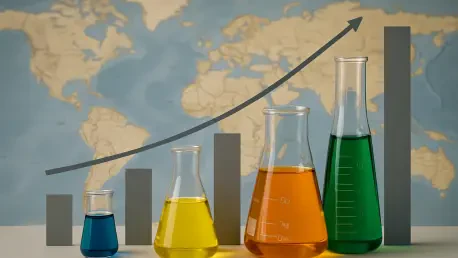

The global chemical landscape is currently navigating a profound transformation as traditional, volatile organic compounds are increasingly replaced by safer, high-performance alternatives that align with stringent environmental mandates. This movement is epitomized by the rapid ascent of the ionic liquids market, a specialized sector focused on salts that maintain a liquid state at temperatures below 100°C. Initially valued at approximately $51.7 million in 2024, the market is on a steady trajectory to reach $136.8 million by 2035, representing a robust compound annual growth rate of 9.3 percent. This expansion is not merely a statistical trend but a reflection of a deeper industrial shift toward green chemistry, enhanced energy storage solutions, and superior solvent performance across various manufacturing domains. As regulatory pressures mount and the demand for sustainable technological foundations grows, these unique substances are transitioning from laboratory curiosities to essential components of the modern industrial supply chain, promising a more resilient and eco-friendly future for global chemical production. This growth is further propelled by the increasing integration of these liquids into high-tech sectors such as aerospace and electronics, where their unique physical properties provide a competitive edge that traditional solvents simply cannot match.
Molecular Architecture: The Design and Properties of Ionic Liquids
Ionic liquids represent a significant departure from conventional molecular chemistry, consisting entirely of ions rather than neutral molecules. Unlike table salt, which forms a rigid crystal lattice at high temperatures, these substances utilize large, asymmetric organic cations paired with smaller anions to prevent crystallization at room temperature. This structural irregularity allows them to remain fluid in conditions where most salts would be solid, earning them the classification of “designer solvents.” Engineers can precisely manipulate their chemical composition to fine-tune physical properties such as viscosity, density, and melting points to meet the specific requirements of a given industrial application. This level of customization provides a significant advantage over traditional solvents like ethanol or toluene, which have fixed properties that cannot be easily adjusted for specialized processes. By altering the combination of cations and anions, researchers can create a nearly infinite variety of liquids tailored for tasks ranging from metal extraction to precision lubrication in vacuum environments.
Beyond their structural versatility, ionic liquids possess a suite of physical characteristics that make them exceptionally useful in high-stakes environments. One of their most critical features is a negligible vapor pressure, meaning they do not evaporate under normal conditions and do not emit volatile organic compounds into the atmosphere. This trait dramatically reduces the risk of inhalation toxicity and fire hazards in industrial settings, providing a safer working environment compared to traditional organic solvents. Furthermore, their high thermal stability allows them to function effectively at temperatures that would cause other fluids to boil or decompose, making them ideal for high-heat chemical reactions. They also exhibit remarkable electrical conductivity and a wide electrochemical window, properties that have positioned them as leading candidates for next-generation electronic components and energy storage systems. Their ability to dissolve diverse materials, including complex polymers and tough lignocellulosic biomass, further cements their status as a versatile tool for advanced chemical engineering across multiple disciplines.
Sustainable Solutions: Catalyzing Growth via Green Chemistry
The primary momentum behind the adoption of these substances stems from a global commitment to green chemistry principles and the implementation of increasingly strict environmental regulations. For decades, the manufacturing sector relied heavily on volatile and often flammable organic solvents that posed significant risks to both human health and the ecological landscape. These traditional substances frequently required complex recovery systems and often resulted in significant hazardous waste streams that were difficult and expensive to manage. In contrast, ionic liquids offer a path toward a circular economy because they are non-flammable and can be recovered and recycled through multiple production cycles with minimal loss of efficacy. This recyclability not only reduces the environmental footprint of a factory but also provides a long-term cost benefit that offsets the initial investment in these high-performance fluids. As governments around the world introduce more aggressive carbon reduction targets and waste management laws, the transition to these “green” salts is becoming a strategic necessity for companies aiming to remain compliant.
Integrating these advanced fluids into industrial processes also brings about a significant improvement in operational safety and overall process efficiency. By eliminating the risks associated with solvent evaporation and flammability, manufacturers can simplify their safety infrastructure and reduce the insurance premiums and liability risks associated with chemical processing. Moreover, the unique solvation properties of ionic liquids often allow for faster reaction rates and higher selectivity in chemical synthesis, which means that less raw material is required to achieve the desired output. This increase in efficiency directly translates to reduced energy consumption during the heating and cooling phases of manufacturing, further aligning industrial operations with global sustainability goals. The move toward these solvents is also facilitating the development of “one-pot” synthesis methods, where multiple chemical steps can occur in the same vessel without the need for frequent solvent changes. This streamlined approach minimizes downtime and reduces the physical footprint of chemical plants, making it an attractive proposition for modern manufacturing facilities looking to optimize their resources.
Energy Infrastructure: Enhancing Safety and Battery Performance
In the rapidly evolving energy sector, ionic liquids are emerging as a critical solution for the safety and performance challenges associated with high-capacity battery technology. Current lithium-ion batteries typically utilize carbonate-based electrolytes that are highly flammable and prone to thermal runaway if the battery is damaged or overheated. By replacing these volatile fluids with ionic liquid electrolytes, manufacturers can produce batteries that are inherently safer and more stable under extreme conditions. This advancement is particularly vital for the electric vehicle market, where battery safety is a paramount concern for consumers and regulators alike. Beyond safety, these electrolytes can operate across a broader temperature range than traditional fluids, ensuring that electric cars maintain their performance and range in both freezing winters and scorching summers. This reliability is a key factor in the global push to phase out internal combustion engines and replace them with electric powertrains that do not compromise on safety or utility in diverse climates.
The benefits of these specialized salts extend beyond safety to significant improvements in the energy density and lifespan of energy storage devices. Because ionic liquids have a wider electrochemical window, they allow for the use of higher-voltage electrode materials, which can lead to batteries that store more energy in a smaller and lighter package. This property is also being leveraged in the development of supercapacitors, which require fluids that can handle rapid charging and discharging cycles without degrading. The chemical stability of these liquids means they do not break down as quickly as traditional electrolytes, leading to devices with much longer service lives and fewer maintenance requirements. This longevity is essential for grid-scale energy storage systems that support renewable energy sources like wind and solar, where reliability over several decades is a mandatory requirement. As the world transitions toward a decentralized and renewable-heavy power grid, the role of these high-performance fluids in ensuring stable and efficient energy storage will only continue to grow in importance as a foundation for global electrification.
Industrial Optimization: Advancements in Pharma and Manufacturing
The pharmaceutical industry is currently leveraging the unique properties of ionic liquids to overcome some of the most persistent challenges in drug formulation and delivery. Many active pharmaceutical ingredients are naturally poorly soluble in water or standard organic solvents, which can limit their effectiveness and make the manufacturing process incredibly difficult. Ionic liquids act as powerful solubilizers, allowing researchers to dissolve high concentrations of these difficult ingredients and create more potent medications with better bioavailability. This capability is leading to the development of new drug delivery systems, such as liquid-state pharmaceuticals that can be absorbed more easily by the human body. Furthermore, the ability to fine-tune the properties of the solvent means that manufacturers can create environments that stabilize sensitive drug molecules, preventing them from breaking down before they reach the patient. This technological leap is not only speeding up the drug development pipeline but also opening the door for personalized medicine where treatments are tailored at the molecular level.
In the broader chemical manufacturing sector, these substances are being used to revolutionize the production of plastics, polymers, and other essential materials. By serving as both a solvent and a catalyst, ionic liquids can significantly accelerate chemical reactions, reducing the time required for industrial synthesis from days to hours. This acceleration is often accompanied by an increase in product purity, as the unique environment provided by the liquid minimizes the formation of unwanted byproducts. In plastic manufacturing, these fluids are helping to create more durable and heat-resistant polymers that are essential for the aerospace and automotive industries. Additionally, the ease of separating the final product from the ionic liquid solvent simplifies the purification process, which is traditionally one of the most energy-intensive parts of chemical production. By reducing the energy required for distillation and filtration, chemical plants can lower their overhead costs while simultaneously reducing their carbon emissions. This combination of economic and environmental benefits is driving widespread adoption across the global landscape.
Economic Considerations: Managing Production Costs and Scaling
While the technical advantages of these substances are well-documented, the primary barrier to their universal adoption remains the significant cost associated with their production. Currently, manufacturing high-purity ionic liquids involves complex multi-step synthesis processes that require expensive raw materials and specialized equipment. This makes them considerably more costly than traditional solvents like acetone or methanol, which are produced in massive quantities and have well-established supply chains. For many smaller manufacturing firms, the initial capital expenditure required to transition to these advanced fluids can be a deterrent, especially when profit margins are thin. To address this issue, researchers are focusing on developing more cost-effective synthesis methods, such as using cheaper starting materials or simplifying the purification steps. As production scales up to meet the growing demand, economies of scale are expected to drive prices down, making these designer solvents more accessible to a broader range of industries over the next several years as the market matures.
Beyond the direct cost of the chemicals themselves, many existing industrial facilities face the challenge of upgrading their infrastructure to handle the unique properties of ionic liquids. Because these fluids can have higher viscosities than traditional solvents, existing pumps, filters, and mixing equipment may need to be replaced or modified to ensure efficient operation. Additionally, while these salts are non-volatile and generally safer, their long-term effects on various piping materials and gaskets must be thoroughly understood to prevent corrosion or leaks. This requirement for specialized hardware and thorough compatibility testing adds another layer of complexity to the adoption process. However, the long-term savings associated with solvent recycling and improved process efficiency are increasingly being recognized as a justification for these upfront investments. Many companies are now adopting a phased approach, integrating these substances into specific, high-value production lines before committing to a full-scale transition across their entire manufacturing footprint, thereby managing the financial risk of modernization.
Global Dynamics: Regional Leadership and Market Competition
The global distribution of growth in this market is notably uneven, with the Asia-Pacific region currently positioned to lead the charge in both production and consumption. While North America and Europe remain the primary hubs for fundamental research and the development of strict environmental regulations, countries like China, India, and South Korea are rapidly expanding their industrial capacity. These nations are making massive investments in renewable energy infrastructure and the manufacturing of electric vehicles, two sectors that are heavily dependent on ionic liquid technology. The presence of large-scale chemical manufacturing hubs in this region allows for a more rapid scaling of production, which is essential for bringing down costs. Furthermore, government-led initiatives in these countries are providing significant incentives for companies that adopt green technologies, further accelerating the regional market expansion. This shift in the industrial center of gravity is forcing Western chemical giants to re-evaluate their supply chains and consider strategic partnerships within the Asian market.
The competitive landscape of the market is characterized by a strategic mix of large-scale chemical corporations and agile, specialized technology firms. Major global players are leveraging their extensive distribution networks and massive production facilities to dominate the market for high-volume, standardized ionic liquids. Their focus is primarily on achieving economies of scale to make these products competitive with traditional solvents in the mass market. In contrast, smaller firms are carving out lucrative niches by focusing on the development of custom-made, “task-specific” liquids for specialized applications such as aerospace lubrication or advanced pharmaceutical processing. These smaller players often work in close collaboration with their clients, providing bespoke chemical solutions that larger corporations may find too small or complex to handle. This dynamic creates a healthy ecosystem of innovation, where large-scale efficiency and specialized expertise coexist to push the boundaries of what is possible with this technology. This competition ensures that a wide variety of solutions are available to meet the diverse needs of different industrial sectors.
Strategic Progress: Evolution and Integration in Modern Systems
The industry observed a shift where the focus moved from simple discovery toward the seamless integration of these liquids into existing global supply chains. This transition from a specialty chemical to a mainstream industrial tool required a demonstration of long-term stability and economic viability, which became increasingly evident. Stakeholders recognized that companies looking to capitalize on this shift prioritized the development of standardized testing protocols to ensure the consistency and purity of their ionic liquid supplies. Establishing these standards was crucial for building trust among industrial users who were cautious about switching from tried-and-true traditional solvents. Furthermore, the development of modular recycling systems allowed smaller factories to implement circular economy practices without needing to invest in massive on-site purification plants. By lowering the barrier to entry through standardization and modularity, the sector ensured that the benefits of these advanced fluids were shared across the entire manufacturing spectrum rather than being limited to a few high-tech sectors.
For organizations that aimed to integrate these advanced substances into their operations, the immediate next steps involved a comprehensive assessment of current solvent usage and a targeted identification of processes where safety or efficiency was lacking. Engaging in pilot programs with specialized chemical providers helped determine the specific formulations required for their unique needs before they committed to large-scale changes. It was also essential for firms to have invested in workforce training, as handling these substances required a different set of skills and safety protocols than those used for volatile organic compounds. Collaborative research and development projects with academic institutions provided a cost-effective way to have explored new applications and stayed ahead of the regulatory curve. By having taken a proactive and structured approach to adoption, manufacturers not only future-proofed their operations against tightening environmental laws but also gained a significant competitive advantage in a world where sustainability was no longer optional but a core requirement for business success.