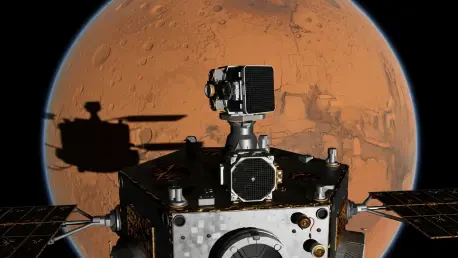

Navigating the vast, desolate expanse of the inner solar system requires more than just raw engine power; it demands a sophisticated dance with the gravity of neighboring planets. The Psyche spacecraft, a robotic explorer roughly the size of a van, is currently executing a pivotal gravity assist maneuver as it swings past the red planet to gain the momentum necessary for its long voyage. By passing within approximately 2,800 miles of the Martian surface—a distance comparable to the width of the continental United States—the probe utilizes the orbital energy of Mars to accelerate to a staggering speed of 12,333 mph. This slingshot effect is essential for reaching the outer asteroid belt, where the mission’s ultimate target resides. This journey now enters a critical phase as the solar electric propulsion system, powered by xenon gas, continues to provide the steady, efficient thrust needed for long-duration deep space travel. The sheer scale of this maneuver underscores the complexity of modern celestial mechanics, where every second of engine burn and every kilometer of distance must be accounted for with absolute certainty. Engineers on the ground are monitoring telemetry in real-time, ensuring that the spacecraft’s orientation remains optimal for the gravity assist while managing the thermal loads generated by its proximity to a large planetary body. This specific phase of the mission serves as a bridge between the inner solar system and the mysterious metal-rich environments that await in the distant reaches of the asteroid belt, proving that efficient navigation is as much about timing as it is about power.
Gravity Assist Operations and Scientific Synthesis
While the primary goal of the flyby focused on velocity, the mission team seized the opportunity to activate all scientific instruments for a comprehensive rehearsal. Thousands of images and data points were captured during the closest approach, providing a unique vantage point of the Martian atmosphere. This effort was coordinated with existing rovers and orbiters already stationed at Mars, allowing for a multi-perspective analysis of surface conditions and atmospheric dynamics that would otherwise be impossible. These observations acted as a vital stress test for the multispectral imager and magnetometer before the spacecraft reached its final destination in 2029. The ultimate target, the potato-shaped asteroid Psyche, presented a rare scientific mystery: a world composed primarily of nickel and iron rather than common rock or ice. Researchers theorized that this 173-mile-long relic was once the exposed core of a fledgling planet that lost its outer layers during the chaotic formation of the solar system. By analyzing this metallic body, scientists aimed to look back at the building blocks of terrestrial planets like Earth. Future investigations prioritized the mapping of the asteroid’s surface topography and the measurement of its gravitational field to determine if the metal was truly the remnant of an ancient planetary heart. This data provided the foundation for a new understanding of how metallic worlds evolved differently from their rocky counterparts. The successful execution of the flyby ensured that the mission remained on its precise path to unlock these deep-space secrets, paving the way for the next generation of discovery in the outer belt.