
Kwame Zaire stands as a prominent figure in the evolving landscape of automotive manufacturing, where the intersection of high-end electronics and industrial efficiency defines the next generation of transport. With a career rooted in the complexities of production management and predictive maintenance, Zaire has become a leading voice on how vehicle architectures must evolve to meet the demands of a software-driven world. His insights are particularly relevant as the industry pivots away from fragmented electronic control units toward integrated, zonal systems that promise to redefine vehicle safety and performance. This discussion explores the critical partnership between NXP Semiconductors and Quanta, examining how their new deterministic networking platform addresses the technical hurdles of real-time communication, scalable power management, and the seamless integration of high-performance computing in modern vehicles. We delve into the nuances of Time-Sensitive Networking and the strategic shift toward software-defined architectures that are set to dominate the market by 2026.
How does the transition from traditional ECU-based systems to zonal architectures impact development timelines, and what specific coordination challenges must engineers overcome to maintain system performance?
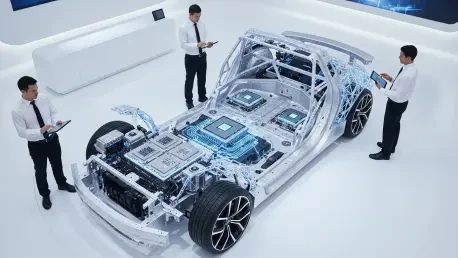
The shift from a decentralized model featuring dozens of isolated electronic control units to a streamlined zonal architecture is a monumental undertaking that fundamentally reshapes our development cycles. When we move away from traditional setups, we are essentially trying to condense the intelligence of the car into a few high-performance hubs, which creates a massive coordination challenge for engineers who must manage distributed computing across a unified network. In this new environment, we utilize NXP’s S32 automotive processing platform combined with MotionWise middleware to ensure that every bit of data arrives exactly when it is supposed to, preventing the lag that can plague older, more cluttered systems. Integration efficiency is no longer just about hardware fitting into a chassis; it is measured by how effectively the software can orchestrate real-time communication across these zones without data bottlenecks. We have seen that by implementing these deterministic platforms, we can actually accelerate rollout timelines because the automated configuration tools reduce the manual labor previously required to map out complex in-vehicle networks.
Utilizing specialized processing platforms and middleware aims to provide deterministic timing across vehicle networks. How does Time-Sensitive Networking (TSN) specifically ensure low-latency communication for applications like audio-over-Ethernet and real-time control systems?
Time-Sensitive Networking, or TSN, acts as the rhythmic heartbeat of the vehicle’s nervous system, ensuring that high-priority data packets—like those required for real-time braking or steering control—are never delayed by less critical information. For applications such as audio-over-Ethernet, the precision must be absolute; even a few milliseconds of jitter can ruin the sensory experience for the driver or, more critically, disrupt the synchronization of safety alerts. By integrating TSN-enabled networking within the Quanta Adaptive Zonal System, we create a deterministic environment where the hardware knows exactly which data stream takes precedence at any given microsecond. Success in these high-performance integrations is defined by our ability to maintain predictable latency, a technical requirement that Sebastien Clamagirand of NXP has highlighted as a cornerstone for scaling these architectures across different vehicle programs. I recall early testing phases where the “sensory feel” of the vehicle’s response time was noticeably sharpened once the TSN protocols were properly tuned to handle the massive throughput of modern sensor data.
When deploying a unified hardware and software architecture across multiple vehicle programs, how do you balance the need for scalable power management with CAN and LIN connectivity?
Balancing the legacy requirements of CAN and LIN connectivity with the high-power demands of modern zonal controllers requires a very nuanced approach to hardware design. We rely on scalable power management systems that can dynamically adjust to the needs of different vehicle models, whether we are looking at a compact city car or a high-performance electric SUV. The practical implementation involves using a unified architecture that provides a “plug-and-play” style of automated configuration, allowing the zonal controllers to recognize the specific CAN/LIN peripherals attached to them and adjust their communication protocols accordingly. This ensures that even as we push toward a software-defined future, we do not lose the reliable, cost-effective connectivity that traditional networks provide for simpler tasks like seat adjustments or window controls. By keeping the underlying hardware consistent across programs, as Terrisa Chung from Quanta has noted, we achieve a level of system-level scalability that allows OEMs to deploy updates across their entire fleet without redesigning the power distribution for every new model.
Software-defined vehicles require predictable latency across the entire network to function safely and reliably. How does a deterministic networking platform reduce the complexity of software deployment, and what specific strategies ensure the architecture remains flexible enough for future energy networking and computing upgrades?
The beauty of a deterministic networking platform lies in its ability to abstract the underlying hardware complexity, giving software developers a stable and predictable environment to deploy new features. When the latency is guaranteed, engineers no longer have to build massive “safety buffers” into their code, which significantly reduces the overhead and integration risks associated with software-defined vehicle programmes. We ensure future flexibility by building the architecture around modular blocks, such as NXP’s S32 platform, which supports high-performance computing integration and smart energy networking out of the box. This means that when an OEM wants to upgrade the vehicle’s energy management system or add a new autonomous driving feature in 2026 or beyond, they are not starting from scratch; they are simply adding a new software layer onto a network that was designed to grow. It is a strategic move away from rigid, “baked-in” hardware functions toward a fluid system where the car’s capabilities can be refined and expanded through over-the-air updates long after it leaves the factory floor.
What is your forecast for software-defined vehicles?
I believe that by 2026, the industry will have moved past the experimental phase and into a period where software-defined vehicles are the standard expectation for all new global platforms. The transition to zonal architectures and deterministic networking will drastically reduce the physical weight of vehicles by eliminating miles of redundant wiring, while simultaneously making cars safer through lightning-fast, real-time control systems. We will see a shift where the value of a vehicle is measured by its processing power and its ability to integrate into a wider smart energy ecosystem, rather than just its mechanical specs. As companies like NXP and Quanta continue to demonstrate these platforms, the barrier to entry for advanced digital features will drop, allowing even entry-level models to benefit from high-performance computing. Ultimately, the car will stop being a static machine and become a living, breathing digital entity that evolves alongside the driver’s needs.