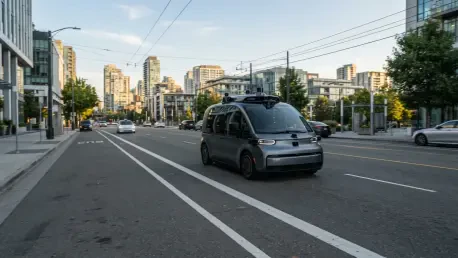

Autonomous driving technology is moving beyond rigid rule-based systems to embrace models that can predict physical consequences such as friction and inertia. This shift represents a fundamental pivot in the architecture of artificial intelligence, moving away from purely digital patterns found in text and code toward a visceral understanding of the tangible world. Baidu is leading this charge with its World Model, a system designed to simulate reality itself rather than just reacting to it. By integrating the laws of physics directly into the neural fabric of its vehicles, the company is bridging the gap between digital intelligence and physical reality. This evolution is not merely an incremental upgrade but a revolutionary change in how machines perceive their surroundings, effectively granting them a form of “common sense” that has long eluded the industry. As urban environments become increasingly complex, the ability for a vehicle to anticipate cause and effect based on physical constraints becomes the ultimate differentiator in safety and reliability. This development marks a significant departure from previous technological paradigms, signaling an era where AI must not only process information but also comprehend the immutable laws of physics and causality in every second of operation.
Understanding the World Model Paradigm
The transition toward a World Model paradigm signifies a departure from the “black box” approach of previous AI generations, which often relied on massive datasets to predict the next most likely action without understanding the underlying physical reasons. By creating a system that internalizes the laws of gravity, velocity, and material resistance, Baidu is providing its autonomous fleet with a cognitive framework that mirrors human intuition. This allows vehicles to navigate the world not just by identifying objects, but by understanding the potential energy and kinetic possibilities those objects represent. For example, a vehicle equipped with this model does not simply see a cyclist; it understands the physical effort required for that cyclist to accelerate or turn on a steep incline. This layer of physical intelligence is essential for operating in high-density urban areas where human behavior and physical environmental factors are inextricably linked. This foundational shift ensures that the AI’s decision-making process is grounded in the reality of the physical world, leading to more predictable and safer interactions on public roads.
Defining the Core Technology
The World Model functions as a foundational AI architecture that constructs internal representations of the physical environment to forecast future states with high fidelity. While earlier iterations of artificial intelligence focused heavily on large language models and digital syntax, this new paradigm is built specifically for the real world, anchored within Baidu’s Apollo Go robotaxi ecosystem. By acting as a sophisticated simulation engine that runs in parallel with real-time sensor data, the model allows a vehicle to envision multiple potential outcomes of a single scenario. It does not just see a wet road; it understands the reduction in traction and the corresponding increase in braking distance. This internal simulation capability means the vehicle can anticipate the behavior of pedestrians, cyclists, and other motorists by calculating the physical likelihood of their movements. For instance, if a ball rolls into the street, the system predicts the high probability of a child following it, adjusting its speed and positioning based on inertia and reaction times. This predictive capacity transforms the vehicle from a reactive machine into a proactive agent capable of navigating the inherent unpredictability of city streets.
Central to this technology is the concept of latent space representation, where the AI distills complex visual and sensory inputs into high-level physical concepts. Rather than processing every pixel as an isolated data point, the World Model identifies objects as physical entities governed by gravity, mass, and velocity. This architectural shift enables the system to maintain a coherent understanding of the world even when visibility is partially obscured by rain, fog, or shadows. By maintaining a continuous “state” of the world, the AI fills in the gaps left by sensor limitations, effectively hallucinating probable hidden dangers through the lens of physical causality. This is particularly vital in the context of robotaxis, where the safety of passengers and bystanders depends on the vehicle’s ability to simulate “what-if” scenarios at millisecond speeds. As Baidu integrates this into its broader Apollo Go fleet, the technology serves as an underlying infrastructure that supports safer navigation and more fluid interactions with human drivers. The resulting system is more robust than traditional AI, as it relies on the immutable laws of nature rather than just statistical correlations found in training datasets.
Evolution from Rules to Reasoning
To comprehend the magnitude of this technological leap, one must examine the progression from the rigid, rule-based systems of the past to the nuanced, reasoning-driven models of today. In the early stages of development, autonomous vehicles relied on “if-then” logic, where engineers wrote millions of lines of code to handle specific scenarios. While effective in controlled environments, these systems struggled with the chaotic variability of real-world traffic, often freezing when faced with a situation not explicitly programmed by their creators. The industry eventually transitioned toward data-driven, end-to-end models that utilized deep learning to mimic human driving behaviors by analyzing vast quantities of recorded footage. Although these models made driving appear more natural and fluid, they operated largely as black boxes that lacked a fundamental understanding of physical reasoning. They could identify a stop sign but didn’t necessarily understand the physical purpose behind it or the consequences of ignoring it beyond what was seen in the data. This lack of causal reasoning meant that even the most advanced systems were prone to catastrophic failures when encountering rare “corner cases.”
The World Model addresses these historical bottlenecks by moving beyond simple probability fitting toward advanced causal reasoning. Instead of merely predicting the next most likely pixel or coordinate, the system reasons through the evolution of an entire scene several seconds into the future. This foresight allows the vehicle to navigate complex intersections and narrow lanes with a level of confidence previously unattainable. By understanding the “why” behind environmental cues, the AI can deduce that a vehicle ahead is braking because of a hidden obstacle, even if that obstacle is not yet visible to the sensors. This shift from reaction to reasoning is the key to solving the long-standing challenge of the long-tail problem in autonomous driving. Because the model understands the underlying physics of movement, it can generalize its knowledge to handle entirely new scenarios it has never encountered in its training data. This capability reduces the reliance on having seen every possible road event, as the AI can apply its physical common sense to navigate safely through any configuration of objects and forces, marking the transition of autonomous driving into true physical intelligence.
Strategic Advantages and Global Viability
The competitive landscape of autonomous driving has shifted toward the mastery of real-world data and vertical integration, areas where Baidu has established a significant lead. By controlling both the software brain and the hardware fleet, the company can iterate on its World Model with a speed that fragmented competitors find difficult to match. This vertical integration allows for a closed-loop data cycle where every mile driven on a city street immediately informs the next version of the AI model. Furthermore, the ability to operate in 28 different cities provides a breadth of experience that covers a wide spectrum of road geometries, weather patterns, and local driving cultures. This diverse data pool is the essential fuel for a World Model, as it forces the AI to learn universal physical constants that apply across all environments. Consequently, Baidu is not just building a driving system for a specific city, but a generalized intelligence capable of adapting to any urban center on the planet. This strategic positioning creates a formidable moat that combines technological depth with massive operational scale, setting a new standard for the industry.
Data Power and Vertical Integration
Baidu’s primary strategic advantage is its immense repository of high-fidelity, real-world road data gathered across a diverse range of urban landscapes. Operating in nearly 30 cities provides a geographic diversity that is nearly impossible for competitors to match without a similar physical footprint. This operational breadth exposes the AI to a staggering variety of traffic conditions, from the hyper-congested thoroughfares of metropolitan centers to the unique driving behaviors found in regional hubs. Every kilometer driven by the Apollo Go fleet serves as a data point that refines the World Model’s understanding of human-vehicle interaction. Unlike synthetic data generated in laboratories, which often lacks the messy unpredictability of reality, Baidu’s data includes extreme weather conditions, irregular pedestrian movements, and complex road construction scenarios. This wealth of information allows the model to learn the subtle cues that signal an impending traffic shift or a potential hazard. With over 350 million kilometers of public test mileage logged, the system has experienced more road time than any human could, providing a foundation of experience that is both deep and wide-ranging.
By feeding this massive influx of real-world data into the World Model, Baidu has succeeded in creating a high-precision digital twin of the physical environment. This virtual world serves as a hyper-realistic training ground where the AI can engage in reinforcement learning at a scale and speed that would be physically impossible on actual streets. In this digital domain, the system can simulate millions of dangerous scenarios—such as high-speed collisions or sudden tire blowouts—without any risk to equipment or human life. The fidelity of these simulations ensures that the lessons learned in the virtual space translate seamlessly to the physical world, drastically reducing the time required for on-road validation. Furthermore, the use of real-road data ensures that the digital twin reflects the actual physical properties of different cities, such as specific asphalt friction in rainy weather. This localized physical knowledge allows Baidu to optimize its vehicles for specific urban environments, ensuring a level of smoothness and safety that feels intuitive to passengers while maintaining a competitive edge over companies that rely more heavily on generalized or synthetic datasets.
Scaling for Global Commercial Viability
The long-term success of the World Model is intrinsically linked to its ability to enhance the commercial viability and operational efficiency of autonomous services. For the Apollo Go robotaxi division, the model acts as a primary driver for cost reduction by streamlining the training and validation processes. Traditionally, deploying autonomous vehicles in a new city required months of intensive data collection and manual mapping to account for local idiosyncrasies. However, a mature World Model equipped with physical common sense can adapt to new environments much faster than its predecessors. By understanding the universal laws of physics, the AI can generalize its driving skills across different geographies, recognizing that the fundamental dynamics of a turn or a merge remain the same regardless of the specific street layout. This reduced reliance on localized data collection allows Baidu to scale its operations rapidly, entering new markets with a shorter lead time and lower overhead costs. The ability to utilize high-fidelity simulations for the majority of training further lowers the demand for massive physical test fleets, allowing for a capital-efficient expansion strategy.
In conclusion, the strategic implementation of the World Model by Baidu signaled a move away from the limitations of purely statistical AI toward a future defined by physical intelligence. This transition was marked by the successful integration of real-world physics into the decision-making processes of the Apollo Go fleet, which allowed for unprecedented levels of safety and adaptability. By 2026, the company had established a formidable lead through its vertical integration and its massive repository of diverse urban road data, creating a high-fidelity digital twin that accelerated the development of autonomous systems. The focus on causal reasoning over simple pattern matching enabled vehicles to navigate the most complex “corner cases” with human-like intuition and machine-like precision. As these systems were deployed across nearly 30 cities, the reduction in operational costs and the acceleration of cross-city adaptation demonstrated the clear commercial viability of the paradigm. This journey from digital syntax to a profound understanding of the physical world laid the groundwork for a new era of mobility, where the laws of physics served as the ultimate guide for artificial intelligence.