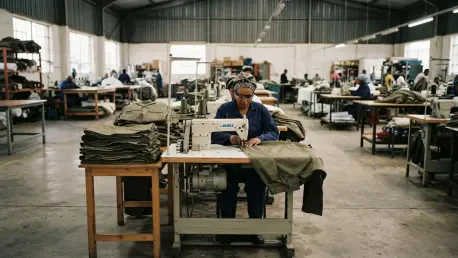

Despite being a major purchaser of apparel, the South African government fails to capture the full economic benefits of its R7.52 billion annual budget. This massive expenditure covers essential items ranging from military uniforms and police tactical gear to hospital linens and school uniforms. However, current data reveals a staggering R5.11 billion of this total is directed toward non-local suppliers, creating a significant economic drain. This represents a 68% leakage rate, meaning that for every rand spent by the state, a mere 32 cents actually remain within the borders to support local manufacturers and workers. The Clothing, Textiles, Footwear, and Leather sector, which should be a cornerstone of industrial growth, is instead struggling to maintain its footing as procurement funds vanish into international markets. This situation highlights a profound disconnect between the nation’s stated industrialization goals and the practical execution of its buying power in the global marketplace.
Legislative Obstacles and Economic Implications
Legal Challenges: The Regulatory Limbo
The root of this systemic failure can be traced back to a persistent legal limbo that has paralyzed effective procurement strategy for years. In 2022, revised regulations under the Preferential Procurement Policy Framework Act effectively stripped away explicit local content rules, leaving a vacuum in oversight. While specific designations for the textile and leather sectors remain technically binding on paper, they have become practically unenforceable in the field. This regulatory gap forces individual government departments to self-police their spending, often with little to no accountability for prioritizing domestic goods. The situation was further complicated when the 2024 Public Procurement Act, which was intended to streamline these processes and enforce localization, was struck down by the Constitutional Court. This legal setback has prolonged a period of deep uncertainty, allowing procurement officers to opt for cheaper, imported alternatives without fear of meaningful repercussions or audits.
Financial Losses: The Real Price of Leakage
The economic consequences of these procurement failures are both severe and measurable, reaching far beyond simple balance sheet imbalances. Current estimates suggest that the country is forfeiting approximately R7.16 billion in potential Gross Domestic Product and losing out on over 51,000 job opportunities that could have been created or sustained. These figures represent a missed opportunity to rejuvenate an industry that once stood as a powerhouse of South African employment. If the localization rate were increased to the industry-wide target of 60%, local manufacturing revenue would nearly double overnight, injecting much-needed vitality into urban and rural industrial hubs alike. The data suggests that for every R1 billion redirected from imports to local factories, the domestic economy would support roughly 2,450 direct manufacturing roles and an additional 5,050 indirect positions in logistics, maintenance, and support services. This ripple effect demonstrates that strategic state spending is one of the most potent tools available for tackling the national unemployment crisis.
Operational Failures and Future Requirements
Systemic Flaws: Procurement Processes Under Scrutiny
Beyond the overarching legislative hurdles, the day-to-day procurement process itself is riddled with structural flaws that actively favor imported goods. A primary concern is the prevalence of weak tender specifications that are often drafted without a deep understanding of local manufacturing capabilities. These specifications sometimes mirror the characteristics of specific imported products, effectively excluding local producers from the start. Additionally, the system relies heavily on unverified self-declaration forms, known as SBD 6.2, where bidders simply claim their products are locally made without having to provide immediate proof. This honor system is frequently abused by middlemen who import finished goods and relabel them to meet bid requirements. Another critical failure occurs when funds are released to suppliers before local content compliance has been independently verified. This practice leaves the state with no leverage to demand accountability once the money has changed hands, further entrenching a culture of non-compliance.
Strategic Pathways: Bridging the Localization Gap
In summary, the challenges facing the South African textile industry are deeply rooted in a combination of legislative gaps and administrative oversights that allow billions in potential revenue to leave the country. Moving forward, the government must prioritize the finalization of a robust and legally sound procurement framework that places localization at its core. Future strategies should involve collaborative efforts between the Department of Trade, Industry and Competition and individual provincial departments to align their buying habits with national industrial goals. Actionable steps include the development of a comprehensive database of verified local manufacturers to assist procurement officers in identifying capable suppliers. Additionally, investing in vocational training and modern manufacturing technologies will ensure that the local industry can meet the increased demand generated by stricter localization rules. By taking these decisive steps, the state could effectively turn the tide on economic leakage, fostering a resilient manufacturing sector.