
Kwame Zaire stands at the intersection of heavy machinery and high-performance engineering, bringing a sophisticated perspective to the evolution of zero-emission power. As a manufacturing expert with a deep focus on production management and predictive maintenance, he has watched the industry shift from traditional diesel dominance to the cutting edge of hydrogen combustion. His background in overseeing complex electronics and equipment makes him an ideal voice to discuss the ambitious leap from industrial diggers to land-speed record contenders. In this conversation, we explore the technical breakthroughs and strategic vision behind the attempt to push a hydrogen-powered vehicle beyond the 350 mph barrier at the iconic Bonneville Salt Flats.
The following discussion examines the engineering shifts, safety protocols, and global manufacturing implications of this $134 million technological endeavor.
Developing hydrogen internal combustion engines involves a five-year, $134 million investment to transition from traditional diesel power. How does the engineering for these 1,600 bhp production-based engines differ from standard designs, and what specific technical hurdles must be overcome to ensure reliability during a high-speed record attempt?
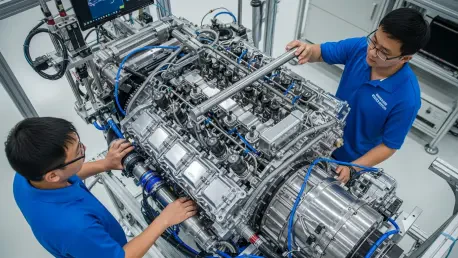
Transitioning a production-based engine to a 1,600 bhp racing powerhouse requires a fundamental rethink of the combustion cycle, as hydrogen burns much faster and hotter than diesel. We have invested five years into refining these internal combustion designs to handle the unique properties of hydrogen, specifically focusing on fuel injection and thermal management to prevent pre-ignition. The engineering team had to “sprinkle magic engineering dust” on the base architecture to ensure that the twin engines can withstand the extreme stress of a land-speed run without compromising the zero-emissions goal. Reliability is our primary hurdle; we are essentially taking the same technology found in our new production-line diggers and pushing it to its absolute physical limit on the salt.
The current speed record for hydrogen vehicles is 185.5 mph, but the goal for the new 32-foot car is to exceed 350 mph. What aerodynamic refinements and weight-saving measures allow for such a massive jump in performance, and how do the twin engines synchronize to maintain stability at those speeds?
To bridge the massive gap between the existing 185.5 mph record and our 350 mph target, the Hydromax utilizes a 32-foot streamlined chassis designed to minimize drag while maintaining downforce. This new car is significantly lighter and more powerful than the Dieselmax from twenty years ago, benefiting from advanced composites and a more efficient layout for the hydrogen storage tanks. Maintaining stability at these speeds requires perfect synchronization between the two engines to ensure balanced power delivery to the wheels, preventing any yaw moment that could lead to a loss of control. Every inch of the car’s surface has been refined through rigorous modeling to ensure it remains glued to the salt even as it approaches the sound of a roaring jet.
Transitioning from the 2006 diesel record to a zero-emissions hydrogen attempt requires a total rethink of vehicle architecture. In terms of power-to-weight ratios and fuel delivery, how does the new hydrogen-powered car outperform its diesel predecessor, and what are the primary safety implications of using hydrogen at Bonneville?
The Hydromax represents a massive leap forward, offering a superior power-to-weight ratio because we have stripped away the heavy emissions-scrubbing equipment required for diesel engines. By utilizing hydrogen, we achieve a high-energy output with zero carbon emissions at the tailpipe, which is a major victory for our engineering philosophy. However, hydrogen delivery presents unique safety challenges, particularly regarding high-pressure storage and the invisible nature of hydrogen flames. We have implemented rigorous leak detection systems and reinforced fuel cells to ensure that Wing Commander Andy Green is protected while he attempts to shatter the 350.092 mph benchmark set two decades ago.
High-speed racing projects are often used to prove that green technology can handle extreme stress before it reaches the commercial market. How will the data gathered during the Utah speed trials influence the performance of hydrogen-powered construction machinery, and what metrics are most critical for validating this technology?
The Bonneville Salt Flats serve as the ultimate laboratory; if a hydrogen engine can survive the heat and sustained high-load demands of a 350 mph run, it can certainly handle a ten-hour shift on a construction site. We are specifically looking at thermal stability and fuel flow consistency under peak load, as these metrics directly translate to the durability of the diggers now rolling off our production lines. Using a “speed-hero” project like this proves to our customers that hydrogen isn’t just a theoretical concept, but a robust, high-performance alternative to traditional fuels. The data we collect on ignition timing and cylinder pressures will be fed back into our manufacturing process to improve the efficiency of our commercial fleet.
Testing on the Bonneville Salt Flats requires navigating unique surface conditions while meeting strict SCTA and FIA regulations. What practical steps are involved in the UK testing phase to prepare for the salt environment, and how do the verification processes for an official world record differ from standard speed trials?
Our UK testing phase is a meticulous process of simulated runs and systems checks designed to mimic the low-traction, high-vibration environment of the salt. We work closely with partners like Prodrive and Ricardo to validate every component before the car is shipped to Utah for Bonneville SpeedWeek. The verification process is two-fold: the Southern California Timing Association (SCTA) governs the initial class records, while the Fédération Internationale de l’Automobile (FIA) provides the formal framework for an official world record. To secure an FIA record, the car must perform two runs in opposite directions within a set timeframe, and the average speed is what enters the history books.
Expanding manufacturing footprints, such as building a million-square-foot facility in Texas, often coincides with major technological breakthroughs. How does a high-profile land speed record attempt support a broader global manufacturing strategy, and what role do these “speed-hero” projects play in attracting engineering talent and investment?
Launching a record attempt alongside the opening of our new $500 million, 400-acre factory in San Antonio sends a powerful message about our commitment to the North American market. These high-profile projects act as a beacon for the 1,500 new employees we are looking to hire, showing them that we are an innovation-led company, not just a traditional manufacturer. It proves that we are willing to invest $134 million into the future of energy, which in turn builds confidence among investors and partners. By setting records with tractors, backhoe loaders, and now hydrogen cars, we establish a culture of excellence that permeates every level of our global workforce.
What is your forecast for hydrogen-powered transportation?
I believe we are on the cusp of a hydrogen revolution, particularly in the heavy-duty and high-performance sectors where battery weight remains a significant disadvantage. As we prove the reliability of hydrogen internal combustion engines at 350 mph, we will see a rapid acceleration in the adoption of this technology for construction, shipping, and long-haul transport. The infrastructure will catch up as more manufacturers follow our lead in scaling production-ready hydrogen solutions. Ultimately, hydrogen will become the cornerstone of a zero-emission future because it offers the power and refueling speed that modern industry demands.