
The vast, seemingly empty expanse of the Pacific Ocean hides a lethal intersection where thousand-ton cargo vessels unknowingly cross paths with migrating cetaceans, often with devastating results. The emergence of AI whale detection systems marks a pivotal transition in marine conservation, shifting from reactive casualty reporting to proactive collision avoidance. These systems represent a sophisticated marriage of thermal imaging, acoustic monitoring, and deep learning, designed to provide a digital safety net for species that have historically been invisible to the massive ships sharing their habitat. By automating the surveillance of vast maritime corridors, the technology addresses a critical gap in traditional marine mammal observation, which is frequently limited by light conditions, weather, and human fatigue.
The Evolution of Automated Marine Surveillance
Automated marine surveillance has undergone a radical transformation, moving away from rudimentary sonar and visual lookouts toward integrated artificial intelligence frameworks. Historically, the protection of whales relied on seasonal speed restrictions and human observers stationed on bridges with binoculars, methods that were inherently flawed during nighttime transit or in heavy fog. The introduction of platforms like WhaleSpotter has redefined the standard for situational awareness by providing a continuous, 24-hour stream of data that does not suffer from the limitations of the human eye. This evolution was accelerated by the increasing frequency of ship strikes in high-traffic areas, where the speed and volume of modern commerce outpaced the natural evasive capabilities of marine life.
The current technological landscape is characterized by a shift toward decentralization and real-time processing. Modern systems are no longer isolated experiments but are integrated into broader maritime traffic management networks. This transition signifies a movement from purely biological research tools to essential maritime safety infrastructure. By utilizing a network of land-based stations, buoy-mounted sensors, and vessel-integrated cameras, the technology creates a comprehensive picture of the underwater environment. This holistic approach ensures that whale presence is treated as a critical navigational hazard, much like an uncharted reef or a drifting container, elevating conservation data to the status of essential maritime intelligence.
Core Architectural Components and Detection Logic
Multi-Spectral Sensor Integration
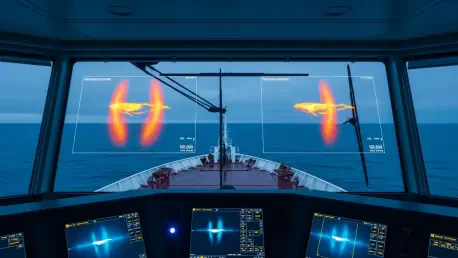
At the heart of modern detection systems lies a sophisticated array of multi-spectral sensors that bridge the gap between visual and thermal data. Unlike standard cameras that rely on reflected light, thermal sensors detect the heat signatures of whale blows—the moist, warm air exhaled as a whale surfaces—against the cooler background of the ocean. This capability is vital for round-the-clock monitoring, particularly in regions like the San Francisco Bay, where dense fog often renders traditional visual observation impossible. These sensors function by identifying temperature differentials as small as a fraction of a degree, allowing the system to pinpoint the exact moment a whale breaks the surface even at distances exceeding two nautical miles.
The performance of these sensors is enhanced by their ability to filter out environmental noise, such as the thermal reflection of the sun on the waves or the heat generated by other vessels. This precision is achieved through a combination of high-resolution optics and rapid refresh rates, which allow the system to track the movement of a heat signature over time. By correlating thermal data with geographical coordinates, the system can provide vessel operators with a precise bearing and distance to the animal. This level of detail is essential for large ships that require significant lead time to adjust their course or reduce speed, making the sensor integration a cornerstone of the entire detection architecture.
Machine Learning Algorithms and Pattern Recognition
The raw data captured by sensors would be overwhelming without the intervention of advanced machine learning algorithms. These systems employ convolutional neural networks that have been trained on thousands of hours of marine footage to recognize the specific visual and acoustic patterns associated with different whale species. The AI does not merely look for an object; it analyzes the shape of the blow, the arch of the back, and the fluke pattern to differentiate a gray whale from a humpback or a passing dolphin. This pattern recognition is what allows the technology to operate with high levels of accuracy in complex environments where waves, sea foam, and birds might otherwise trigger false positives.
Furthermore, these algorithms are designed to be adaptive, learning from each encounter to refine their detection parameters. When a potential sighting is flagged, it is often cross-referenced with acoustic data—low-frequency vocalizations captured by underwater hydrophones—to confirm the presence of a whale. This multi-modal verification process significantly increases the reliability of the system, ensuring that alerts sent to ship captains are based on high-confidence data. The significance of this implementation lies in its ability to process massive datasets in milliseconds, providing a real-time stream of information that human observers simply cannot match in speed or consistency.
Current Trends and Technological Breakthroughs
One of the most significant trends in the field is the move toward edge computing, where the AI processing occurs directly on the sensor hardware rather than in a distant cloud server. This shift minimizes latency, allowing for near-instantaneous alerts that are critical in high-stakes navigational scenarios. Additionally, there is a growing trend toward the integration of satellite-derived sea surface temperature data and chlorophyll maps to predict where whales are likely to congregate. By understanding the oceanographic conditions that draw whales into specific areas, AI systems can now provide “predictive” alerts, warning mariners of increased risk before a single whale is even detected.
Another breakthrough involves the miniaturization of hardware, allowing detection systems to be mounted on smaller vessels and autonomous underwater vehicles. This expansion of the sensor network creates a denser grid of observation, providing more granular data on whale movements within narrow channels and estuaries. Moreover, the industry is seeing a shift toward open-data platforms where sighting information is shared across multiple sectors, including commercial shipping, local fisheries, and government agencies. This collaborative approach ensures that the entire maritime community operates from a single, accurate “source of truth” regarding cetacean locations.
Real-World Implementations in High-Traffic Corridors
The San Francisco Bay serves as a primary proving ground for these technologies, specifically in response to the alarming mortality rates among the eastern North Pacific gray whale population. As these whales increasingly enter the estuary to forage due to changing Arctic conditions, they find themselves in one of the most crowded ferry and cargo corridors in the world. The deployment of WhaleSpotter in this region has provided a crucial layer of protection, allowing traffic controllers to monitor “hotspots” between Angel Island and the Golden Gate Bridge. These real-world applications have demonstrated that when captains are provided with real-time AI alerts, they are significantly more likely to adhere to voluntary speed reductions.
In other sectors, such as the Dungeness crab fishery, AI-driven data is being used to support the transition to ropeless, or “on-demand,” fishing gear. By identifying exactly when and where humpback whales are migrating, regulators can allow fishermen to use traditional gear in certain zones while mandating ropeless technology in others. This adaptive management approach balances economic activity with conservation, proving that AI detection is not just about avoiding collisions but also about managing entire ecosystems. These implementations highlight the versatility of the technology, showing its value across diverse industries ranging from international logistics to local food production.
Technical Hurdles and Operational Constraints
Despite the impressive strides in detection logic, several technical hurdles remain that prevent a purely automated solution. Environmental interference, such as heavy rain or extreme sea states, can still degrade the quality of thermal and visual data, leading to a temporary loss of surveillance capability. Moreover, the “dark” ocean problem—where whales remain submerged for long periods without surfacing—limits the effectiveness of surface-based sensors. While acoustic monitoring can mitigate this, it is often complicated by the high levels of ambient noise produced by the ships themselves, which can mask the subtle vocalizations of a distant whale.
Operational constraints also include the challenge of regulatory adoption and the “human in the loop” requirement. Currently, most systems still require a human analyst to verify AI-flagged sightings before a formal alert is broadcast to the fleet. This step is necessary to prevent “alert fatigue” among mariners but introduces a delay that could be critical in fast-moving situations. Furthermore, the high cost of installing and maintaining these sophisticated sensor networks can be a barrier for smaller ports or developing nations. Ongoing development is focused on reducing the cost of hardware and improving the autonomy of the AI to the point where human verification becomes a secondary, rather than primary, necessity.
Future Outlook and Strategic Development
The trajectory of AI whale detection is moving toward a fully integrated global network that functions similarly to air traffic control for the oceans. Future developments will likely involve the use of swarms of autonomous drones and gliders that patrol the high seas, providing protection for whales far beyond the reach of coastal sensor stations. There is also potential for the integration of “digital twin” technology, where a real-time virtual model of the ocean environment allows for the simulation of various traffic scenarios to determine the safest possible routes for both ships and marine life. This level of strategic development would transform marine conservation from a reactive effort into a predictive science.
The long-term impact of this technology will likely extend to international maritime law, where AI-verified whale presence could trigger mandatory, dynamic speed limits in real-time. As machine learning models become more adept at identifying individual whales by their unique physical characteristics, we may see a future where specific “high-risk” individuals are tracked throughout their entire migration. This granular level of monitoring would allow for unprecedented protection of endangered populations, ensuring that industrial expansion does not come at the cost of biological extinction. The integration of these systems into the standard bridge equipment of every major ocean-going vessel appears to be an inevitable step toward a more responsible blue economy.
Assessment of Technology Impact and Potential
The review of AI whale detection systems revealed a technology that has moved past the experimental phase and into a critical operational role. The transition from human-centric observation to AI-driven surveillance provided a level of consistency and night-vision capability that was previously unattainable. It was observed that the integration of multi-spectral sensors and deep learning algorithms successfully reduced the ambiguity of marine data, turning fleeting sightings into actionable navigational intelligence. This progress demonstrated a clear advantage over traditional methods, offering a scalable solution to the persistent problem of ship strikes in industrial shipping lanes.
The overall state of the technology indicated that while technical hurdles like environmental noise and high deployment costs persisted, the strategic benefits far outweighed the limitations. The systems empowered vessel operators with the data necessary to make informed decisions, fostering a culture of accountability in the maritime industry. Ultimately, the impact of these AI frameworks was measured not only in the number of collisions avoided but in the creation of a technological blueprint for sustainable ocean management. The findings suggested that as these systems become more autonomous and interconnected, they will serve as the foundation for a new era of coexistence between global commerce and the natural world.