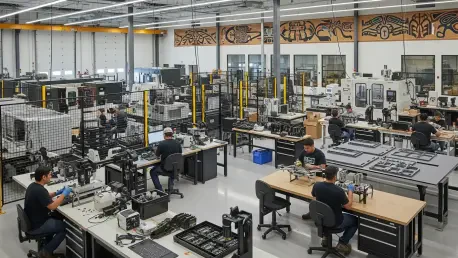

From ceremony podiums to factory floors, India’s defense story is shifting at speed and scale that now turns public accolades into industrial signals and converts political rhetoric into order books, certifications, and supply chains that did not exist a decade ago. This shift has mattered for strategic autonomy and bargaining power, but just as crucially for resilience—owning core components has reduced exposure to sanctions, shipping delays, and sudden export curbs.
Speeches in Nagpur recently captured that arc with unusual clarity. Leaders linked Make in India reforms with private-sector breakthroughs and used specific exemplars to show how policy translated into product. The symbolism traveled both ways: recognition of local achievement doubled as an index of national capability, and the city’s growing defense footprint became a narrative device for a larger realignment.
This analysis connects those themes to the dathow production and exports scaled since 2014, why drones and munitions emerged as anchor applications, how leadership messages aligned with industry traction, and where risks could slow momentum. The throughline is not celebratory mood music, but a measurable shift from buyer to builder.
1. The Momentum Behind India’s Defense Manufacturing Shift
1.1 Data, Growth Curves, and Policy Catalysts (2014–2026)
Production value recorded steady gains after liberalization widened licenses and raised FDI ceilings, as noted across Ministry of Defense annual statements and DPIIT disclosures. By 2026, exports cited by MoD and SIPRI showed multi-fold growth over mid-2010s baselines, while private firms moved from components to sub-systems and, in select cases, to complete platforms.
Procurement policy pulled the market forward. Positive Indigenization Lists set import-substitution targets, and IDDM preferences nudged designs toward original IP. Innovation funnels broadened: iDEX seeded startups, DRDO–industry co-development compressed timelines, and trial cycles were fast-tracked through expanded ranges and standards labs, allowing MSMEs to clear qualification gates once reserved for PSUs.
Benchmarking against South Korea and Turkey revealed a narrowing gap on cost and time-to-field, though depth in seekers, propulsion, and advanced materials still required co-development. The supply chain thickened at the middle tiers: test infrastructure multiplied, vendor audits matured, and quality frameworks began to lower defect rates and raise mean time between failures across product lines.
1.2 Applications and Regional Anchors: From Drones to Munitions
The strongest conversion from policy to outcome came through munitions and unmanned systems. Solar Group’s trajectory—patient licensing, vertical integration in energetics, and export forays—became shorthand for how persistent private players navigated a once-closed sector to reach global buyers while serving domestic orders at scale.
Drones, loitering munitions, ISR payloads, and EW components formed a coherent platform cluster. Domestic services issued repeat orders, joint ventures filled technology gaps, and niche export wins signaled product–market fit beyond government patronage. Missiles and their sub-systems, especially propulsion grains and fusing, moved from aspiration to credible local content.
Nagpur stood out as a regional anchor. Industrial clustering lowered logistics friction, academic and vocational pipelines supplied skilled labor, and proximity to test corridors supported faster iteration. The city offered a microcosm of dispersed hubs now visible across the country, where dual-use manufacturing spilled into aerospace, sensors, and advanced composites.
2. Leadership Perspectives and Expert Opinions
Policy signals emphasized continuity. Devendra Fadnavis framed post-2014 liberalization and Make in India as the unlock that shifted defense from PSU primacy to mixed participation, bringing capital, competition, and accountability. The underlying claim was straightforward: once the gate opened, local firms proved willing and able to climb the value chain.
Nitin Gadkari extended that logic to strategy, arguing that state power now rests on credible defense capacity more than on headline GDP. He pointed to drones and missiles as decisive vectors, not only for deterrence but for affordability and tempo—fields where manufacturing learning curves produce compounding advantages.
Mohan Bhagwat supplied the cultural lens, underlining perseverance as the hidden engine behind capability. Role models such as Satyanarayan Nuwal and young achiever Daksh Khante were cast as social proof that ambition can scale. Industry analysts largely validated the reform momentum while urging caution: capability claims need test data, export control clarity, and transparent certification pathways. They also flagged the partisan framing around “import lobbies,” urging separation of rhetoric from durable structural trends.
3. Future Trajectories, Risks, and Systemic Implications
Near-term developments point to swarming UAS, smarter loitering systems, and more capable ISR payloads; propulsion and seeker co-development is expanding with domestic materials work; and digitized ranges promise faster, cheaper trials. These, in turn, should raise throughput for certifications and shrink time-to-type-approval.
Mid-term goals concentrate on higher indigenous content in complex systems—air defense, naval combat suites, and next-wave missiles—while exports target niches where cost, climate ruggedness, and maintenance simplicity differentiate. The benefits map is broader than security: strategic autonomy, quicker upgrade cycles, supply-chain resilience, and high-quality regional jobs, with spillovers into aerospace and precision manufacturing.
Challenges remain material. Quality assurance must tighten; IP needs stronger shields; patient capital is required for long test cycles; export clearances can bottleneck; and geopolitics can still shock input availability. Cross-industry links to semiconductors, composites, and AI at the edge will set ceilings on performance. Metrics worth watching include IDDM share in procurements, defect rates and MTBF, export license volumes, private R&D intensity, and certification lead times. Best-, base-, and downside scenarios range from globally competitive primes with deep supplier tiers to fragmentation that stalls exports.
4. Synthesis and Call to Action
The synthesis is clear: reforms created room, entrepreneurial grit filled it, and exemplars like Solar Group proved that competitive products can emerge from domestic ecosystems. Drones and missiles anchored the narrative because they combine deterrent value with manufacturability, giving policymakers and investors a practical path to scale.
Action now concentrates on execution details. Policymakers should streamline testing and clearances, facilitate exports proactively, and harden IP and standards. Industry should invest in R&D pipelines, rigorous certification, and collaborative supply chains while targeting export niches where performance-to-cost wins. Investors should back dual-use platforms and enabling sub-systems with credible certification roadmaps and resilient sourcing.
Nagpur’s spotlight crystallized a national arc: policy, perseverance, and product excellence converged to reset expectations of what indigenous defense manufacturing could deliver, and the trajectory suggested that credibility would increasingly be earned on data, trials, and deliveries rather than on slogans.