
The industrial landscape is currently witnessing a profound architectural shift as legacy metals like forged steel and cast aluminum relinquish their long-held dominance to a new generation of advanced composite materials. This transition is not merely a substitution of one substance for another but a fundamental reimagining of structural engineering where the properties of the material are engineered simultaneously with the part itself. By integrating high-strength fibers within sophisticated polymer, ceramic, or metallic matrices, manufacturers are achieving performance thresholds that were previously deemed physically impossible. In the high-stakes environment of heavy-duty manufacturing, this evolution is driven by an uncompromising demand for weight reduction, thermal stability, and operational longevity that traditional alloys can no longer satisfy at a competitive scale.
The Industrial Transition Toward Advanced Composite Materials
The shift from monolithic metals to heterogeneous composites marks a departure from subtractive manufacturing toward a philosophy of material integration. While steel and aluminum have served the industry well due to their predictable isotropic properties, they are inherently limited by their weight and susceptibility to fatigue. Advanced composites solve these issues through the core principle of reinforcement-matrix synergy, where continuous fibers provide directional strength while the matrix protects these fibers and transfers loads between them. This allows for a level of customization where engineers can “tune” a component to be stiff in one direction while remaining flexible in another, a feat no solid metal can replicate.
In the context of heavy-duty manufacturing, the primary catalyst for this change is the relentless pursuit of efficiency. In sectors such as transcontinental logistics and heavy construction, every pound of dead weight removed from a vehicle or machine translates directly into increased payload capacity or reduced fuel consumption. This transition has moved rapidly from the high-margin, low-volume world of aerospace into the broader industrial landscape. The democratization of these materials is reshaping how we build everything from industrial pumps to massive turbine blades, signaling the end of the metal-only era.
Primary Technological Breakthroughs and Material Components
Additive Manufacturing and Geometric Optimization
The convergence of 3D printing and composite science has unlocked the ability to create intricate geometries that defy traditional casting or machining constraints. By utilizing continuous fiber reinforcement during the printing process, manufacturers can now consolidate complex assemblies consisting of dozens of parts into a single, unified component. This consolidation does more than just simplify supply chains; it eliminates the fasteners and joints that typically serve as the primary failure points in high-stress environments. Moreover, the reduction in material waste is staggering, as the process deposits material only where the internal stresses require it, optimizing the load distribution across the entire structure.
Ceramic Matrix Composites for Thermal Resistance
When operating in environments that would melt or oxidize standard superalloys, Ceramic Matrix Composites (CMCs) have become the definitive solution. These materials involve reinforcing ceramic fibers within a specialized ceramic matrix, creating a structure that maintains its integrity at temperatures exceeding 2,000 degrees Fahrenheit. Unlike traditional ceramics, which are notoriously brittle, the fiber reinforcement provides the necessary toughness to prevent catastrophic fracture. This makes CMCs indispensable for the next generation of industrial engines and high-temperature processing equipment, where they enable higher operating temperatures and, consequently, significantly higher thermal efficiency.
Metal Matrix Composites and Structural Stiffness
For applications requiring the conductivity of metals combined with the extreme stiffness of advanced fibers, Metal Matrix Composites (MMCs) represent the pinnacle of material design. By embedding silicon carbide or carbon fibers into aluminum or titanium bases, engineers produce components with strength-to-weight ratios that dwarf those of standard alloys. In the mining and construction sectors, MMCs are being deployed in high-stress components such as heavy-duty pistons and structural beams. These parts provide the necessary electrical or thermal conductivity for the application while offering the rigidity required to withstand massive mechanical loads without deforming.
Recent Developments and Production Scaling Innovations
The most recent advancements in the field focus on the scaling of production through Large Format Additive Manufacturing (LFAM). This technology allows for the rapid creation of massive structural components that were previously limited by the size of autoclaves or molding tools. Coupled with topology optimization algorithms, which use computational power to determine the most efficient material layout for a given set of loads, manufacturers are producing frames and housings that are 40% lighter than their predecessors. This shift indicates a move toward multi-material landscapes where different composites are fused together to balance the high cost of premium fibers with the affordability of industrial polymers.
Real-World Industrial Implementations and Case Studies
Composite Leaf Springs in Heavy-Duty Transportation
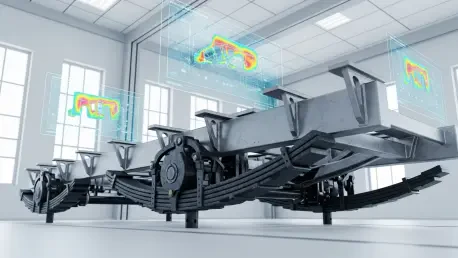
A compelling example of this technology in action is the widespread adoption of glass fiber reinforced polymer (GFRP) leaf springs in heavy-duty suspension systems. Traditional steel springs are heavy, prone to corrosion, and suffer from metal fatigue that limits their service life. In contrast, GFRP springs offer a weight reduction of up to 75% while providing superior damping characteristics. This transition has resulted in a quantifiable increase in vehicle uptime and a smoother ride that protects sensitive cargo from high-frequency vibrations, proving that the benefits of composites extend far beyond mere weight savings.
Deployment in High-Stress Machinery and Infrastructure
In the mining sector, the integration of composite parts into massive earth-moving equipment has mitigated the chronic issue of metal fatigue. By replacing traditional steel booms and arms with carbon-reinforced structures, operators have increased payload capacities without increasing the gross vehicle weight. These implementations have shown that composites can survive the abrasive and chemically harsh environments of open-pit mines, where traditional coatings often fail. This durability in extreme conditions has validated the long-term operational savings that justify the initial investment in these advanced materials.
Navigating Economic, Technical, and Sustainability Challenges
Despite the technical triumphs, the path to universal adoption is obstructed by the high per-unit cost of raw materials and the relatively slow manufacturing cycles. Unlike the rapid stamping of steel, composite curing often requires precise temperature and pressure controls that lengthen production times. Furthermore, the industry faces a significant “sustainability gap.” While composites reduce operational emissions through weight savings, the lack of a mature global recycling infrastructure means that many of these materials end up in landfills at the end of their lifecycle. Current research into bio-resins and chemical recycling is attempting to bridge this gap, but a truly circular economy for composites remains a work in progress.
Future Trajectory: Smart Materials and Autonomous Maintenance
The horizon of material science is defined by the emergence of “Smart Composites” that function as more than just passive structural elements. By embedding fiber-optic sensors and conductive pathways directly into the material during the layup process, engineers are creating structures that can sense their own health. These materials provide real-time data on strain, temperature, and internal damage, allowing for a shift from scheduled maintenance to predictive maintenance. In the near future, we may see self-healing resins that can repair micro-cracks automatically, further reducing industrial downtime and extending the safe operating life of critical infrastructure.
Summary of Key Takeaways and Industry Impact
The transition toward advanced composites represented a pivotal moment in the history of industrial engineering, moving the sector away from a reliance on heavy, fatigue-prone metals. The review of these technologies confirmed that while the initial financial hurdles were significant, the long-term gains in efficiency and durability proved undeniable for high-performance applications. The integration of additive manufacturing and smart sensing capabilities transformed static components into intelligent systems capable of self-monitoring. Ultimately, the industry moved toward a hybrid model that leveraged the best attributes of both metals and composites. Future developments focused on closing the recycling loop and refining continuous fiber printing to drive costs down further. This evolution ensured that global manufacturing remained resilient, efficient, and capable of meeting the rigorous demands of a performance-driven world.