
Modern medical science has reached a pivotal juncture where the integration of high-performance electronic hardware directly onto biological surfaces is no longer a distant theoretical concept but a tangible engineering reality. This transformation is largely driven by a necessity to bypass the rigid constraints of traditional microelectronics, which typically require high-temperature processing environments that would instantly destroy organic matter. Researchers at Rice University, collaborating with the National University of Singapore, recently introduced a solution that utilizes near-field microwave 3D printing to bridge this gap. By focusing energy with extreme precision, this technique allows for the creation of functional circuitry on surfaces that are as delicate as human tissue or as flexible as synthetic polymers. The development marks a departure from conventional manufacturing methods that rely on large-scale ovens or broad-spectrum heat sources, offering instead a desktop-scale alternative that maintains the integrity of the base material while ensuring the functionality of the electronic components.
Precision Manufacturing of Integrated Circuits
The Mechanism: Localized Heating
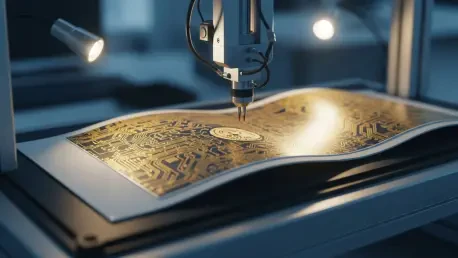
The technical foundation of this advancement relies on a sophisticated metamaterial device known as Meta-NFS, which functions by concentrating microwave energy into a heating zone as narrow as a single human hair. Unlike standard microwave applications that distribute energy over a broad area, this specific configuration creates a highly focused electromagnetic field that targets only the deposited electronic ink. This spatial precision is critical because it allows the printer to program the functional properties of the ink in real time during the additive manufacturing process. By adjusting the intensity and duration of the microwave exposure, the system can harden or anneal specific sections of a circuit without affecting the surrounding environment. This level of control effectively turns a standard 3D printer into a high-precision manufacturing tool capable of producing complex, multi-material structures. The ability to manipulate materials at such a granular level ensures that the resulting devices are both durable and highly conductive.
Overcoming Thermal Barriers: Material Science
Historically, the primary obstacle to printing electronics on heat-sensitive surfaces was the thermal degradation of the substrate, as the heat required to cure conductive inks often exceeds the melting point of plastics or the survival threshold of living cells. The near-field microwave process circumvented this issue by employing selective heating, which ensures that the energy is absorbed primarily by the nanoinks rather than the underlying material. This methodology allows for the seamless integration of diverse material classes, including ceramics, metals, and thermosets, within a single, continuous printing cycle. By eliminating the need for separate assembly steps, the technology reduces the risk of mechanical failure at the interfaces between different materials. Furthermore, the microextrusion of these nanoinks allows for high-resolution patterns that maintain their electrical properties even when applied to irregular or curved surfaces. This capability significantly expands the range of materials that can be used as substrates in the production of advanced electronic systems.
Expanding the Frontiers of Medical and Industrial Use
Biocompatible Electronics: Medical Innovation
The implications of localized microwave heating extend deep into the realm of medical technology, where the demand for personalized diagnostic tools and bionics interfaces is rapidly increasing. One of the most promising applications involves the creation of ingestible electronics designed to monitor physiological data from within the human digestive tract or other internal environments. Because the printing process can occur on ultrahigh-molecular-weight polyethylene and similar biocompatible polymers, researchers can now produce sensors that are safe for internal use. These sensors are capable of detecting strain, temperature, or chemical changes, providing real-time feedback to medical professionals. The technology also facilitates the development of bionic devices that can interface directly with human organs, offering new possibilities for prosthetic control and chronic disease management. By printing circuits directly onto biological tissue or its synthetic mimics, the medical field moves closer to a future where electronic and biological systems operate in a truly symbiotic and non-invasive manner.
Smart Infrastructure: Resilient Sensing Systems
Beyond the scope of healthcare, the versatility of near-field microwave 3D printing is poised to transform the way industrial and civil infrastructure is monitored and maintained. The ability to print resilient, enclosed sensors directly into structural components allows for the creation of smart infrastructure, such as bridges and lamp posts that can detect their own structural integrity or environmental stresses. These sensors are integrated during the fabrication process, protecting them from the elements and ensuring a long operational lifespan without the need for external housing or complex wiring. In the field of soft robotics, this technology enables the production of flexible machines that can navigate complex environments while maintaining constant communication with their controllers. The precision of the microwave heating process ensures that the electronic components remain functional even when the robot undergoes significant deformation. This development provides a scalable and cost-effective method for producing next-generation drones and autonomous systems that require lightweight, integrated sensing capabilities.
The shift toward decentralized electronics manufacturing through near-field microwave technology offered a definitive path for producing high-performance devices outside of traditional cleanroom facilities. The research team demonstrated that localized energy delivery effectively solved the long-standing problem of substrate damage, thereby enabling the use of organic and flexible materials. This progress established a new standard for additive manufacturing where material properties were manipulated at the microstructural level during the printing phase. Moving forward, the industry should prioritize the refinement of multi-material nanoinks to expand the functional range of printed components. Engineers and designers might consider integrating these desktop printing solutions into local production hubs to reduce supply chain dependencies and accelerate the prototyping of wearable health monitors. The successful fusion of microwave physics and material science provided the necessary tools to create a new generation of electronics that were previously considered impossible to manufacture due to thermal limitations.