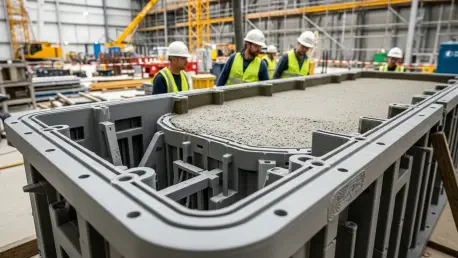

Mounting pressure to deliver clean, reliable power has exposed a hard truth about nuclear construction: time lost on concrete work can erase entire business cases before a single kilowatt-hour is sold, and that is precisely where a new class of 3D-printed composite molds has begun to shift outcomes from delay to delivery. Oak Ridge National Laboratory’s Manufacturing Demonstration Facility earned the 2026 SME Aubin Additive Manufacturing Case Study Award for showing that large-format additive manufacturing can move beyond prototyping to production-grade tooling. The team’s molds were designed, printed, machined, and sealed to cast complex, nuclear-grade precast elements for Kairos Power’s reactor program. Results were not theoretical. The tools performed repeatedly at full scale, preserved tight tolerances, and helped compress critical-path activities. The core idea is simple but powerful: a digital-first workflow produces lighter, faster, and more adaptable molds without sacrificing nuclear-quality precision.
The Bottleneck in Nuclear Builds
Nuclear construction is dictated by concrete, not just steel and fuel, because shielding structures, bio-shields, and thick walls set the pace for everything that follows, often consuming scarce schedule float and turning late design changes into cascading rework. On advanced reactors and small modular reactors, intricate geometries and fit-up requirements for shielding assemblies demand meticulous molds that are slow to fabricate and difficult to modify once steel cutting starts. Traditional steel tooling brings weight, complexity, long lead times, and awkward on-site handling that drives labor and lifting risks. Industry practitioners routinely cite that concrete can account for a majority of schedule uncertainty on large nuclear jobs. Those realities explain why a fast, precise, and reconfigurable tooling method earns outsized leverage: every day saved on molds ripples into formwork cycles, crane time, and downstream installation.
Concrete also governs field sequencing, which amplifies the cost of change late in design. When radiological shielding pieces must stitch together with millimeter-level fidelity across curved interfaces, contractors often resort to handwork or grout adjustments that mask misalignments but slow progress and raise quality concerns. The resulting friction clashes with modern project controls that prize repeatable preassembly and modularization. Moreover, when delivery of molds slips by just weeks, the critical path extends, craft resources sit idle, and opportunity costs escalate. Against that landscape, a tooling solution that holds one-sixteenth-inch tolerances and lands on site in about two weeks reframes planning assumptions. It turns previously high-risk elements into manageable, digitally traceable steps that align with model-based construction and quality assurance workflows in regulated environments.
The Solution: Large-Format Printed Composite Molds
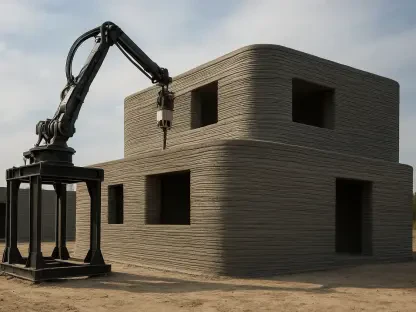
The ORNL-led approach starts on the screen, not the shop floor. Engineers build a parametric model of the mold, manage revisions through digital change control, and split large geometries into printable modules sized for the LFAM cell. Those segments are printed quickly, then precision-machined and sealed to deliver surface finish and dimension control consistent with nuclear-grade precast. The resulting composite tools are robust without being massive, making them easier to rig, transport, and reposition as sequences change. Crucially, the digital chain never breaks. Design updates propagate directly into revised print files, which shortens the loop between engineering decisions and field-ready hardware. When late-stage adjustments arise—as they often do in nuclear preconstruction—the team can respond without scrapping weeks of fabrication.
Dimensional performance is the measure that matters, and the molds delivered. Critical surfaces stayed within one-sixteenth of an inch, a level that supports complex interlocks across heavy panels and reduces reliance on field grout to correct misfits. Structural stability under pour loads also proved decisive. These composite tools absorbed hydrostatic pressure from wet concrete cast up to 12 feet high without distortion that would compromise fit. That combination—geometric precision plus stiffness under dynamic conditions—enabled the production of large, intricately joined precast elements. Because the process is modular, it scales to different part families while retaining repeatability. It also helps decouple forming time from crane and crew schedules, reducing time-on-site pressures that often force compromises between speed and quality.
What Was Built for Kairos Power
The program focused on two nuclear-grade precast components central to Kairos Power’s reactor construction sequence: bio-shield strongback columns and radiation shielding wall panels. The strongbacks measure roughly 8 feet by 8 feet by 20 feet, a volume that demands both precise alignment surfaces and enough structural rigidity in the mold to hold shape during high-head pours. The wall panels extend up to 27 feet and incorporate complex interlocking joints. Those joint geometries function like a three-dimensional puzzle, promoting tight fit-up, controlling gaps, and reducing or even eliminating grout in many seams. This geometry-first mindset aligns with Kairos Power’s low-pressure system, where concrete shields radiation and provides structural support rather than serving as a pressure-rated containment barrier.
That operating context is significant for manufacturing strategy. With containment-grade pressure loading off the table, tooling can prioritize smooth surfaces, accurate angles, and durable sealing rather than ultra-thick steel construction that resists yield under extreme internal pressures. Composite LFAM molds match that target. They keep weight manageable for field logistics and permit rapid iteration when a dimension shifts or a tolerance tightens. The team validated that large, monolithic appearance does not require monolithic tools: printed modules locked together into stable assemblies that met casting requirements at full scale. Interlocking features in the panels further improved installation efficiency by guiding pieces into alignment and cutting down time spent on layout, shimming, or grinding. The result was a leaner, more predictable assembly process embedded upstream in the mold.
Field Results: Repeatability, Schedule, and Flexibility
Performance in a live industrial environment tested more than geometry; it tested endurance and practicality. The composite molds supported four casting cycles for the bio-shield strongback columns and three cycles for the shielding wall panels without measurable degradation in quality. Across those pours, dimensional fidelity stayed within spec, and the tools resisted dynamic effects associated with concrete placement at height, including shifting head and vibration. Lighter weight also paid off in handling. Crews moved and reset the tooling with fewer heavy lifts, reducing rigging time and potential safety exposures. In short, the tools behaved like production assets, not prototypes—a crucial distinction in nuclear work, where repeatability is the currency of confidence.
Schedule and budget impacts followed. Lead time for the LFAM composite molds landed at about two weeks, compared with six to eight weeks for traditional steel. That delta compresses the concrete-driven critical path and offers planners a cushion against late design churn. Because the workflow is model-based and modular, engineering can push through quick updates without sending a fabricator back to torch and weld. In practice, that flexibility limits rework and helps keep installation sequences intact when external factors shift. By arriving faster, weighing less, and adjusting readily, the molds lowered indirect costs tied to holding crews, extending equipment rentals, and reshuffling laydown areas. The upshot was a tighter feedback loop between design, procurement, and field execution that supported quality and predictability.
Collaboration, Validation, and Path to Scale
Recognition by SME carried weight because it validated technical rigor alongside national relevance. The effort was funded by the Department of Energy’s Advanced Materials and Manufacturing Technologies Office through the SM2ART program, led by ORNL’s Manufacturing Demonstration Facility, and executed with the University of Maine’s Advanced Structures & Composites Center, Kairos Power as end user, and an industrial consultant. Judges cited the program’s collaboration and measurable impact on a safety-relevant domain. More than an award, the result established evidence that digitally designed, additively produced composite tools can meet nuclear-grade tolerances in field conditions. That matters in a regulated sector, where independent scrutiny and documented performance often set the threshold for adoption.
Scaling is now the operative question. The team is engaging a major U.S. precast manufacturer to broaden deployment, a step that would plug LFAM tooling into established production lines. Early data suggested the approach is best suited to non-pressure-rated concrete elements—bio-shields, shielding walls, and complex structural forms—while continued validation will be needed across reactor types, climates, and inspection regimes. Action items for stakeholders were straightforward: general contractors should map critical-path concrete packages against LFAM lead times; precasters should pilot a part family with demanding geometries to benchmark cycle life and finish; and owners should incorporate digital-change allowances that exploit rapid retooling. Taken together, those moves positioned LFAM composite molds as a practical lever to cut risk and accelerate clean energy buildouts.