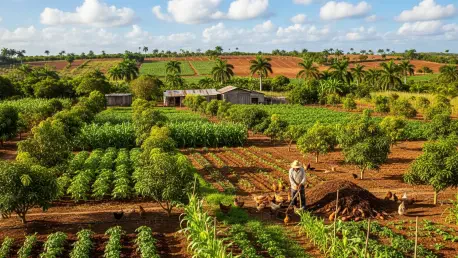

The skeletal remains of once-productive farms across the Cuban countryside now serve as a grim testament to a nation grappling with its most severe nutritional deficit in modern history, while President Miguel Díaz-Canel attempts to frame a shift toward traditional farming as a revolutionary victory. This administrative pivot toward agroecology aims to eliminate the reliance on chemical fertilizers and heavy machinery, presenting a vision of national sovereignty that reduces the staggering two-billion-dollar annual expenditure on foreign food. Despite this ideological push, the reality remains that nearly eighty percent of the island’s caloric needs are met through international markets, creating a precarious dependency that the current state budget can no longer sustain. The government maintains that domestic production is the only path forward, yet structural inefficiencies and the lack of basic inputs have led to a freefall in the output of staples like rice and milk. This gap between the state’s sustainable rhetoric and the empty shelves in local markets has left the citizenry in a state of constant anxiety as they navigate a landscape where basic survival is no longer a certainty.
Infrastructure Collapse: The Fuel Paradox
The capture of Nicolás Maduro and the subsequent geopolitical shifts in 2026 have triggered a catastrophic energy collapse that effectively paralyzed the Cuban agricultural sector. Without the steady flow of subsidized diesel, the tractors and transport trucks necessary to move produce from rural fields to urban centers have been rendered useless, leaving crops to rot in the sun. This fuel scarcity has exposed the fatal flaw in the government’s agroecological plan, which relies on the assumption that manual labor and organic methods can compensate for a total lack of industrial infrastructure. While the administration promotes sustainable farming as a strategic remedy, the lack of electricity and fuel has made it impossible to maintain irrigation systems or refrigeration for perishable goods. Consequently, the transition to chemical-free agriculture is not a choice driven by environmental ethics but a desperate reaction to a complete breakdown in the national supply chain and logistics network.
The systemic failure to provide basic energy requirements has created a ripple effect that extends far beyond the farm, impacting the ability of small-scale cooperatives to function. Many farmers who previously attempted to embrace agroecology now find themselves unable to even deliver their goods to state-run distribution points, known as Acopio, due to the absence of functional vehicles. This lack of mobility has forced a retreat into subsistence farming, where local communities consume what they grow while the larger population in the cities faces mounting scarcity. The government’s refusal to allow for private investment in energy infrastructure has only exacerbated the problem, ensuring that the agricultural sector remains trapped in a cycle of low productivity. Without a reliable power grid or fuel reserves, the promise of food self-sufficiency remains a distant mirage, as the physical labor required to sustain a nation of eleven million people cannot be achieved through traditional ox-and-plow methods alone.
Economic Contraction: The Worst Performer in the Region
The broader economic landscape of the island has darkened significantly, with a projected contraction of over seven percent in the gross domestic product for the current year. This decline marks the island as the worst-performing economy in the region, a statistic that translates directly into the daily suffering of millions of residents who cannot find or afford basic protein. Domestic production of essential goods like pork and eggs has plummeted to historic lows, as the state-run industry fails to secure the animal feed and veterinary supplies previously imported from abroad. While the leadership admits to a lack of investment in the agricultural sector, the proposed solutions often focus on ideological purity rather than the market-driven incentives required to stimulate production. This disconnect has led to a scenario where the official narrative of resilience is met with deep skepticism by a public that is increasingly forced to skip meals to survive the harshest economic climate in decades.
Public disillusionment has reached a breaking point, with roughly eighty percent of the population asserting that the current crisis is more severe than the “Special Period” of the 1990s. Unlike that previous era of hardship, the current situation is compounded by a globalized market where the cost of living has skyrocketed, leaving those without access to foreign currency in a state of absolute poverty. Five major provinces, including the densely populated hubs of Havana and Santiago de Cuba, have been identified as operating at critical levels of food survival, where the caloric intake of the average citizen is well below international health standards. The government’s reliance on agroecology as a panacea ignores the fact that a modern economy cannot be fed by low-yield, labor-intensive methods in the absence of a functional market. This economic stagnation is not merely a byproduct of external pressures but is deeply rooted in a centralized system that continues to stifle the individual initiative needed to revitalize the soil.
Strategic Reorientation: Transitioning Toward Structural Reform
The state leadership persisted in utilizing revolutionary rhetoric to promote a sustainable future, yet the total lack of resources and fuel left the nation in a state of unprecedented fragility. By prioritizing agroecology without addressing the underlying energy deficit, the administration failed to provide a viable path for the smallholder farmers who were expected to carry the burden of national nutrition. The reliance on manual labor proved insufficient to meet the demands of an urbanized population, and the absence of private property rights continued to discourage the long-term investment necessary for soil health and irrigation. It became clear that the crisis was not merely a matter of farming techniques but a systemic failure of the distributive model. For agroecology to have succeeded, it would have required a supportive environment of decentralization and robust logistical support that the current bureaucratic framework was unable or unwilling to provide to the agricultural community.
The transition toward a more resilient food system necessitated a move beyond ideological slogans and toward the integration of modern technology and private capital. Future considerations for the island must include the deregulation of food prices and the direct empowerment of independent farmers to sell their products without state mediation. Actionable steps involved creating a legal framework that protected foreign and domestic investment in agricultural technology, including solar-powered irrigation and localized processing plants that did not rely on the national grid. While sustainable methods remained a valuable component of a diversified farming strategy, they could not serve as a replacement for a functional economy. The ultimate solution lay in a hybrid approach that combined the ecological benefits of organic farming with the efficiency of modern market structures. Only by abandoning the rigid controls of the past could the nation hope to secure its food sovereignty and end the cycle of chronic deprivation.