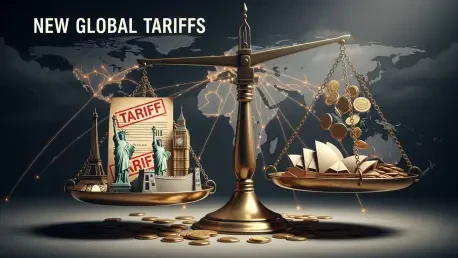

A quiet courtroom in lower Manhattan has become the epicenter of a financial earthquake that threatens to raise the price of every foreign-made object entering American homes. Within the mahogany-paneled walls of the U.S. Court of International Trade, a three-judge panel is currently wrestling with the validity of a 10% levy on all global imports. This legal battle is not merely a dispute over numbers; it is a fundamental test of how far a president can stretch executive authority to reshape the flow of international commerce without the explicit consent of Congress.
The stakes could not be higher for the American economy, as the ruling will dictate the cost of everything from high-end electronics to basic household staples. This litigation follows a major setback for the administration, occurring after the Supreme Court blocked a previous attempt to use broader emergency powers to address trade imbalances. By pivoting to a different legal mechanism, the administration has reignited a fierce debate over whether the executive branch can unilaterally impose sweeping taxes under the premise of solving a “national economic crisis.”
A Ten Percent Tax on Everything: The Judicial Clock Starts Ticking
The proceedings in New York represent a critical junction for global trade stability, as businesses nationwide scramble to account for the sudden 10% overhead. This broad-based tariff is being challenged by a massive coalition of two dozen states and prominent business groups who argue that the administration is overstepping its constitutional boundaries. The court must decide if the executive branch has found a legitimate legal loophole or if it is simply attempting to bypass the legislative process through creative interpretation.
While the administration frames these tariffs as a necessary tool to protect domestic industries, the opposition warns of a domino effect that could spark retaliatory measures from trading partners. The judicial clock is ticking loudly because these measures are currently active, draining capital from supply chains every day the case remains undecided. For the judges, the task is to balance the president’s traditional leeway in foreign affairs against the strict statutory limits imposed by trade laws designed decades ago.
From the Gold Standard to Modern Protectionism: The Context of Section 122
The administration’s current legal strategy relies on Section 122 of the Trade Act of 1974, a provision that has largely gathered dust since the end of the Nixon era. This specific law was originally crafted during a period of intense global financial instability when the U.S. dollar was still fundamentally linked to gold. It was intended to give the president temporary, 150-day authority to address severe “balance-of-payments” emergencies, a term that carries very specific historical weight in the context of fixed exchange rates.
Applying this 1970s relic to the modern digital economy requires a significant leap of legal imagination, as the current financial system operates on floating exchange rates that did not exist when the law was written. Critics argue that using a gold-era tool to manage contemporary trade deficits is intellectually dishonest and legally flawed. The court is now tasked with determining if the “international payments problem” described in the statute can be redefined to fit the administration’s modern protectionist agenda.
Decoupling the Legal Arguments: Statutory Authority vs. Executive Discretion
At the heart of the litigation is a sharp disagreement over the definition of executive discretion versus statutory intent. The government argues that the phrase “fundamental international payments problems” is broad enough to include persistent trade deficits, thereby granting the president the power to act without waiting for a congressional vote. This interpretation would effectively allow for a revolving door of 150-day tariffs that could be renewed indefinitely, fundamentally shifting the power of the purse from the Capitol to the White House.
Plaintiffs counter that such an interpretation turns a narrow, emergency provision into a permanent grant of taxing power, which was never the intent of the 1974 legislature. They maintain that a trade deficit—the difference between what a country imports and exports—is not the same as a balance-of-payments crisis that threatens the stability of the national currency. This distinction is vital because if the court accepts the administration’s broad definition, it could set a precedent that allows any future president to tax imports at will.
The Irony of the DOJ’s Flip-Flop and Expert Skepticism
Observers in the courtroom have noted a striking reversal in the Justice Department’s legal position compared to its arguments from just a year ago. In previous litigation, government lawyers argued that Section 122 was an archaic mechanism that did not apply to modern trade imbalances, yet they are now defending it as the primary pillar of the president’s policy. This shift has drawn sharp questions from the three-judge panel, who appear skeptical of a legal logic that seems to change based on the administration’s immediate political needs.
Legal experts remain divided on the likely outcome, noting that courts have historically been reluctant to second-guess the president on matters involving foreign policy and national security. However, the intensity of the judges’ questioning regarding the technical definition of a “deficit” suggests that the court may not be ready to offer the administration a blank check. The skepticism from the bench indicates that the government must provide a more rigorous economic justification for why a standard trade imbalance constitutes a national emergency.
Preparing for the July 24 Deadline: Practical Strategies for Stakeholders
As the July 24 expiration date for the current tariff round approaches, the business community is bracing for a period of intense volatility. If the court rules in favor of the administration, companies should expect these 10% taxes to become a recurring feature of the trade landscape through rolling 150-day extensions. Organizations must prioritize auditing their global supply chains to identify which components are most vulnerable to these costs and begin exploring alternative sourcing regions that might offer more stability.
To navigate this uncertainty, stakeholders ought to develop flexible pricing models that can absorb sudden 10% shifts in overhead without alienating customers. Diversifying logistics and increasing inventory levels for critical imports may provide a temporary buffer against the “two-week turnaround” rulings that often characterize these high-priority trade cases. Ultimately, the focus should shift toward long-term resilience, ensuring that operational budgets are robust enough to withstand a new era where trade policy is dictated as much by judicial rulings as by market demand.