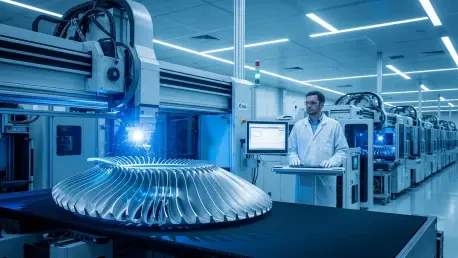

Engineers within the aerospace sector have long struggled with the inherent limitations of conventional casting and machining, but the arrival of industrial-scale 3D printing has finally shattered those barriers. The recent establishment of a specialized additive manufacturing cell at the Bristol facility in the United Kingdom represents a defining moment for Rolls-Royce and the broader aviation industry. This high-tech hub, supported by the UK Ministry of Defence, is not merely an experimental lab but a fully operational production center dedicated to generating critical engine components for the next generation of aircraft. By moving away from traditional subtractive methods, the facility utilizes advanced laser-based powder bed fusion to construct parts that were previously considered impossible to manufacture. This shift allows for the creation of intricate internal architectures, such as optimized cooling channels, which significantly enhance the thermal efficiency and overall performance of modern jet turbines.
Precision Engineering through Advanced Fusion
The operational heart of this transformation lies within a 350-square-meter controlled environment where every variable, from air pressure to humidity, is meticulously regulated to maintain part quality. German-engineered laser systems are the primary tools in this space, meticulously melting layers of metal super-alloys to build complex structures from the ground up. This level of environmental control is necessary because even the slightest variation in temperature could compromise the structural integrity of a high-pressure turbine blade or a fuel nozzle. By mastering this process, the facility ensures that every component meets the rigorous safety standards required for flight while achieving a level of precision that manual machining simply cannot match. This approach has already begun to streamline the production of high-value parts, allowing engineers to move from a digital design to a physical prototype in a fraction of the time required by traditional tool-and-die methods.
Beyond the immediate speed of production, the use of additive layer manufacturing enables the integration of multiple separate parts into a single, unified component. This consolidation reduces the number of joints, fasteners, and seals within the engine, which in turn minimizes the risk of mechanical failure and simplifies the assembly process. The ability to work with advanced metal super-alloys in a layer-by-layer fashion also means that the metallurgical properties can be tailored to the specific stresses the part will face during operation. As a result, the engines currently being developed are not only more reliable but also significantly lighter, contributing to a better power-to-weight ratio. This capability is particularly vital for the propulsion systems being designed for the Global Combat Air Programme, where every kilogram of weight saved translates directly into increased range, higher speed, or additional payload capacity for the aircraft in the field.
Strategic Impact on Defense and Resource Management
The strategic implications of this technology extend far beyond the workshop floor, as it fundamentally alters the logistics and supply chains of modern defense projects. Projects like the Future Combat Air System rely on the rapid innovation cycles facilitated by this additive manufacturing cell to stay ahead of evolving threats. Because the manufacturing process is driven by digital files rather than physical molds, design updates can be implemented and tested almost instantaneously. This agility is a game-changer for military aviation, where the ability to iterate on a design based on real-world performance data can mean the difference between technological superiority and obsolescence. Furthermore, the potential for distributed manufacturing means that critical spare parts could eventually be produced closer to the point of use, reducing the reliance on vulnerable global shipping lanes and shortening the time aircraft spend grounded for maintenance.
From an environmental and economic perspective, the shift toward 3D printing has introduced a level of resource efficiency that was previously unattainable in heavy industry. Traditional manufacturing often involved starting with a large block of expensive alloy and machining away a significant portion of it, resulting in substantial material waste. In contrast, additive processes use only the exact amount of powder required to form the part, with any unused material being recycled for the next build cycle. This reduction in waste, combined with lower energy requirements for the manufacturing process itself, aligned perfectly with the industry’s growing focus on sustainability. Industry leaders recognized that adopting these methods was no longer a matter of experimentation but a vital step in maintaining a competitive edge. The implementation of this technology successfully demonstrated that high-performance engineering and responsible resource management could coexist within a modern industrial framework.