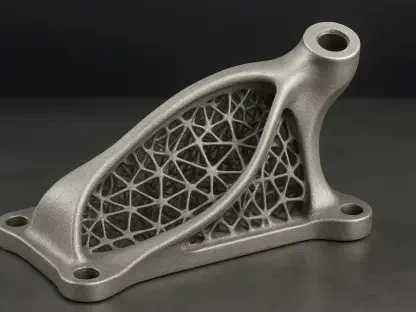

The landscape of domestic industrial production is undergoing a profound transformation as legacy supply chains struggle to meet the demands of aerospace and energy sectors requiring complex geometries. Velo3D has positioned the Forge 1 as a pivotal solution in this shift, offering an integrated approach to metal additive manufacturing that aims to standardize production across global networks. Unlike traditional systems that require extensive manual intervention and support structure removal, this platform utilizes a cohesive ecosystem of hardware and software to ensure consistency. This reliability is crucial for American manufacturers. They are currently facing labor shortages and a desperate need for decentralized production capabilities. By streamlining the path from digital design to physical part, the technology seeks to eliminate the trial-and-error phase that has long plagued laser powder bed fusion. Consequently, the emphasis is no longer just on printing a part, but on the ability to replicate it perfectly regardless of the machine’s location.
Technical Integration: Bridging the Gap Between Design and Production
Success in advanced additive manufacturing depends heavily on the underlying software architecture that translates complex CAD models into printable instructions without compromising structural integrity. The Flow preparation software acts as the primary intelligence layer, automatically identifying challenging features such as low-angle overhangs and thin-walled structures that typically require massive support structures. By utilizing sophisticated simulation and print-file optimization, the system minimizes the need for sacrificial material, which significantly reduces the post-processing time and labor costs associated with traditional metal printing. This digital-first strategy ensures that the intent of the design is preserved through the entire manufacturing cycle, allowing engineers to push the boundaries of what is physically possible. Furthermore, the integration of real-time monitoring allows for immediate feedback during the build process, preventing catastrophic failures that often haunt large-format metal additive projects.
Hardware consistency remains a significant hurdle for companies attempting to scale their 3D printing operations across multiple facilities or geographical regions. The Forge 1 addresses this by ensuring that every machine in the fleet operates under identical parameters, effectively turning the printing process into a predictable commodity rather than a specialized craft. Through the use of standardized calibration and optical sensors, the system verifies that the laser interaction with the powder bed remains constant, which is vital for maintaining the mechanical properties of materials like Inconel 718 or Titanium 6Al-4V. This level of repeatability allows aerospace contractors to qualify a design once and then produce it at any certified location without needing to re-validate the process for each individual printer. As a result, the transition from prototyping to full-scale production becomes more fluid, enabling a faster response to market demands and reducing the overhead costs typically associated with high-performance metal fabrication.
Strategic Implementation: Navigating the Shift to Digital Warehousing
The shift toward digital warehousing represents a fundamental change in how spare parts and critical components are managed within the broader American manufacturing infrastructure. Instead of maintaining massive physical inventories of cast or forged parts that may sit unused for years, organizations are beginning to store digital twins of their components for on-demand printing. The Forge 1 facilitates this transition by providing the necessary precision and material certification required for flight-critical or pressure-sensitive parts in the energy sector. This approach reduces the dependency on centralized foundries, which are often located overseas and subject to geopolitical instability or logistical bottlenecks. By moving production closer to the point of use, companies can significantly lower their carbon footprints while simultaneously increasing the agility of their operations. This localized model supports a more resilient economy that is less vulnerable to the sudden disruptions that have characterized global trade in the recent years.
Industrial leaders recognized that the adoption of advanced metal printing required a shift from exploring technical feasibility to implementing robust operational frameworks. They established comprehensive training programs for engineering teams to master the nuances of design for additive manufacturing, ensuring that components were optimized for the Forge 1 ecosystem from the start. Collaborative efforts between material scientists and quality assurance departments were prioritized to validate the performance of printed parts under extreme environmental conditions. Strategic investments were directed toward building interconnected networks of printers that allowed for seamless capacity sharing during peak demand periods. These organizations successfully mitigated the risks of technological obsolescence by choosing platforms with modular upgrades and standardized software updates. By focusing on the integration of digital threads across the entire product lifecycle, manufacturers moved beyond the limitations of legacy fabrication, ensuring that domestic production remained competitive.