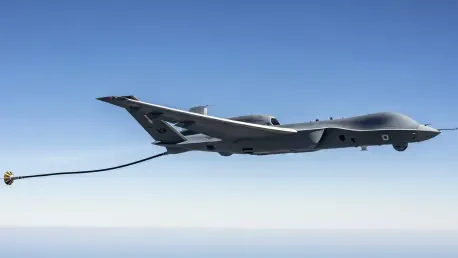

The successful inaugural flight of the MQ-25A Stingray signals a monumental shift in how the United States Navy intends to project power across the maritime domain through the integration of unmanned platforms. During a mission spanning approximately two hours at the Boeing facility located at MidAmerica Airport in Mascoutah, Illinois, the aircraft demonstrated its capability to operate as the first carrier-based unmanned aerial system specifically designed for refueling operations. This milestone represents a technical breakthrough and a fundamental change in the operational philosophy of naval aviation. By successfully launching and maneuvering this prototype, the Navy has initiated a transition toward a more flexible and resilient carrier air wing. The event marks the start of a rigorous evaluation process that seeks to validate the safety and efficiency of autonomous flight in complex environments. It addresses the long-standing challenge of buddy-tankering, where manned F/A-18 Super Hornets are diverted from combat roles to refuel their peers. By automating this role, the Navy can maximize the utility of its manned assets while testing the endurance limits of unmanned systems. This flight marks the official transition from conceptual design to a physical reality that will redefine the logistics of deep-strike missions. The data gathered during this two-hour window provides the foundation for the next several years of carrier-based autonomous aviation, ensuring that the fleet remains adaptable to evolving global security requirements and technological shifts in modern aerial warfare.
Technical Validation and the Control Interface
During the initial flight maneuvers, a collaborative team of pilots from the Navy and Boeing operated the aircraft using the MD-5 ground control station, which utilizes the Lockheed Martin MDCX system for seamless communication. The primary objectives of this mission centered on validating foundational flight characteristics, including the stability of basic flight controls, engine performance through various power cycles, and the aircraft’s responsiveness to handling commands. By achieving these specific performance metrics, the test team successfully confirmed the basic airworthiness of the platform, ensuring that the software and hardware interfaces work in harmony. This digital backbone is essential for the MQ-25A to eventually operate autonomously alongside manned aircraft in the high-stress environment of a carrier deck. This integration of the MDCX system allows for precise oversight while the unmanned tanker performs complex maneuvers, providing a blueprint for future autonomous platforms that require robust data links and real-time responsiveness. The successful execution of these maneuvers proves that the current control architecture is capable of managing the unique stresses of takeoff and landing transitions. This phase of development ensures that the propulsion and control surfaces are synchronized to handle the aerodynamic requirements of a large-scale refueling drone. Moreover, the feedback from the ground control station provided engineers with a high-fidelity look at how the airframe reacts to real-world atmospheric conditions and remote inputs.
Strategic Deployment and Operational Evolution
Leadership within the naval community, including figures such as Rear Adm. Tony Rossi and Capt. Daniel Fucito, viewed this flight as a catalyst for a more lethal and efficient carrier air wing. The strategic move to assign the MQ-25A to aerial refueling roles allowed manned fighter jets to focus entirely on strike missions, thereby extending the effective combat radius and speed of the entire carrier group. Moving forward, the integrated test team established a roadmap to expand the performance envelope and verify mission-critical systems through 2026 and into 2027. The next logical step involved relocating the testing operations to Patuxent River for more intensive sea-based trials. Commanders prioritized the refinement of autonomous landing software and high-bandwidth data links to ensure the Stingray operated reliably in all weather conditions. Planners also looked toward integrating these unmanned tankers into broader multi-domain networks, where they could serve as secondary communication relays or sensor nodes. This evolution required the Navy to invest in advanced training for operators and to update the infrastructure of existing carriers to accommodate the unique requirements of autonomous maintenance. By standardizing these operational procedures early, the Navy ensured that the transition to an unmanned-assisted fleet remained smooth and strategically sound for the years ahead. Future considerations also focused on the modularity of the platform, allowing for potential secondary reconnaissance missions that would further enhance the situational awareness of the fleet.