
The global pharmaceutical infrastructure is currently grappling with a monumental shift as Glucagon-like peptide-1 (GLP-1) receptor agonists transition from niche diabetic treatments to a foundational pillar of modern metabolic health and obesity management. Originally conceived to regulate blood sugar, these therapies have witnessed an explosive adoption rate, with market analysts projecting that annual sales will comfortably surpass the $100 billion threshold within the next four years. This unprecedented surge has effectively forced the industry to abandon its initial reactive strategies—characterized by emergency stop-gap measures and rapid-response scaling—in favor of a more permanent, robust, and technologically advanced manufacturing framework. As the patient population continues to expand, the focus has pivoted toward building a long-term operational model that can reliably sustain tens of millions of people who now view these medications as chronic, lifelong therapies rather than short-term interventions. This structural evolution requires more than just adding more factory floor space; it demands a total reimagining of the biopharmaceutical supply chain, moving from a rigid, centralized system to a more agile, distributed network that can withstand the pressures of global demand while maintaining the highest standards of quality and safety.
Technical Barriers: The Peptide Synthesis Landscape
The most significant hurdle to achieving the necessary volume of GLP-1 therapies lies in the intricate and demanding chemical processes required to synthesize the active pharmaceutical ingredients. Unlike traditional small-molecule drugs that are produced through relatively straightforward and highly scalable chemical reactions, GLP-1s are complex peptides that generally necessitate the use of Solid-Phase Peptide Synthesis (SPPS). This specific methodology involves the sequential addition of amino acids to a growing peptide chain, a process that requires extreme precision and a strictly controlled environment to ensure structural integrity. Because each amino acid must be added one by one, the synthesis is inherently time-consuming and difficult to accelerate without introducing significant risks of error. Furthermore, as the peptide chain grows in length, the efficiency of the reaction often declines, leading to a crude product that is frequently only 45% to 65% pure. This low yield means that a substantial portion of the raw materials and energy expended during production ultimately results in chemical waste that must be discarded, placing an immense burden on both the economics and the logistics of the manufacturing cycle.
Compounding the difficulties of initial synthesis is the arduous purification process required to bring the crude peptide up to therapeutic-grade standards. Because the impurities produced during synthesis are often chemically similar to the target molecule, separating them requires advanced chromatography techniques that are both technically demanding and prohibitively expensive at a global scale. In the current market environment, even a minor fluctuation in purification efficiency can lead to a significant loss of usable product, further exacerbating the existing supply shortages. This technical bottleneck is worsened by the environmental footprint of the process, which is highly solvent-intensive and requires specialized facilities capable of managing large volumes of chemical waste safely. To overcome these constraints, manufacturers are increasingly exploring alternative synthesis methods, such as liquid-phase synthesis or hybrid approaches, which promise higher yields and better scalability. However, transitioning to these newer technologies requires massive capital investment and a multi-year lead time for facility certification, meaning the industry remains locked in a race to optimize existing infrastructure while simultaneously building the high-tech factories of the future.
Workforce Gaps: Systemic Vulnerabilities and Global Logistics
The physical ability to produce GLP-1 medications is fundamentally limited by a widening talent gap that currently leaves tens of thousands of specialized roles vacant across the global biopharmaceutical sector. High-tech peptide synthesis is not a process that can be easily automated or managed by generalist laboratory technicians; it requires a deep understanding of organic chemistry, process engineering, and stringent regulatory compliance that typically takes years of focused training to acquire. As pharmaceutical giants and contract development and manufacturing organizations (CDMOs) race to expand their footprints, they are finding that the availability of human capital is often a more restrictive bottleneck than the availability of capital or equipment. This shortage of expertise creates a high-stakes environment where companies must compete fiercely for a limited pool of talent, often leading to increased operational costs and potential delays in the commissioning of new production lines. Without a concerted effort to invest in specialized educational pipelines and internal training programs, the industry risks building advanced facilities that remain underutilized due to a lack of qualified personnel to operate them at peak capacity.
In addition to the workforce challenges, the GLP-1 supply chain is currently exposed to significant geopolitical and logistical risks due to a high level of regional concentration. A vast majority of the key starting materials and chemical reagents required for peptide synthesis are currently sourced from a handful of suppliers, with a particularly heavy reliance on manufacturing hubs located in specific regions like China. While this centralized model previously offered cost advantages, the current landscape of global trade and regional instability has made it a liability, as any disruption in a single geographic area could potentially paralyze the production of life-saving medications worldwide. To mitigate these risks, industry leaders are aggressively pursuing a strategy of geographic diversification, which involves establishing secondary and tertiary supply lines and building new manufacturing sites closer to their primary consumer markets in North America and Europe. This shift toward a more localized supply chain is not merely a response to political pressure but a strategic necessity to ensure resilience against unforeseen disruptions, whether they stem from trade disputes or environmental disasters. Building this redundant infrastructure is a multi-billion dollar undertaking, yet it is increasingly seen as the only way to guarantee a stable supply.
Delivery Mechanisms: Managing Sterile Fill and Finish Operations
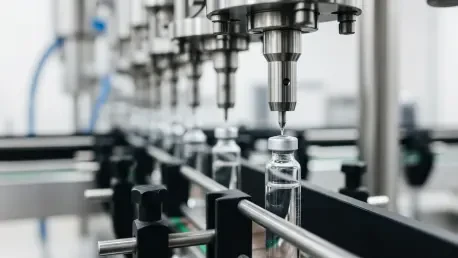
The journey of a GLP-1 drug from a chemical laboratory to a patient’s hands often encounters its most rigid obstacle at the fill and finish stage, where the synthesized active ingredient is prepared for final delivery. For the injectable formulations that currently dominate the market, the drug must be processed in highly specialized sterile environments and integrated into complex, multi-component autoinjector devices that are designed for patient ease of use. This phase of production requires a completely different technical skill set and set of equipment compared to the initial peptide synthesis, involving precision robotics, sterile handling systems, and rigorous quality control protocols to ensure that each device functions perfectly. Historically, the capacity for high-volume sterile filling has been one of the most significant points of failure in the pharmaceutical supply chain, as the demand for these specialized services often outstrips the available infrastructure. Because any contamination or mechanical failure at this stage can lead to the loss of an entire batch of expensive medication, manufacturers must maintain an uncompromising focus on operational excellence and technological precision.
While the development of oral GLP-1 therapies has been hailed as a potential solution to the injectable delivery bottleneck, it introduces a separate and equally daunting set of manufacturing challenges. The primary issue with oral delivery is the extremely low bioavailability of peptides when they are ingested; current formulations often see less than 1% of the active drug successfully entering the patient’s bloodstream after surviving the harsh environment of the digestive system. This inefficiency creates a paradoxical situation where producing a single oral dose requires significantly more of the active pharmaceutical ingredient (API) than a single injection would. Consequently, a massive shift toward oral medications could actually increase the strain on the already overburdened peptide synthesis capacity, as manufacturers would need to produce vastly larger quantities of the drug to achieve the same therapeutic effect. Until significant breakthroughs in drug delivery technology can improve the absorption rate of oral peptides, the industry remains heavily reliant on the sterile fill and finish model for injectables. This reality has prompted many organizations to invest heavily in expanding their in-house filling capacity, reducing their reliance on third-party contractors and gaining more direct control.
Strategic Responses: Diverse Industrial Paths for Leading Entities
The two primary leaders in the GLP-1 space, Eli Lilly and Novo Nordisk, have adopted starkly different but equally aggressive industrial strategies to maintain their market dominance and overcome production constraints. Eli Lilly has positioned itself as a technological innovator, focusing heavily on modernizing the actual synthesis process through the implementation of continuous manufacturing and real-time process analytical technology (PAT). By moving away from traditional batch-based processing and toward plug flow reactors and advanced filtration systems, they are attempting to increase throughput and reduce the time-lag associated with post-production quality testing. Their strategy involves building a highly sophisticated, technology-forward manufacturing network with strategic hubs in locations like Ireland and various sites across the United States. This approach not only increases the total volume of drug produced but also creates a more flexible and responsive system that can be adjusted in real-time to meet shifting demand or address local production issues without bringing the entire network to a standstill.
In contrast, Novo Nordisk has pursued a strategy characterized by aggressive vertical integration and the massive acquisition of existing manufacturing assets. The most notable example of this was the multi-billion dollar acquisition of a major contract development and manufacturing organization, which provided Novo Nordisk with immediate ownership of several critical sterile fill and finish facilities across Europe and the United States. By bringing these essential services in-house, the company has effectively eliminated its reliance on external partners for the most restrictive part of the supply chain, ensuring that its production capacity is not shared with or limited by the needs of other pharmaceutical clients. This move represents a fundamental shift in the industry’s traditional reliance on outsourcing, signaling that for high-demand therapies like GLP-1s, control over the entire end-to-end production process is a competitive advantage that justifies enormous capital expenditures. These two diverging paths—technological modernization versus asset acquisition—highlight the diverse ways in which the industry is attempting to solve the same fundamental problem of scaling production to meet an unprecedented global need.
Future Resilience: Transitioning toward Distributed Manufacturing Networks
As the pharmaceutical industry moves into a more stable phase of the GLP-1 era, the metric for success is shifting from the mere volume of output to the overall resilience and intelligence of the production system. Leading organizations are increasingly adopting demand-based planning models that utilize advanced data analytics to forecast needs across various medical indications, from obesity and diabetes to emerging uses in sleep apnea and addiction therapy. This shift allowed manufacturers to move away from rigid, long-term production schedules and toward a more agile approach where capacity was reallocated based on real-time market signals. By coordinating a global network of manufacturing sites that are capable of operating independently but are linked through shared quality standards and digital infrastructure, companies protected themselves against localized disruptions. This distributed model ensured that a problem at a single site—whether it was a regulatory issue, a supply chain break, or a natural disaster—did not jeopardize the availability of medication for the millions of patients who relied on it daily.
The long-term viability of the GLP-1 market also depended on a commitment to operational optimization and sustainable innovation that addressed the high costs and environmental impacts of production methods. Embedding quality control mechanisms directly into the production line to eliminate the need for time-consuming batch releases became an economic necessity rather than a luxury. Furthermore, the industry saw a push toward green chemistry, such as the development of aqueous peptide synthesis, which reduced the dependency on hazardous solvents and lowered the overall carbon footprint of manufacturing. These innovations did more than just improve a company’s public image; they lowered operational risks and reduced the volatility of raw material costs. Ultimately, the focus moved beyond the discovery of the molecule to the engineering of the system, ensuring that the promise of these therapies could be fulfilled for a global population. This transformation solidified the role of manufacturing as a strategic asset, moving the industry toward a model where reliability and sustainability are as vital as the clinical efficacy of the drug itself.