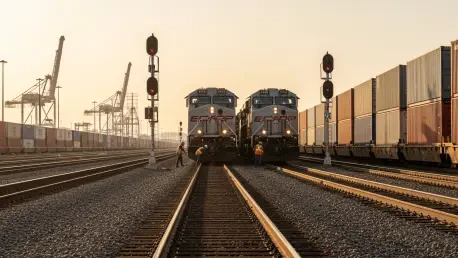

Freight demand softened but pricing held, and that combination set the stage for a quarter in which Union Pacific delivered enough outperformance to keep an $85 billion railroad megamerger in play even as regulators circled with sharpened pencils. Earnings rose 5% to $1.7 billion, or $2.87 per share, edging past estimates despite roughly $0.06 per share of merger-related costs, while revenue increased 3% to $6.22 billion on stronger rates and fuel surcharges that offset about 1% lower shipments. Expenses climbed 3% to $3.76 billion, but margin discipline remained intact as operations absorbed inflation without ceding price. Management reaffirmed a mid–single-digit EPS growth outlook for the year and kept capital plans at $3.3 billion, positioning the network for resiliency. CEO Jim Vena argued the Norfolk Southern acquisition would speed deliveries, lower costs, shift freight from highways to rail, and create the first coast-to-coast U.S. railroad.
Regulatory Stakes and Competitive Fault Lines
Momentum met friction at the gatekeeper. The Surface Transportation Board previously rejected Union Pacific’s initial filing for lack of information, and a revised application is due next week that will test whether the pitch for a five-carrier landscape can satisfy competition skeptics. Consolidation worries loomed large: chemical and farm shipper groups questioned potential routing limits and pricing leverage, while hundreds of other businesses endorsed the tie-up on promises of faster coast-to-coast lanes and better reliability. Labor remained split. The largest rail union and several smaller groups supported the deal after job-security pledges; two big unions representing engineers and track maintenance opposed it. Former President Donald Trump expressed support, adding political heat. Against that backdrop, pricing power, fuel surcharge tailwinds, and efficiency gains underpinned resilience despite flat-to-lower volumes.
Building on this foundation, the path to approval had depended on how convincingly Union Pacific addressed competitive access and service quality in legally binding terms that the STB could monitor and enforce. Stakeholders seeking practical guardrails prioritized open gateways with rate reasonableness protections, reciprocal switching commitments where service degraded, and time-bound performance targets tied to car velocity and terminal dwell. Financial backers watched for clear capex phasing—spending that hardened chokepoints, upgraded positive train control integrations, and improved crew availability—so efficiency claims translated into on-time delivery. Labor assurances worked best when paired with funded training pipelines and technology upskilling rather than attrition, while shippers benefited when fuel surcharge formulas and index triggers were disclosed with audit rights. In the end, the most credible route forward rested on enforceable access, measurable service metrics, transparent pricing mechanics, and investments that de-risked execution.