
The high-stakes world of enzyme and pharmaceutical production has reached a critical juncture where the difference between a successful batch and a million-dollar loss often hinges on how a system interprets microscopic shifts in biological behavior. Traditional biomanufacturing has long served as the reliable backbone of this industry, maintaining steady production through manual monitoring and the measurement of environmental proxies. However, as 2026 unfolds, a sophisticated new paradigm is rapidly gaining ground. This shift toward intelligent automation is spearheaded by a high-profile collaboration between Iowa State University (ISU), the global biosolutions leader Novonesis, and the nonprofit BioMADE. Together, these organizations are redefining the boundaries of what is possible in the bio-industrial sector.
The primary objective of these technological advancements is to facilitate a transition from reactive to proactive manufacturing environments. In a traditional setting, operators are often forced to react to problems after they have already affected the culture. In contrast, the AI-enhanced systems currently in development utilize real-time data to optimize the biological output itself before deviations become critical. Key components of this evolution include Reinforcement Learning (RL) agents and Digital Twins, which are virtual replicas of physical reactors. These tools work in tandem with Bioreactor Educational Activity Kits (BREAKs) to not only improve industrial yields but also democratize the complex knowledge required to manage these sensitive systems.
Evolution of Industrial Biomanufacturing and Key Stakeholders
Traditional biomanufacturing has historically operated on a foundation of static environmental control, where the primary goal is to keep external conditions within a narrow, safe range. This method relies heavily on human operators who use their experience to nudge the process back on track when variables shift. While this has been sufficient for decades, the integration of artificial intelligence and machine learning is creating a more resilient framework. This transition is being catalyzed by the ISU-Novonesis-BioMADE partnership, which focuses on moving away from the “if it isn’t broken, don’t fix it” mentality toward a future of continuous, AI-driven optimization.
By leveraging the combined expertise of academic researchers and industry giants like Novonesis, the sector is beginning to address the fundamental limitations of biological production. The focus is no longer just on keeping a culture alive; it is about maximizing the “desired output” of enzymes or molecules with surgical precision. This requires a level of coordination that transcends human capability, especially when dealing with the non-linear complexities of microbial growth. This collaborative effort ensures that the benefits of high-level AI are not confined to the laboratory but are instead scaled for real-world industrial impact across the bio-economy.
Technical Foundations and Operational Performance
Direct Output Monitoring vs. Environmental Proxy Measurements
In a traditional biomanufacturing facility, an operator typically looks at a dashboard displaying pH, temperature, optical density, and oxygen consumption. These are environmental “proxies” used to guess at what is happening inside the cells. While useful, these metrics are indirect and do not provide a real-time assessment of the actual protein or enzyme being produced. The AI-enhanced system developed by the BioMADE-funded project breaks this mold by utilizing advanced analytical sensors and ML algorithms to monitor enzyme activity levels directly. This allows the system to focus its control efforts on the product itself rather than just the air or water surrounding it.
The precision offered by this direct monitoring approach provides a competitive advantage that traditional methods cannot replicate. By measuring the concentration of the target molecule in real time, the AI can make micro-adjustments that ensure the microbes are always performing at their peak metabolic capacity. This shift from monitoring the environment to monitoring the output results in higher batch consistency and significantly reduces the waste associated with underperforming cultures. It effectively removes the guesswork that has plagued biological manufacturing since its inception, replacing it with a data-driven certainty.
Machine Learning Control vs. Traditional Distributed Control Systems
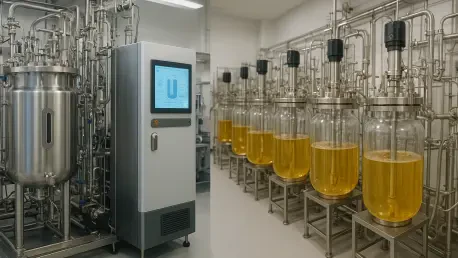
Most industrial-grade reactors currently use Distributed Control Systems (DCS) governed by Proportional-Integral-Derivative (PID) controllers. These systems are excellent at maintaining a steady state in simple mechanical processes, but they often struggle with the chaotic, non-linear nature of biology. The AI-enhanced approach replaces or supplements these rigid controllers with a Reinforcement Learning agent. This agent is trained within a Digital Twin environment, where it can simulate thousands of different production scenarios in a matter of seconds. By using historical data provided by Novonesis, the RL agent learns how to anticipate disruptions rather than simply reacting to them after the fact.
The difference in operational performance is stark when the system faces an unexpected “upset,” such as a pump failure or a sudden temperature spike. While a traditional PID controller might oscillate wildly while trying to correct the error, the AI model processes thousands of variables simultaneously to find the most efficient path back to optimization. This proactive control strategy allows the system to outperform traditional controllers by anticipating the ripple effects of a single change across the entire bioreactor. Consequently, the reliance on rigid, predefined rules is fading in favor of dynamic, adaptive intelligence.
Operational Consistency and the Codification of Expertise
One of the most persistent challenges in biomanufacturing is the reliance on “tribal knowledge.” This refers to the intuition held by veteran operators who, through years of experience, have learned the specific “moods” of their microbial cultures. When a problem arises, these experts are often the only ones who can save a batch. AI-enhanced bioprocessing changes this dynamic by codifying that human expertise into digital rules. Through reinforcement learning, the system creates a consistent operational baseline that reflects the best possible decision-making processes 100% of the time, regardless of which shift is currently on duty.
This democratization of expertise ensures that the high performance of a veteran operator is baked into the software itself. By eliminating the variability inherent in human judgment, companies can maintain a uniform level of quality across different facilities and global locations. Moreover, this digital codification allows for the rapid training of new staff, as the AI handles the complex, non-linear adjustments while the humans focus on higher-level strategy. This fundamental shift ensures that institutional knowledge is preserved and improved upon continuously rather than being lost when an experienced employee retires.
Challenges and Limitations in Modern Bioprocessing
Despite the clear benefits of AI integration, the transition is not without significant technical and financial hurdles. The development of a functional Digital Twin requires a massive influx of high-quality historical data, which can be difficult to obtain for new startups or niche biological products. Furthermore, there is often a discrepancy between the virtual world of simulation and the messy reality of physical validation. Discrepancies between in silico models and real-world bioreactor arrays can lead to unforeseen errors when the AI is first deployed, requiring a careful and often expensive calibration period.
The “cost of entry” remains another significant barrier for many organizations. Industrial-grade reactors are notoriously expensive, often costing hundreds of thousands of dollars, which limits experimental AI testing to the largest corporations. While the BREAKs initiative has introduced $300 “bare bones” reactors to lower these barriers for educational settings, scaling these low-cost solutions to meet rigorous industrial standards is a complex engineering task. Organizations must also navigate the trade-offs between using flexible, open-source AI software and the more proprietary, but often more stable, traditional control platforms that have dominated the market for decades.
Strategic Recommendations for Biomanufacturing Adoption
The decision to stick with traditional methods or pivot to AI-enhanced processing should be guided by the specific goals of the production facility. For high-volume, established processes where the biological path is simple and well-understood, traditional biomanufacturing with PID controllers may still be the most cost-effective solution. These systems are reliable and require less specialized labor to maintain. However, for organizations involved in complex enzyme production or research and development, the AI-enhanced framework developed by the ISU-Novonesis-BioMADE partnership is clearly the superior choice for maximizing efficiency and shortening the time-to-market.
For entities focused on workforce development, the Bioreactor Educational Activity Kits (BREAKs) are recommended as an essential tool. These low-cost kits allow students to learn the interplay between hardware and AI without the financial risks of using industrial equipment. On a larger scale, companies seeking to remain competitive in 2026 and beyond should prioritize the development of Digital Twins. This allows for safe, high-speed testing of manufacturing scenarios that would be too dangerous to attempt in a physical plant. Ultimately, the shift toward autonomous, AI-driven reactors represented a movement toward a more sustainable and predictable bio-industrial future.
The collaboration between Iowa State University, Novonesis, and BioMADE successfully proved that the integration of reinforcement learning and digital twin technology offered a more resilient alternative to traditional manufacturing. By moving from reactive environments to proactive, product-focused monitoring, the project demonstrated significant improvements in operational consistency. These findings encouraged the industry to move away from relying solely on human intuition and environmental proxies. As organizations scaled these technologies, the focus transitioned toward creating fully autonomous systems that could sustain peak performance with minimal intervention. This evolution highlighted the necessity of investing in both advanced data infrastructure and low-cost educational tools to support a modern bio-economy.