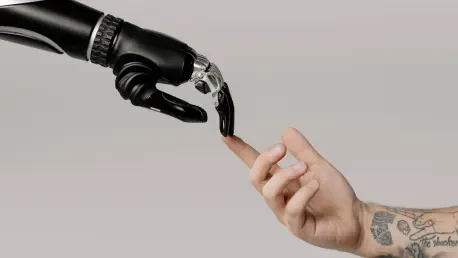

Humanoid robots require upwards of thirty individual sensors distributed throughout their frame, placing immense pressure on manufacturers to miniaturize core components. This technological demand highlights a major divide in the current industrial landscape, where roughly 40% of manufacturing tasks are automated while the remaining 60% still rely on human workers. The bottleneck is not a lack of visual capability or mechanical force, but rather the absence of tactile intuition. Machines have historically struggled to interpret the subtle feedback required to handle irregular objects like sponges or thin plastic bags. Aidin Robotics, a specialized spinoff from the robotics engineering laboratory at Sungkyunkwan University, is now addressing this gap. By focusing on advanced force and tactile sensing, the company aims to provide robots with the delicate touch necessary to navigate unstructured environments. This shift is vital for tapping into the vast portion of the global manufacturing market that has resisted automation due to the complexity of human-like interaction.
Disrupting Traditional Markets with Capacitive Sensing
Traditional robotic sensors usually rely on the strain gauge method, which detects changes in electrical resistance when a material is subjected to physical force. Although this approach is common, it often leads to bulky designs that require complex manufacturing processes and expensive external amplifiers to function correctly. This complexity has historically kept the price of high-quality sensors out of reach for many smaller-scale operations. Aidin Robotics has pivoted away from this standard by refining capacitive sensing technology, which measures the minute variations in electrical charges between internal electrodes. This method allows for far greater precision and sensitivity while reducing the overall physical footprint of the hardware. By simplifying the sensor architecture, the company has managed to remove the need for additional signal processing equipment, which contributes to both a more streamlined integration process and a significantly lower total cost of ownership for robot manufacturers.
A central breakthrough in this sensing methodology is the development of a proprietary vertical electrode design that utilizes the fringe effect. Conventional capacitive sensors place electrodes in a parallel arrangement, but Aidin’s vertical orientation allows the electric field to spread at the edges, enabling the sensor to detect more than just direct downward pressure. This innovation ensures that the robot can accurately measure shear forces, or sideways pushing, which is essential for tasks like turning a doorknob or smoothing out a material. The resulting hardware is ten times more sensitive than traditional strain gauge alternatives, allowing for an unprecedented level of control during delicate operations. Furthermore, this design transition has allowed the company to lower the market price of force-torque sensors from nearly ten million won to roughly one million won. This reduction in cost is a game-changer for the mass adoption of humanoid robots, as it makes advanced tactile intelligence commercially viable for the first time.
Advancing the Humanoid Hand through Tactile Ecosystems
Aidin Robotics is expanding beyond the production of individual components to create a comprehensive ecosystem of tactile technology, exemplified by the Aidin Hand Gen2. This robotic hand features sophisticated sensors integrated across its entire surface rather than just the fingertips, mimicking the widespread sense of touch found in human anatomy. This development is crucial for complex manipulation tasks, such as twisting heavy components or performing delicate grasping maneuvers that require real-time adjustments. By internalizing the control functions that previously required an external computer, the Gen2 model offers a more compact and efficient solution for humanoid platforms. The addition of a greater degree of freedom in the thumb further enhances its dexterity, allowing it to grip tools and objects with a level of precision that was once thought impossible for a machine. This integration of sensing and processing within the hand itself represents a significant step toward autonomous robotic labor.
Looking beyond the current hardware, the company is already laying the groundwork for a Gen3 model that aims to integrate visual data with tactile feedback. This approach seeks to create a multi-modal “brain” for robotic limbs, allowing them to cross-reference what they see with what they feel. By combining these two streams of information, a robot can better understand the physical properties of an object, such as its weight, friction, and fragility, before even making full contact. This multi-modal integration is expected to drastically reduce errors in automated picking and assembly lines. The future roadmap also emphasizes further miniaturization to ensure that these advanced hands can fit into the same physical spaces as human hands without sacrificing power or sensitivity. By perfecting this synergy between sight and touch, Aidin is positioning its technology as the standard interface for humanoid robots tasked with navigating the complexities of the real world alongside human workers.
Achieving Scale through Miniaturization and Specialized Circuitry
For humanoid robots to be truly effective in diverse environments, they must be equipped with dozens of sensors across their frames without becoming overly cumbersome or prohibitively expensive. Aidin has successfully miniaturized its six-axis force-torque sensors from a 15-millimeter diameter down to just 10 millimeters, bringing the dimensions closer to those of human joints. This miniaturization is a critical milestone, as it allows for the placement of high-precision sensors in tight spaces like finger joints and wrists. As robots become more agile and human-like in their movements, the need for lightweight, compact sensing hardware becomes a primary engineering constraint. Aidin’s ability to shrink these components while maintaining high sensitivity ensures that manufacturers do not have to choose between performance and physical design. This progress is fundamental to the creation of nimble humanoid robots that can operate in standard domestic and industrial settings.
To drive further efficiency, the company is developing a dedicated system-on-chip (SoC) in close collaboration with semiconductor specialists. Unlike general-purpose chips that are designed for a broad range of applications, this proprietary silicon is optimized specifically for the high-precision requirements of tactile sensors. By tailoring the chip to the exact measurement ranges needed for robotic touch, Aidin can simplify the surrounding circuitry and reduce the number of mechanical parts required for each sensor unit. This specialization is expected to cut production costs even further, potentially bringing the price of these vital components down to a fraction of their current market value. As mass production continues to scale through 2027 and 2028, these advancements will likely democratize access to high-end robotic technology. The transition to specialized chips not only improves performance but also hardens the system against electrical noise, ensuring consistent reliability in high-intensity industrial environments.
Implementing Comprehensive Solutions for Industrial Application
A significant evolution in the company’s business strategy occurred when it transitioned from being solely a component manufacturer to a provider of “process automation solutions.” This shift was prompted by the observation that many industrial clients struggled to integrate raw tactile data into their existing software frameworks. To bridge this gap, Aidin launched the AIRO-One system, which is specifically designed for high-precision tasks such as grinding and polishing metal, semiconductor equipment, and automotive parts. This solution uses a robotic arm that automatically regulates contact force based on real-time sensor feedback, ensuring a consistent finish regardless of surface irregularities. By providing the software and the hardware as a single package, the company has simplified the automation process for manufacturers who may lack deep expertise in force control. This integrated approach has created a lucrative new revenue stream that now matches the success of the company’s original component business.
In addition to surface finishing, Aidin is actively validating its logistics picking solutions in real-world environments, such as those operated by CJ Logistics. These systems focus on the critical aspect of gripping force, which is the ability of a robot to pick up a wide variety of items without dropping them or causing damage through excessive pressure. In a warehouse setting where objects range from heavy boxes to fragile electronics, the ability to “feel” the appropriate amount of force is essential for efficiency and safety. By applying its core force-control technology to the logistics sector, Aidin is demonstrating the versatility of its sensor-driven approach across multiple industries. The success of these pilot programs indicates a growing demand for robots that can adapt to changing tasks on the fly. This adaptability is the key to automating the final 60% of manufacturing and logistics labor, providing a clear path for the future of industrial robotics and autonomous systems.
Establishing a New Standard for Machine Interaction
The industry recognized that the path forward for humanoid robots required a complete transition from machines that merely observed to systems that could physically feel their surroundings. Aidin Robotics successfully demonstrated that high-sensitivity force control could be both miniaturized and affordable, setting a new benchmark for the entire sector. Companies were encouraged to integrate multi-modal sensing platforms that synchronized vision and touch to overcome the unpredictability of human environments. This evolution facilitated the adoption of robotic labor in delicate manufacturing and logistics roles that were once considered impossible to automate. Stakeholders prioritized the development of specialized hardware like dedicated system-on-chips to ensure the long-term scalability of these advanced tactile systems. By focusing on the nuances of contact and pressure, the robotics field established a foundation for more intuitive human-machine collaboration. Future developments focused on perfecting these interactions to create safer and more efficient workspaces.
Strategic investments from major players like HD Hyundai Robotics and Samsung Venture Investment accelerated the deployment of these technologies into heavy industries. These partnerships allowed for the creation of specialized robots capable of performing complex tasks, such as treating the hulls of massive ships, which required a high degree of adaptability to irregular surfaces. As production facilities expanded and automation within the manufacturing process reached 70%, the cost of these sensors dropped significantly, making them accessible to a wider range of developers. The move toward a public listing provided the necessary capital to triple output capacity, ensuring that the global demand for humanoid components was met with a reliable supply. This period marked a fundamental change in how robots were designed and implemented, shifting the focus toward mechanical empathy and physical intelligence. Ultimately, the integration of advanced tactile sensors proved to be the most critical step in enabling robots to work effectively alongside humans in any environment.