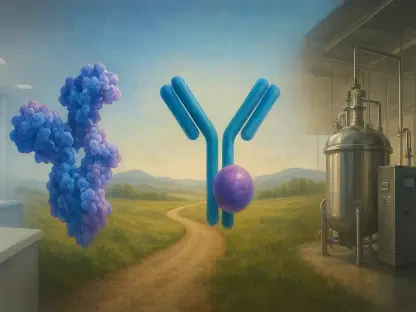

The pharmaceutical landscape is currently undergoing a fundamental and historic pivot where biologics in development officially outnumber traditional small-molecule drugs for the first time in medical history. This transition signifies a permanent move away from the chemically synthesized medications that have dominated the market for over a century and toward complex therapies derived from living organisms. Such a shift is not merely a change in product focus; it represents a comprehensive overhaul of the research, development, and manufacturing infrastructures that underpin global health systems in 2026. This evolution reflects the growing necessity to treat chronic and rare diseases with extreme precision, moving past the one-size-fits-all approach of traditional pharmacology.
The economic trajectory of these “living medicines” indicates a massive expansion of the industrial footprint required to sustain them. In 2026, the biologics manufacturing sector is valued at approximately $47 billion, yet projections suggest it will climb to over $140 billion by the early 2030s. This growth is fueled by an aggressive pursuit of advanced modalities, particularly antibody-drug conjugates and messenger RNA platforms, which have redefined expectations for therapeutic efficacy. As the industry recalibrates, the ripple effects are felt across the entire life sciences economy, moving from laboratory-scale experiments to massive, specialized industrial complexes.
The Great Pharma Pivot: Why Living Medicines Are Outpacing Chemical Synthesis
The move toward biological drugs represents a departure from predictable chemical synthesis to the cultivation of therapies within living systems. Traditional small-molecule drugs, such as aspirin or common antibiotics, are created through standardized chemical reactions that yield identical results every time. In contrast, biologics are produced using microorganisms, plant cells, or animal cells, making them inherently more complex and volatile. These molecules are often 1,000 times larger than their chemical predecessors, possessing intricate three-dimensional structures that determine their ability to interact with specific biological targets in the human body.
This complexity offers a therapeutic advantage that small molecules simply cannot match, especially in the realms of oncology and autoimmune disorders. Biologics act like guided missiles, seeking out specific proteins or receptors without damaging surrounding healthy tissue. However, this precision comes at the cost of manufacturing stability. Because they are grown rather than built, any minor change in the fermentation environment—such as a slight shift in temperature or pH—can alter the final product. This sensitivity requires a level of engineering sophistication that is currently reshaping the design of modern manufacturing facilities.
Beyond the molecular level, the shift is driven by the limits of what chemistry can achieve for complex diseases. Many modern ailments are the result of malfunctioning proteins or genetic errors that small-molecule chemicals are too blunt to address effectively. Living medicines provide the ability to replace missing enzymes, block specific inflammatory pathways, or even reprogram a patient’s own immune system. As researchers unlock more genomic data, the demand for these tailored biological solutions continues to rise, pushing the industry into an era where the factory is a biological organism rather than a steel vat of reagents.
Mapping the $140 Billion Shift Toward a Biologics-First Economy
The financial commitment required to sustain this transition is staggering, reflecting a compound annual growth rate that significantly outpaces the broader pharmaceutical market. From its current baseline in 2026, the market is expanding through a surge in biotechnology investments and a strategic focus on niche therapeutic areas. This surge is most evident in the rise of antibody-drug conjugates, which have seen a massive increase in development activity over the last twelve months. These “smart drugs” combine the targeting power of monoclonal antibodies with the cell-killing strength of chemotherapy, creating a high-demand sector that requires specialized, high-containment manufacturing facilities.
A significant portion of this economic shift is also driven by the trend of reshoring production to major domestic markets. Companies are increasingly moving manufacturing closer to their primary patient populations in the United States and Europe to secure supply chains against geopolitical instability. This localization has led to a boom in “tools- and services-intensive” investments, where the focus is not just on the drug itself but on the specialized laboratory equipment and high-purity raw materials needed to produce it. Large-scale life sciences hubs are expanding rapidly, turning former industrial zones into high-tech corridors dedicated to cellular and molecular production.
This biologics-first economy is also transforming the business models of the world’s largest pharmaceutical firms. Rather than relying on a few blockbuster chemical drugs with broad patents, companies are now managing diverse portfolios of biological assets that require continuous innovation. This shift necessitates a broader ecosystem of suppliers and service providers who can handle the nuances of viral vectors, mRNA, and cell therapies. The resulting economic environment is one where technical expertise and specialized infrastructure have become the most valuable currencies, dictating which regions and companies will lead the next decade of healthcare innovation.
Managing Fragility: The Intersection of Molecular Complexity, Cold Chains, and Strategic Outsourcing
The physical fragility of biologics has necessitated a total transformation of the global logistics and storage infrastructure. Unlike shelf-stable tablets, biological therapies are highly sensitive to environmental factors like light, vibration, and thermal fluctuations. This sensitivity has spurred the growth of “white-glove” cold chain services, where products are monitored in real-time through GPS and thermal sensors from the moment they leave the bioreactor. The demand for ultra-low temperature storage and specialized transport containers has created a secondary market focused entirely on preserving the integrity of these high-value medicines.
To manage the high capital expenditure associated with these complex production lines, pharmaceutical companies are increasingly relying on Contract Development and Manufacturing Organizations. These strategic partners provide the infrastructure and regulatory expertise that many smaller biotech firms lack. By outsourcing the manufacturing process, developers can remain focused on clinical research while leveraging the sophisticated technologies of the contractors, such as continuous bioprocessing and single-use systems. This collaborative model has become the standard for the industry, allowing for greater agility and risk mitigation in a high-stakes market.
The rise of single-use technologies has been a particularly influential development in managing the fragility and sterility of biologics. Rather than using permanent stainless steel tanks that require extensive cleaning and validation between batches, manufacturers are using disposable plastic bioreactors and tubing. This approach significantly reduces the risk of cross-contamination and accelerates the turnaround time between different product runs. As the industry moves toward more personalized medicine, the ability to rapidly switch production lines while maintaining absolute sterility has become a critical competitive advantage for both drug owners and their manufacturing partners.
Quantifying the Crisis: Talent Shortages and the CMC Bottleneck
Despite the influx of capital and technology, a profound human capital crisis threatens to slow the industry’s momentum. There is currently a 35% talent deficit in the biomanufacturing sector, with nearly 80% of manufacturers reporting a critical mismatch between available skills and technical requirements. The roles required to operate a biologics facility are highly specialized, demanding expertise in cell biology, fluid dynamics, and advanced automation. A general background in chemistry is no longer sufficient; the modern workforce must understand the intricacies of living systems and the digital interfaces used to monitor them.
This labor shortage directly contributes to the “CMC bottleneck,” referring to the Chemistry, Manufacturing, and Controls sections of regulatory filings. Approximately 64% of drug-launch delays are currently tied to CMC issues, where companies struggle to prove that they can manufacture a biologic consistently and safely at scale. When a company lacks the specialized staff to oversee these complex processes, the likelihood of regulatory rejection increases, leading to multi-million-dollar setbacks and delays in patient access. The gap between discovery and delivery is widening, not because of a lack of ideas, but because of a lack of hands to build them.
The impact of this shortage is especially acute in emerging fields like gene therapy and mRNA production, where the science is moving faster than the educational curriculum. Companies are finding that they must invest heavily in internal training programs to upskill their existing employees, essentially acting as vocational schools to fill the void. While general biomanufacturing employment has reached historic highs due to reshoring efforts, the demand for top-tier technical experts remains unmet. This talent war has driven up operational costs, making the retention of specialized staff a primary strategic concern for pharmaceutical executives.
Scaling with Intelligence: Integrating AI, Robotics, and Digital Twins into the Production Line
To overcome the challenges of complexity and labor shortages, the industry is aggressively integrating intelligent technologies into the production line. Artificial intelligence and advanced analytics are being used to monitor bioreactor conditions in real-time, allowing systems to make autonomous adjustments to optimize yields. These “smart factories” reduce the reliance on manual intervention and minimize the risk of human error, which is the leading cause of batch failure. By transforming manufacturing into a data-driven enterprise, companies can achieve levels of consistency that were previously impossible with biological processes.
Digital twins—virtual replicas of physical manufacturing systems—have become a cornerstone of modern bioprocessing. These simulations allow engineers to test different production scenarios and predict potential failures before they occur in the real world. By running thousands of virtual batches, manufacturers can identify the optimal parameters for a specific cell line, significantly shortening the time required for scale-up. This proactive approach to process development helps mitigate the CMC bottleneck by providing regulators with robust data on how the manufacturing process responds to various environmental stresses.
The integration of robotics and automation is also redefining the final stages of drug production, particularly in the fill-finish process. Robotic arms operating in isolated, sterile environments can handle vials and syringes with a precision and speed that exceeds human capability. This automation not only improves sterility but also allows for smaller, more flexible batch sizes, which is essential for the growing field of personalized medicine. As these technologies mature, the goal is to create a fully autonomous manufacturing loop where the journey from cellular master bank to finished vial is managed by an integrated digital architecture.
Decision-makers successfully repositioned the manufacturing infrastructure to accommodate these living medicines. They expanded domestic capacity and forged deeper alliances with specialized contractors to mitigate logistical risks. These collective actions established a more robust framework for therapeutic delivery, ultimately transforming the operational standards of global medicine. By prioritizing long-term workforce development and localized manufacturing hubs, the industry solidified its foundation for a new era of healthcare. The transition marked a definitive shift toward a more resilient and patient-centric ecosystem where complex biological therapies were no longer the exception, but the standard of care.