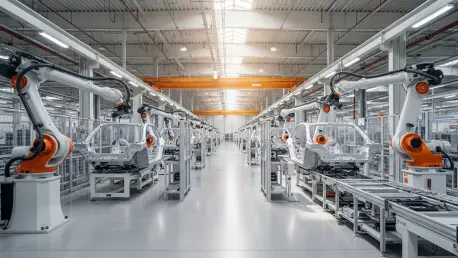

The global industrial landscape has witnessed a seismic shift as China officially moves past Germany to secure its position as the world’s second-largest exporter of sophisticated robotics. By late 2025, the nation’s robotics exports reached a historic valuation of over $8 billion, representing a significant portion of the international market and leaving only Japan ahead in the global rankings. This achievement highlights a decade-long metamorphosis where the country transitioned from being the primary consumer of foreign automation to a dominant supplier capable of meeting global demand. Driven by necessity and strategic foresight, the Chinese robotics sector has effectively addressed domestic labor shortages while simultaneously modernizing its manufacturing capabilities. This surge is not merely a matter of volume but a reflection of deep-seated structural changes within the Asian economic powerhouse that have allowed it to compete with long-standing European leaders. As of 2026, the global market is increasingly defined by this new reality of high-quality, cost-effective machinery that is reshaping how factories operate.
Strategic Drivers: Leveraging Scale and Expansion
Market Foundations: Technical Refinement through Scale
The foundation of this remarkable export surge lies in the massive domestic market of China, which has functioned as a critical testing ground for the latest automation hardware and software. Since the start of 2026, the country has continued to install industrial robots at a rate that exceeds the rest of the global total combined, maintaining an operational stock of several million units across diverse industries. This immense internal volume provides a unique environment where manufacturers can iterate on designs with unprecedented speed, refining product quality through constant real-world application. Consequently, Chinese robotics firms have successfully moved beyond basic machinery into the production of highly complex systems that are now suitable for heavy manufacturing and specialized services. The ability to test these systems at scale before they ever reach an international buyer has instilled a high level of confidence in global customers who once viewed these products as secondary options in the competitive landscape of industrial automation.
Beyond just physical hardware, the scale of domestic adoption has facilitated a rapid evolution in software integration and artificial intelligence applications within the robotics sector. Because the local manufacturing base is so vast, Chinese developers have access to enormous datasets that allow for the training of more efficient algorithms for path planning and object recognition. This data-driven advantage is translating into robots that are increasingly intuitive and easier to deploy in complex environments, such as semiconductor cleanrooms or automotive assembly lines. The domestic market acts as a massive incubator, where the most resilient and efficient designs survive and are eventually packaged for the international stage. As these refined technologies move across borders, they carry with them the reliability of years of high-intensity use in the world’s busiest factories. This refinement process has essentially narrowed the gap between established legacy brands and emerging Chinese competitors in a very short timeframe, creating a new standard for performance.
International Reach: Expansion and Future Resilience
China’s export growth is intricately linked to the international expansion of its primary manufacturing sectors, particularly those involved in electric vehicles and renewable energy. By 2026, a substantial portion of all Chinese robot exports is flowing toward ASEAN countries, where new industrial zones are rapidly adopting automated solutions to stay competitive. These regions are seeing a massive influx of capital from Chinese battery and vehicle manufacturers who prefer to use familiar automation tools in their overseas facilities. This strategy of following domestic clients into new territories has secured a firm foothold for robotics companies in emerging hubs across Southeast Asia and the Middle East. India has also emerged as a vital destination, absorbing a significant percentage of annual sales as its own manufacturing sector undergoes a period of rapid modernization. This investment-led model ensures that hardware sales are accompanied by established service networks and long-term support contracts that foster lasting partnerships.
The industry successfully navigated the transition toward technological sovereignty by developing high-precision internal components that reduced the reliance on foreign supply chains. This maturity allowed manufacturers to compete on technical excellence, rebranding their machines as premium solutions for complex global tasks. To address geopolitical barriers, organizations prioritized the implementation of transparent cybersecurity protocols and engaged with international standards bodies to harmonize safety requirements. Strategic diversification of manufacturing sites became a central practice for mitigating the impact of trade restrictions and ensuring supply chain resilience across various regions. Future innovation in the sector relied on the continued collaboration between global players on foundational technologies like edge computing and sensor fusion. These actions provided a stable framework for the growth of automated systems, ensuring that the benefits of high-speed production remained accessible to the international manufacturing community.