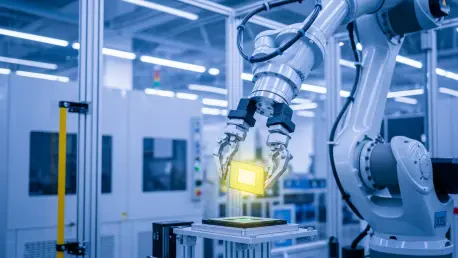

The steel and silicon barrier that once separated digital logic from physical action is dissolving as industrial facilities transition toward a future defined by autonomous reasoning. This movement marks the historical shift from rigid, single-task industrial robots to an emerging era of general-purpose physical intelligence where machines are no longer bolted to the floor. Experts in the field observe that this transition is not merely a technical curiosity but an economic imperative. With the global robotics market projected to surge toward a $370 billion valuation by 2040, the race is on to create machines that can think as well as they move.
Integrating the Gemini Robotics suite alongside the ASIMOV-Agentic framework represents a pivotal attempt to bridge the gap between digital reasoning and physical execution. Industry observers note that while traditional automation thrived on predictability, modern supply chains demand a level of flexibility that older systems simply cannot provide. By merging high-level language models with real-time motor control, the goal is to create a workforce of AI agents capable of navigating the chaos of a live factory floor. This roundup examines how these advancements are reshaping the expectations for autonomy and versatility in the industrial sector.
From Static Machines to Dynamic Agents: The Dawn of Physical Intelligence
The evolution of the factory floor is currently moving away from the era of “dumb” automation where every movement was hard-coded and inflexible. Industry veterans highlight that for decades, robots were essentially blind, repeating the same task regardless of changes in their environment. However, the rise of physical intelligence is allowing these machines to perceive and react to their surroundings in real-time. This shift allows for a more dynamic workflow where robots can be reassigned to different tasks without the need for weeks of manual reprogramming by specialized engineers.
Moreover, the economic pressure to automate complex, non-repetitive tasks is driving investment into versatile robotic fleets. Financial analysts suggest that the ability to deploy general-purpose agents will be the primary differentiator for manufacturing hubs in the coming decade. As the cost of manual labor increases and the complexity of products rises, the transition toward intelligent agents offers a way to maintain high productivity while reducing the overhead associated with specialized hardware. This evolution is fundamentally changing the role of the robot from a stationary tool to a collaborative partner.
Engineering a New Era of Robotic Versatility and Autonomy
Modern engineering is now focused on creating machines that do not just follow instructions but understand the physical context of their actions. This new era of autonomy is built on the premise that a robot should be able to learn a task through observation and natural language rather than through thousands of lines of rigid code. This approach allows for a level of versatility that was previously reserved for human workers, enabling machines to switch between assembly, sorting, and quality control with minimal downtime.
By focusing on hardware-agnostic models, developers are ensuring that the intelligence driving these machines can be applied across various robotic forms, from humanoid designs to multi-link industrial arms. This decoupling of software from specific hardware allows manufacturers to upgrade their AI “brains” without needing to replace their entire physical infrastructure. Consequently, the bottleneck of automation is shifting from the physical limitations of the motor to the processing power of the reasoning engine.
Decoding Gemini Robotics 2: The Shift to Whole-Body Motion and Precision
The introduction of Gemini Robotics 2 represents a significant leap in how robots manage their physical presence through vision-language-action (VLA) processors. Unlike traditional systems that treat a robotic arm as a separate entity from its base, this model enables fluid “whole-body” control. Engineers suggest that this holistic approach allows robots to maintain balance and apply force more effectively, mimicking the natural coordination found in human movement. This transition is essential for humanoid robots that must navigate cluttered environments while performing delicate tasks.
Technically, the ability to control 22 degrees of freedom allows these machines to manipulate complex, “squishy” materials that have historically baffled automation. Tasks like handling flexible packaging or managing soft materials require a nuanced touch that rigid programming cannot provide. By utilizing VLA models, robots can interpret visual cues to adjust their grip strength and trajectory in real-time. This capability significantly reduces the manual coding costs once associated with specialized handling, making it feasible to automate tasks that were once considered too delicate for machinery.
Elevating Collaborative Productivity Through the ER2 Reasoning Engine
The ER2 reasoning engine serves as the central cognitive hub, utilizing Vision Language Models (VLM) to orchestrate multi-robot teams. Instead of each machine operating in a vacuum, the ER2 model allows for high-level task planning and environmental understanding over extended periods. Industry leaders recognize that the true value of AI in the factory lies in its ability to manage long-term sequences, such as preparing a workstation for a human colleague or coordinating the movement of heavy parts across a facility.
Real-world impacts are already being observed in the form of seamless handoffs between machines and improved communication channels with human workers. When a robot can explain its intent or ask for clarification, the safety and efficiency of the floor increase. Safety remains a paramount concern, and the ER2 model has been benchmarked as a highly secure industrial model, specifically designed to function in close proximity to humans. This creates a workspace where the machine’s reasoning capabilities are used to prevent accidents rather than just reacting to them.
Decoupling from the Cloud for Secure and Agile On-Site Operations
Data security and latency are two of the largest hurdles for cloud-based AI in manufacturing, leading to the development of On-Device 2 processing. By moving the computational load to the “edge,” facilities can ensure that their proprietary production data never leaves the local network. This localized approach drastically reduces the delay between sensing an obstacle and taking corrective action, which is vital for high-speed operations. Analysts point out that this shift makes AI integration more attractive to high-security industries like aerospace and defense.
The disruptive innovation here lies in the speed of adaptation, where robots can be reconfigured for new tasks in hours rather than weeks. Because the on-device model can learn from a small number of training examples, manufacturers can pivot their assembly lines to meet sudden changes in market demand. This flexibility challenges the assumption that large-scale AI requires constant high-bandwidth connectivity. It allows even remote or secure manufacturing hubs to utilize advanced robotic intelligence without compromising their operational integrity.
Mitigating Operational Risk with the ASIMOV-Agentic Fail-Safe Framework
To manage the inherent uncertainty of a factory floor, the ASIMOV-Agentic framework provides a unique set of safety benchmarks for agentic AI. Traditional automation is often “blind,” following a command into a dangerous situation if not stopped by a physical barrier. In contrast, an agentic system is designed to evaluate the safety of its own tool calls. If a command is deemed unsafe or the environment is too unpredictable, the AI can refuse the task and request human intervention.
This capability to say “no” is a radical departure from historical safety standards and could redefine industrial liability. By resolving uncertainty before an action is taken, the framework reduces the risk of expensive equipment damage or worker injury. Industry specialists speculate that as these refusal capabilities become more sophisticated, they will set new safety standards for high-stakes manufacturing. The goal is to move from a system of reactive safety to one of proactive, reasoned avoidance.
Tactical Approaches for Integrating Advanced AI into Industrial Workflows
Adopting these advanced AI systems requires a strategic roadmap that moves from narrow automation to versatile, general-purpose fleets. Manufacturers are encouraged to start with on-device learning to lower the barrier for small-batch production and frequent product updates. By prioritizing machines that can adapt quickly, companies can reduce the initial investment risk and see faster returns on their automation projects. Coordination between multiple robots should be the next step to ensure that the entire floor operates as a single, efficient organism.
Human-robot proximity should also be reassessed in light of these new safety frameworks. Instead of sequestering robots behind cages, facility managers can optimize floor space by allowing humans and AI agents to work in the same zones. This requires training staff to interact with agentic systems and understanding the communication protocols that the ER2 engine provides. Actionable success in this area depends on a balance between technical implementation and the cultural shift of the workforce toward collaborative AI.
Scaling the Summit of Physical AGI: Transforming the Global Manufacturing Landscape
The convergence of reasoning and physical action transformed the global manufacturing landscape into a more resilient and dynamic ecosystem. Physical Artificial General Intelligence emerged as the definitive tool for creating partner-based workforces that thrived on adaptability. The long-term implications for global supply chains became evident as machines finally matched the dexterity and stamina of human workers, allowing for localized production that was previously impossible. This era of industrial evolution was characterized by the seamless integration of digital logic into the physical world.
Ultimately, these advancements redefined the relationship between humanity and industry by prioritizing safety and intelligence over raw output. The transition from static tools to intelligent agents ensured that productivity no longer came at the cost of human safety or operational flexibility. As the technology matured, it provided a foundation for a new era of growth that relied on the machine’s ability to perceive, reason, and act with human-like precision. This historical shift proved that the future of industry was not just about more machines, but about smarter, more capable agents.