
The perpetual hum of a modern industrial facility often masks a silent crisis where operators are buried under a relentless deluge of nearly ten thousand daily alerts. This state of constant alarm fatigue does more than just exhaust the workforce; it creates a dangerous environment where critical failures can easily hide behind thousands of routine notifications. Honeywell has stepped into this breach with Forge Cognition, a platform that represents a decisive pivot from traditional monitoring to a sophisticated model of industrial autonomy. By integrating agentic artificial intelligence and high-fidelity simulation, the system aims to turn every facility into a self-aware entity capable of managing its own operational health.
This transition moves beyond simple automation, addressing the data overload that has plagued facility managers for decades and setting a new standard for how large-scale infrastructure functions. The current shift from reactive monitoring to proactive, autonomous facility management is essential for survival in a complex global market. As facilities become more intricate, the human capacity to process sensor data in real-time has reached its limit, necessitating a layer of machine intelligence that can reason and prioritize tasks independently. Consequently, the release of this technology marks a pivotal moment in the evolution of industrial intelligence.
Foundation and Strategic Collaboration: The Triple Partnership
This technological leap was not achieved in isolation but through a high-stakes collaboration involving Honeywell, NVIDIA, and Dell Technologies. Each partner brought a distinct pillar of expertise to the table, creating a unified architecture that bridges the gap between software reasoning and physical execution. Honeywell contributed decades of domain experience in industrial sensors and automation, providing the foundational domain knowledge required for the platform to understand physical systems. This expertise ensures that the AI agents are grounded in the realities of mechanical engineering and sensor integration rather than abstract data patterns.
NVIDIA supplied the computational brainpower for the project, utilizing its Nemotron models for advanced reasoning and its Omniverse platform to create digital twins that mirror reality with uncanny precision. These tools allow the platform to visualize and analyze vision-based sensor data with the same level of nuance as a human inspector. Meanwhile, Dell Technologies provided the heavy-lifting infrastructure via the Dell AI Factory, deploying PowerEdge XE servers to handle the massive data processing requirements at the edge of operations. This combined ecosystem allows for seamless integration between the cloud and the factory floor, ensuring low-latency decision-making in critical moments.
Key Features and Milestone Achievements in Industrial Intelligence
Exploring the distinctive attributes that power Forge Cognition’s performance reveals a system designed for high-stakes environments where precision is non-negotiable. The platform does not simply collect data; it transforms it into actionable intelligence through a series of specialized agents. These agents are programmed to understand the specific nuances of industrial hardware, allowing them to provide recommendations that align with long-term asset health and immediate production goals. By focusing on the intersection of reasoning and execution, the technology sets itself apart from standard diagnostic tools.
The True Alarm Agent
The True Alarm agent functions as a sophisticated digital gatekeeper for facility managers by utilizing artificial intelligence to distinguish genuine emergencies from routine operational noise. Traditional systems often operate on rigid logic, triggering an alarm every time a temperature or pressure reading crosses a pre-set threshold regardless of the context. In contrast, this agent uses advanced reasoning to evaluate whether a spike is a harmless anomaly or a precursor to a total system failure. By understanding the intent behind the data, the system filters out the static, ensuring that when an operator’s attention is requested, it is for a matter of genuine importance.
Success at the Voyager Pilot
The practical validity of this reasoning-based approach was demonstrated during a pilot program at NVIDIA’s Voyager headquarters in California. The results were immediate and transformative, as the platform successfully slashed nuisance alerts by a staggering 90 percent during the evaluation phase. Such a reduction does not just improve the work environment; it fundamentally reclaims thousands of hours for maintenance teams who were previously occupied with chasing ghosts in the system. The success of the Voyager installation proved that when AI handles the mundane task of data filtering, human operators are free to engage in high-value strategic planning.
Advanced Digital Twin Simulations
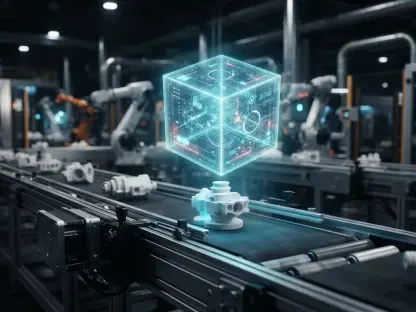
Beyond simple alarm management, the platform utilizes high-fidelity digital twin simulations to revolutionize how operational changes are implemented through a test-before-task methodology. This approach allows managers to run complex what-if scenarios in a virtual environment before a single wrench is turned or a software patch is deployed. Whether it is reconfiguring a cooling system or altering a production line flow, these virtual replicas minimize the physical risk of downtime by predicting exactly how the system will react. This creates a safety net for innovation, allowing facilities to push the boundaries of efficiency without the fear of unintended physical consequences.
Energy Optimization and Environmental Control
Efficiency gains also extended into the realm of utility management and environmental control during initial testing phases across diverse climates. The platform identified specific optimization paths that resulted in a ten percent reduction in energy consumption without sacrificing occupant comfort. By balancing temperature, humidity, and air quality across disparate zones, the system maintained comfort scores consistently above 95 percent. This ability to micro-manage resources in real-time proves that environmental sustainability and operational excellence can coexist when guided by precise, data-driven intelligence.
Competitive Edge: What Sets Forge Cognition Apart
What truly distinguishes Forge Cognition from its competitors is the move toward adaptable, reasoning Agentic AI that can handle unpredictable variables. While many industrial tools rely on rigid if-then scripts that break when faced with unexpected environmental changes, this platform adapts its strategy based on learned context. It incorporates Physical AI, which acts as the connective tissue between digital decision-making and hardware performance. This adaptability makes the technology scalable across diverse environments, from the intricate climate needs of luxury hospitality to the heavy-duty manufacturing requirements of global production plants.
Current Deployment and Global Implementation
Current global implementations are already showing the versatility of the system in high-stakes environments ranging from Vanderbilt University to the NEX Mall in Singapore. At the Fairmont Hotel Dubai, the platform is being used to streamline complex building operations and monitor energy usage in one of the most demanding climates on earth. There is an ongoing effort to transition these capabilities from general building management directly onto the factory floor, where the stakes of equipment failure are even higher. By monitoring equipment fatigue and asset health with granular detail, Honeywell is positioning itself to manage the entire lifecycle of industrial infrastructure.
Reflection and Broader Impacts
The move toward industrial autonomy raises important questions about the role of human oversight in an increasingly automated world. While the technology is capable of making split-second decisions, maintaining a human-in-the-loop philosophy remains central to ensuring trust and accountability in critical systems.
Reflection
Evaluating the strengths of autonomous oversight requires a careful balance between machine speed and human intuition. While the system can process thousands of data points simultaneously, establish trust requires consistent performance over long periods. The challenge lies in ensuring that human operators remain the ultimate decision-makers, particularly in scenarios that fall outside of historical data patterns. As these systems become more prevalent, the definition of oversight will likely evolve from manual checking to high-level strategic management.
Broader Impact
This paradigm shift is poised to influence the global workforce by changing the very nature of industrial labor toward more technical, analytical roles. As AI takes over the cognitive load of monitoring and diagnosis, the demand for traditional manual troubleshooting will likely give way to a need for systems orchestrators. This evolution suggests that the future factory will not be empty of people, but rather populated by workers who spend their time optimizing systems rather than simply repairing them. The ripple effects of this change will be felt across every sector of the global economy as infrastructure becomes more resilient.
Conclusion: Redefining the Future of Infrastructure Management
The launch of Forge Cognition provided a definitive answer to the persistent challenges of operational inefficiency and data saturation. It addressed the core issues of workforce burnout and resource waste by empowering facilities to think and act for themselves in real-time. As organizations moved toward these self-optimizing sites, the reliance on reactive maintenance models began to fade, replaced by a new standard of reliability. Future considerations suggested that the integration of this technology into broader city-wide grids would eventually lead to entirely autonomous urban ecosystems. Stakeholders who embraced this transition found themselves at the forefront of a more resilient industrial landscape, leaving behind the era of the nuisance alarm forever. Moving forward, the focus was shifted toward the development of cross-industry standards for AI reliability and the expansion of these autonomous capabilities into hazardous environments.