
The manufacturing landscape is currently undergoing a profound transformation as the industry moves away from the persistent fear that artificial intelligence will eventually replace the human workforce. Instead, a more pragmatic perspective has emerged that views advanced computing as a powerful partner designed to augment the unique capabilities of experienced planning professionals. By focusing on human empowerment rather than total replacement, organizations are finding innovative ways to leverage agentic AI to navigate the overwhelming complexity of modern supply chains while keeping skilled experts in control of the final decision-making process. This shift represents a departure from traditional automation strategies, which often struggled to account for the unpredictable variables inherent in factory floor operations. Today, the priority is to provide planners with tools that handle the data-heavy aspects of logistics while allowing them to apply strategic judgment to situations that software cannot fully comprehend.
Shifting the Paradigm: From Basic Automation to Intelligent Agency
Manufacturers today are working through a critical transition period where they must distinguish between marketing hype and functional capabilities that deliver measurable value on the shop floor. Although the excitement surrounding artificial intelligence is widespread, a significant portion of logistics professionals still rely on legacy systems for daily operations while carefully testing the waters of autonomous technology. The real challenge involves moving beyond simple, rule-based automation to find flexible tools that can handle dynamic tasks such as intelligent routing and rapid replanning when unexpected disruptions occur. Effective implementation requires a shift in mindset, where technology is seen not as a standalone solution but as a support structure for human intelligence. By prioritizing functional utility over theoretical potential, businesses are beginning to identify specific use cases where AI can mitigate risk without introducing unnecessary complexity to the existing workflow.
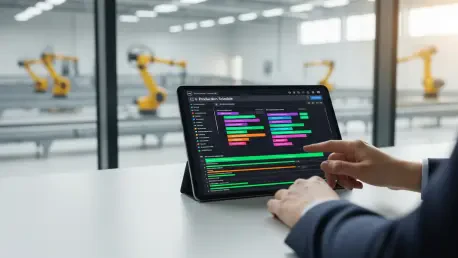
Agentic AI stands apart from traditional automation because it functions more like a digital co-worker capable of independent action within defined boundaries rather than a static piece of pre-programmed software. These systems can take multiple sequential steps to solve a problem while remaining under the constant supervision of a human operator, which helps planners manage the relentless fluctuations in machine capacity and personnel availability. This setup fundamentally transforms the role of the scheduler from someone who manually reacts to incoming data streams into an empowered decision-maker who uses AI to navigate complex, interconnected variables. Instead of spending hours reconciling spreadsheets, planners use these agentic systems to run simulations and evaluate various scenarios in real time. This collaborative approach ensures that the production schedule remains resilient even when facing material shortages or sudden changes in customer demand.
Overcoming Technical Barriers: Simplifying Interaction and Decision Support
One of the most significant obstacles to the adoption of advanced planning software has been the “parameter plague,” where systems are so technically dense they require a data science background to operate effectively. Agentic AI addresses this issue by incorporating natural language interfaces, which allow planners to interact with complex algorithms using plain English rather than adjusting hundreds of obscure technical settings. This evolution makes powerful optimization tools accessible to a wider range of staff members, enabling them to focus on high-level problem-solving instead of struggling with difficult software configurations. When a planner can simply ask a system to “optimize for low energy consumption while maintaining current delivery dates,” the technology becomes a facilitator of expertise rather than a barrier. This democratization of data ensures that the deep institutional knowledge of veteran employees is combined with the processing power of modern computing to drive better results.
Beyond just simplifying the interface, agentic AI provides a level of continuous monitoring that is impossible for human teams to maintain across twenty-four-hour production cycles. When a disruption is detected, such as a machine failure or a delayed shipment, the system does not merely send a generic alert but instead suggests a specific, actionable solution accompanied by an explanation of its reasoning. This transparency is vital for building trust between the human planner and the digital assistant, as it allows the expert to verify the logic behind the recommendation before implementation. The AI handles the exhausting grunt work of processing vast datasets and building the initial schedule frameworks, which saves an immense amount of time and mental energy during a typical shift. By automating the most tedious aspects of the planning process, the technology frees up personnel to focus on the qualitative aspects of production that require emotional intelligence and nuanced negotiation.
Strategic Implementation: Navigating the Human-Machine Collaboration
As artificial intelligence assumes responsibility for the heavy lifting of schedule creation and data reconciliation, the human planner’s job description is shifting toward high-level analysis and strategic oversight. Professionals are now able to focus on the subtle details that a computer might overlook, such as the specific nuances of supplier relationships or the unique workplace dynamics present on the factory floor. This creates a flexible, sliding scale of autonomy where routine, low-risk tasks are handled autonomously by the AI, while high-stakes strategic decisions remain firmly in human hands. This division of labor ensures that the organization benefits from the speed and accuracy of machine learning without losing the critical context provided by human experience. By elevating the role of the planner to that of a strategic coordinator, companies are finding that they can achieve higher levels of efficiency while simultaneously improving employee satisfaction and retention.
The most successful manufacturers prioritized treating agentic AI as a direct extension of their existing workforce rather than a tool for downsizing. They implemented specific training programs that taught planners how to supervise autonomous agents and interpret the logic behind AI-driven recommendations. Instead of jumping directly into full-scale automation, these organizations started with targeted pilot programs that focused on solving one specific bottleneck before expanding the technology to broader applications. Leaders ensured that their data architecture was robust and that human feedback loops were integrated into every stage of the AI’s learning process. This grounded strategy allowed businesses to scale their operations efficiently while maximizing the unique insights of their human experts. Moving forward, the focus remained on fostering a culture of collaborative intelligence, where the integration of agentic systems served to enhance the resilience of the supply chain.