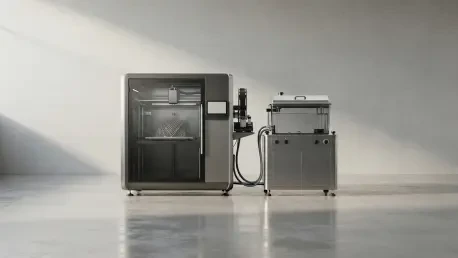

Automating the loading and unloading of detergents in the post-processing phase significantly reduces the manual variability that often hinders large-scale additive manufacturing. This objective is central to the ecosystem unveiled by Axtra3D at Formnext 2026, marking a significant transition from standalone hardware to a fully unified industrial workflow. By synchronizing the variables of vat polymerization with automated cleanup and curing cycles, the company has effectively bridged the gap between experimental prototyping and standardized factory production. This development reflects a broader industry trend where reliability and repeatability are valued as highly as raw print speed. Manufacturers are increasingly seeking integrated solutions that minimize human intervention, thereby reducing the risk of errors that lead to material waste. By focusing on a holistic path from design to the finished part, this strategy provides a predictable framework for companies looking to integrate 3D printing into their existing manufacturing chains.
Optimizing Production with Volume 1.3 Software
Foundations: The Axtra Workflow Solution
The introduction of Volume Professional 1.3 establishes a robust digital foundation for the Lumia X1 printer, focusing on the essential metrics of dimensional stability and automated model repair. This software layer is designed to manage the complexities of vat polymerization by using advanced slicing algorithms that optimize the build process from the first layer. By identifying potential structural issues within a digital model and applying corrective repairs automatically, the system prevents failures that would otherwise result in significant downtime. Furthermore, the refinement of support tree generation ensures that parts are sufficiently stabilized during the print cycle while remaining easy to remove during post-processing. This focus on reliability is crucial for industrial operators who require consistent quality across multiple machines and production shifts. By removing the guesswork from the build preparation phase, the software allows technicians to focus on higher-level production goals rather than troubleshooting basic errors.
Industrial Features: High Volume Manufacturing
For larger manufacturing operations, the Volume Industrial 1.3 variant brings advanced nesting capabilities and wireframe supports that maximize the utility of every build cycle. These tools allow for the dense arrangement of components within the resin vat, ensuring that printer utilization is maximized and the total cost-per-part is minimized through smarter spatial management. The addition of a specialized texturing module further enhances this utility, offering over 100 presets that allow for functional and aesthetic customization directly within the build preparation environment. This level of software-driven efficiency is necessary to make additive manufacturing economically competitive with traditional processes like injection molding. By providing immediate feedback on part positioning and thermal interference, the software ensures that high-density builds are successful on the first attempt. This systematic approach to spatial optimization is a key driver for scaling additive manufacturing in sectors like consumer electronics and automotive part production.
Automating the Post-Processing Lifecycle
Standardizing Cleanup: The Axtra Wash Series
The transition from the printer to the final part is often the most labor-intensive phase, yet the Axtra Wash Series 1 effectively automates this cleanup cycle. Utilizing innovative agitation modes like “Venturi” and nanobubble eductor technologies, the system ensures that even the most complex internal geometries are thoroughly cleaned of excess resin without the need for manual scrubbing. This automation is supported by a dual-tank system that handles the loading and unloading of detergents, which drastically reduces the variability introduced by manual handling. Following the wash cycle, an integrated compressed-air knife and an exhaust system ensure that parts are dried and ready for the next stage of production immediately. By creating a repeatable cleanup environment, manufacturers can ensure that every part produced meets the same high standard of surface quality. This level of standardization is vital for ensuring that downstream processes, such as coating or assembly, are not compromised by residual resin.
Precision Curing: High Performance Materials
To achieve the maximum mechanical potential of advanced resins, the Axtra Cure Series 1 provides a versatile post-curing solution that combines UV and thermal processing in a single unit. Supporting multiple wavelengths and thermal profiles reaching up to 250 degrees Celsius, this hardware is essential for engineering-grade polymers that require specific environmental conditions to reach their design strength. The ability to customize thermal programs allows manufacturers to handle a variety of industrial materials while maintaining strict quality control over molecular cross-linking. This dual-capability ensures that parts are not only aesthetically correct but also possess the durability required for real-world applications in harsh environments. By integrating these curing parameters into the broader Axtra Workflow, the system ensures that the chemical properties of the final part are consistent across every batch. This precision is important for industries like aerospace and medical manufacturing, where material integrity is a non-negotiable requirement.
Implementing Holistic Manufacturing Strategies
The shift toward a unified 3D printing ecosystem successfully addressed the historical bottlenecks of manual labor and process variability that once limited the scale of additive manufacturing. By integrating robust build-preparation software with automated post-processing and certified materials, such as the UL Blue Card-validated Arkema resins, companies established a more predictable path from digital design to industrial-grade finished parts. To maintain this momentum, organizations should now focus on the full integration of data-driven monitoring throughout the production lifecycle, ensuring that every variable is tracked for quality assurance. This approach not only improved production economics but also provided the consistency necessary for additive technology to compete with traditional mass-manufacturing methods. Leaders in the sector recognized that the future of the factory floor depended on these closed-loop systems where hardware and chemistry worked in synchronization. Consequently, the adoption of these comprehensive workflows allowed firms to move beyond prototyping and into the reliable production of high-value components.