
The American industrial landscape relies heavily on a specialized workforce capable of maintaining the complex machinery that powers the national economy, yet a persistent shortage of skilled technicians remains a significant challenge for modern manufacturing. General Motors has responded to this gap with a massive $200 million investment aimed at revitalizing the skilled trades across its domestic operations. This initiative acknowledges that the economic weight of electricians, mechanics, and technicians contributes approximately $1.3 trillion annually to the national gross domestic product. By focusing on both internal development and external community outreach, the company seeks to build a sustainable pipeline of talent that can navigate the increasingly digital and automated environment of current assembly plants. This strategic move is not merely about filling vacancies; it is an effort to elevate the status of vocational careers and ensure that the next generation of workers possesses the sophisticated technical expertise required to sustain American industrial competitiveness during the 2026 to 2028 production cycle.
Strengthening Internal Training and Apprenticeship Systems
The Four-Year Curriculum: Mastery Through Practical Application
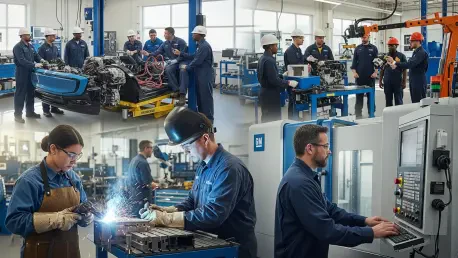
To address the immediate need for high-level technical expertise, the company has successfully onboarded approximately 90 new individuals into a rigorous and comprehensive four-year apprenticeship program. This curriculum is designed to bridge the gap between theoretical knowledge and the physical demands of the factory floor by integrating structured classroom instruction with intense, hands-on experience. Apprentices are not merely observers; they are active participants in the maintenance and optimization of the sophisticated robotics and control systems that define modern automotive production. This long-term commitment ensures that every participant develops a deep understanding of electrical and mechanical systems, preparing them to handle the complexities of the current manufacturing environment. The program is structured to evolve alongside technology, ensuring that the skills learned today remain relevant as new automation tools are introduced throughout the 2026 to 2028 timeframe. By investing in such a lengthy and detailed training process, the organization secures a reliable source of elite talent.
Beyond the formal coursework, a central pillar of this internal strategy is the mentorship provided by seasoned journeypersons who share decades of practical wisdom with the incoming cohort. This transfer of knowledge is vital for preserving the nuances of the trade that are often lost in purely academic settings. These experienced professionals guide apprentices through the intricacies of troubleshooting and preventative maintenance, fostering a culture of precision and safety that is essential for large-scale industrial operations. The relationship between the veteran tradespeople and the new recruits creates a collaborative environment where legacy expertise meets modern innovation. Furthermore, this mentorship model helps to professionalize the career path, demonstrating to new hires that there is a clear trajectory for advancement within the skilled trades. As the automotive industry continues to shift toward more complex electronic architectures, having a workforce that is both fundamentally sound and adaptable becomes a critical competitive advantage that justifies the significant financial resources allocated to these internal educational programs.
Technical Learning University: A Controlled Environment for Innovation
A significant portion of the recent investment has been directed toward the Technical Learning University located in Warren, Michigan, which serves as a dedicated hub for advanced vocational training. This facility provides a specialized “sandbox” environment where apprentices and current employees can safely experiment with new technologies without the pressure of an active assembly line. In this controlled setting, workers are encouraged to solve complex problems and master intricate electrical and mechanical systems through trial and error. This approach reduces the risk of costly downtime during actual production, as technicians arrive on the factory floor already proficient in the specific systems they will be managing. The university environment allows for a level of deep diving into diagnostic procedures that is simply not possible during the fast-paced nature of daily manufacturing operations. By creating a space specifically for learning and experimentation, the company ensures that its workforce is better equipped to handle the unexpected challenges of high-tech production.
The curriculum at the Technical Learning University is specifically tailored to meet the demands of the latest vehicle architectures, including those found in the newest generations of electric and autonomous platforms. This proactive training ensures that the skilled trades are not just keeping pace with technological change but are staying ahead of the curve. Technicians at the facility work with the same hardware and software that they will encounter in the field, ranging from advanced programmable logic controllers to high-voltage battery management systems. This high-fidelity training experience is essential for maintaining the reliability and efficiency of the production process. Moreover, the university acts as a center for excellence where best practices can be developed and then disseminated across the entire manufacturing network. As the company looks toward the 2026 to 2028 period, the Technical Learning University remains a cornerstone of the effort to transform the skilled trades into a data-driven, high-technology discipline that attracts the brightest minds in the technical field.
Building Community Partnerships and Educational Pipelines
Philanthropy and Workforce Development: Expanding the Talent Pool
Recognizing that the challenge of finding skilled labor extends beyond its own factory walls, the company has expanded its influence through substantial community-oriented partnerships and philanthropic initiatives. A key element of this outreach is a $1 million grant provided to the Local Initiatives Support Corporation to expand the “Bridges to Career Opportunities” program. This initiative is designed to provide job seekers with the vocational training and essential support services needed to enter high-demand technical fields. By lowering the barriers to entry for underrepresented populations, the program helps to diversify the talent pipeline and bring fresh perspectives into the industrial sector. This effort is part of a much broader $50 million commitment to STEAM education, which aims to inspire young people to pursue careers in science, technology, engineering, arts, and mathematics. These investments create a ripple effect, strengthening the economic resilience of the communities where the company operates while simultaneously securing a future workforce.
In addition to direct community grants, the organization has tripled its workforce development grants to a total of $15 million, targeting a wide range of educational institutions and non-profit organizations. This increased funding allows for the modernization of technical high school programs and the expansion of community college courses that align with current industrial needs. By providing the resources necessary for schools to purchase modern equipment and update their curricula, the company ensures that students are learning on the same technology used in the professional world. This alignment between education and industry requirements reduces the time needed for on-the-job training after graduation, making the transition from school to work much smoother for new hires. The overarching goal is to create a robust ecosystem where the demand for technical skills is met by a steady supply of qualified candidates. This comprehensive approach to workforce development demonstrates a strategic understanding that corporate success is inextricably linked to the educational health and economic stability of the broader society.
Specialized Training for the Future: From Design to Service
The investment also extends deep into the automotive service sector and specialized product development cycles, ensuring that every phase of the vehicle lifecycle is supported by expert technicians. Programs such as the Automotive Service Educational Program and the “Shifting Gears” initiative provide specialized training in advanced diagnostics, electronics, and electric vehicle systems for those entering the service side of the industry. These programs are critical as vehicles become increasingly defined by software and complex electrical components, requiring a new breed of technician who is as comfortable with a laptop as they are with a wrench. Furthermore, the skilled trades play an indispensable role in the creative process at the design studios, where fabricators and technicians transform digital models into physical prototypes. This collaboration between artists and industrial specialists is what allows conceptual designs to become reality, highlighting the artistic and highly technical nature of modern craftsmanship in the automotive world.
Outreach efforts like the Youth Modelers Artists Designers program and active collaborations with technical high schools focus on mentoring the next generation of industrial specialists. By engaging students early in their educational journey, these programs demystify the skilled trades and showcase the high-tech, high-paying opportunities available in modern manufacturing. This proactive engagement is essential for changing the outdated perception of vocational work as being purely manual or “blue-collar” in the traditional sense. Instead, students see that these roles require significant cognitive ability, problem-solving skills, and a high degree of digital literacy. The collective impact of these efforts reflects a strategic consensus that a modernized, skilled labor force is essential for maintaining corporate competitiveness through the 2026 to 2028 window. Stakeholders recognized that by investing in people and their specialized abilities, the company secured its ability to innovate and deliver high-quality products in an increasingly complex global market. This comprehensive model for labor development established a blueprint for how large-scale industrial entities could take direct responsibility for their human capital.