
Kwame Zaire joins us to discuss a paradigm shift in industrial fabrication that is currently reshaping how we think about heavy construction. As a specialist in production management and electronics, Kwame has spent years observing the manufacturing sector struggle with the inherent limitations of fixed-cell automation. Today, he sheds light on how the Rove system and its underlying AI are finally breaking the chains of the factory floor to bring precision welding to the world’s most demanding environments, from sprawling shipyards to massive infrastructure projects.
Moving welding automation from fixed cells to a mobile quadruped platform presents unique technical hurdles. How does physical AI manage the transition from a controlled environment to the field, and what stabilization techniques allow a legged robot to maintain the precision required for high-quality welds?
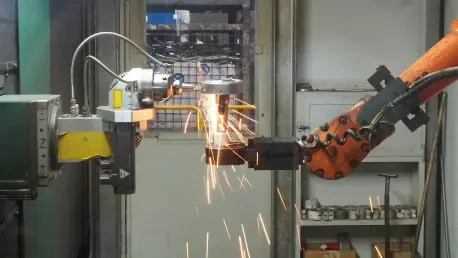
The leap from a controlled factory floor to the unpredictable terrain of a construction site is a massive undertaking for any robotic system. Historically, legged robots were considered far too unstable for the hair-thin tolerances required in high-quality welding, but the integration of the Obsidian physical AI model changes that narrative entirely. This AI provides the necessary perception and adaptability to handle high-variability environments where the ground is rarely level and the lighting is constantly shifting. By processing sensory data in real-time, the system can compensate for the minute vibrations of the quadruped platform, ensuring the welding torch remains perfectly aligned. It creates a bridge between the digital intent and the physical reality of the field, allowing the machine to “feel” its way through a weld just as a skilled human would.
Large-scale fabrication involves massive assemblies and inconsistent fit-up where workpieces cannot be easily moved or fixtured. How does a mobile system adapt to these structural variations in real-time, and what are the primary operational advantages for industries currently limited by manual labor?
In industries like shipbuilding or heavy infrastructure, we often deal with workpieces that are simply too massive to be moved into a traditional welding cell or secured in a rigid fixture. The Rove system solves this by bringing the automation directly to the part, utilizing the Obsidian AI to navigate and adjust to inconsistent fit-ups on the fly. Instead of requiring a perfect, laboratory-grade setup, the robot uses its advanced perception to identify gaps and structural deviations, adjusting its pathing to ensure structural integrity. This mobility eliminates the logistical nightmare of moving multi-ton assemblies, which drastically reduces the downtime associated with transport and positioning. For manufacturers, the primary advantage is a sudden surge in throughput, as they can now automate the most grueling parts of the build without reconfiguring their entire facility.
With skilled welder shortages reaching critical levels, heavy construction needs tools that can operate in high-variability environments. How does the deployment of autonomous mobile tooling change the labor requirements for a production site, and what specific metrics demonstrate that this technology is ready for large-scale projects?
The shortage of skilled welders is no longer a future threat; it is a current crisis that limits how quickly we can build essential infrastructure. By deploying autonomous mobile tooling, we aren’t replacing the human element, but rather augmenting it so that fewer experts can oversee a much larger volume of work. We look at metrics like the successful integration of these systems in real-world environments, such as the shipbuilding operations in Franklin, Louisiana, where the technology is being put to the test. When a single operator can manage multiple robotic units that handle the repetitive, dangerous, and physically demanding welds, the labor requirement shifts from manual execution to high-level system management. This scalability is the only way to meet the production demands of modern maritime and construction projects given the shrinking pool of specialized tradespeople.
Integrating autonomous maritime vessel production with robotic welding requires rethinking traditional manufacturing workflows. What does the step-by-step setup look like when deploying a legged robot at a shipyard, and how does this capability influence the design and assembly timeline for the next generation of ships?
When we partner with forward-thinking companies like Saronic Technologies, the setup involves a complete reimagining of the shipyard workflow, starting with the deployment of the Rove unit directly onto the hull assemblies. The process begins with the AI scanning the environment to localize itself within the massive structure, followed by the identification of specific weld joints that would typically require a human to climb into cramped or hazardous spaces. Because the robot is mobile and autonomous, it can work through the night or in conditions that would be uncomfortable for manual labor, which significantly compresses the assembly timeline. This capability influences ship design by allowing engineers to plan for complex geometries that were previously too difficult or expensive to weld manually. Ultimately, we are seeing a shift where the design of the next generation of autonomous vessels is actually optimized for the very robots that will build them.
What is your forecast for the role of physical AI in heavy industry over the next decade?
I believe we are entering an era where the distinction between a “tool” and a “collaborator” will completely disappear as physical AI becomes the backbone of heavy industry. Over the next ten years, we will see these autonomous systems move beyond simple welding to handle complex assembly, inspection, and even predictive maintenance on-site without human intervention. We are moving toward a “dark shipyard” or “dark factory” model for the most dangerous stages of construction, where fleets of legged robots work in tandem to build the infrastructure of the future. The success we are seeing today with mobile welding is just the first chapter in a story where AI-driven machines will take on the heavy lifting of civilization, allowing humans to focus on the creative and strategic oversight of global production.