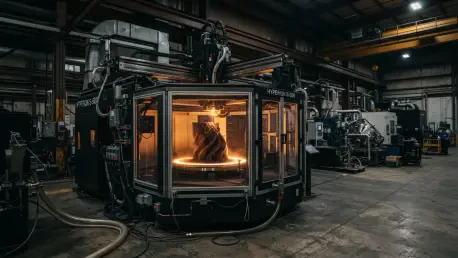

The industrial world has long wrestled with the paradox of tungsten carbide, a material so incredibly resilient it rivals the diamond yet remains notoriously difficult to mold into the intricate shapes required for modern high-precision engineering. For decades, global manufacturing relied on traditional pressing and sintering, methods that frequently limited design creativity and material efficiency. However, the strategic partnership between HP and Hyperion Materials & Technologies signals a decisive shift toward a digital future where hard metals are no longer bound by these conventional constraints.
The Intersection of Extreme Durability and Digital Agility
Modern manufacturing faces a persistent challenge where the materials strong enough to withstand the harshest industrial environments are often the most difficult to shape. Tungsten carbide has long been confined to the limitations of specialized machining and labor-intensive pressing. The strategic partnership between HP and Hyperion signals a movement beyond experimental prototypes into a realm where complex, high-performance hard metal components are produced at a commercial scale. This shift provides the digital agility necessary to adapt to rapidly changing market requirements without sacrificing durability.
Why Tungsten Carbide is the Next Frontier for Additive Manufacturing
As the backbone of the global tooling, mining, and energy sectors, tungsten carbide remains a challenge for standard 3D printing due to its extreme density and high melting point. As industries push for greater efficiency, the need for consolidated parts and optimized geometries has outpaced what conventional subtractive manufacturing can provide. By bridging the gap between high-speed Binder Jetting and metallurgical mastery, this collaboration addresses the urgent demand for wear-resistant components that maintain structural integrity while achieving unprecedented design complexity.
The Mechanics of Scaling: Binder Jetting and CarbiForm Powders
The transition to industrial volume rests on the technical synergy of HP’s Metal Jet S100 platform and Hyperion’s CarbiForm powder innovation. The S100 utilizes Binder Jetting to build parts layer-by-layer without the thermal stresses associated with laser-based systems, allowing for high throughput and the nesting of multiple parts. Central to this strategy are ready-to-use CarbiForm powders, which ensure consistent flowability and packing density to prevent structural defects. This method enables internal cooling channels and consolidated assemblies that reduce weight and minimize the waste of expensive materials.
Leadership Insights on Bridging the Commercialization Gap
Success is anchored in a shared vision for an end-to-end manufacturing route that guarantees quality from the initial powder to the finished part. Leadership from both organizations, including Biju Varghese of Hyperion and Arvind Rangarajan of HP, emphasize providing a reliable route to market that matches the fracture toughness of traditionally manufactured counterparts. The installation of the Metal Jet S100 at Hyperion’s Barcelona facility in 2026 served as a real-world proving ground. This center allowed for the rapid qualification of new applications, ensuring that parts met the rigorous standards of the aerospace and energy sectors.
Strategies for Industrial Integration and Application Qualification
The path to successful implementation involved a structured approach to identifying components where traditional manufacturing created a bottleneck. This included parts with intricate features or those requiring extensive manual assembly. Once a design was optimized, the scalability of the platform allowed for a seamless transition into high-volume manufacturing without changing process parameters. By controlling the entire lifecycle, the partnership provided a closed-loop system vital for maintaining performance standards. This initiative established a blueprint for the broader adoption of additive hard metals, ensuring that industrial clients moved forward with greater confidence and production efficiency.