
Traditional robotic welding often requires rigid fixtures and tedious point-by-point teaching, but the TM3S uses built-in vision to instantly generate welding trajectories. This breakthrough, showcased at the 2026 Taipei International Industrial Automation Exhibition, signalizes a fundamental shift in how mechanical labor is conceptualized on the modern factory floor. Under the strategic banner of SEE・THINK・ACT — Powered by AI Robotics, the industry is witnessing the transition of Physical AI from controlled laboratory experiments to high-stakes, real-world manufacturing environments. This roadmap does not merely update existing hardware but establishes a comprehensive ecosystem designed to bridge the profound gap between digital intelligence and manual labor. By moving beyond standalone mechanical tools, developers are creating systems that can observe their surroundings, process complex variables, and execute precise actions with minimal human intervention. This evolution represents a departure from traditional automation, focusing instead on adaptability and the seamless integration of software and hardware.
Dual Engine Framework: Implementing Shared Intelligence
The core of this transformative strategy rests on a dual-engine framework that integrates conventional collaborative robots with sophisticated humanoid platforms like the TM Xplore I. This approach assumes that the ultimate value of humanoid robotics is not just in their physical form but in a shared intelligence platform that powers various robotic configurations. By utilizing advanced vision-language-action models and sophisticated learning algorithms, engineers have created a feedback loop where the complex mobility and navigation developed for humanoids directly enhance the adaptability of standard industrial cobots. This synergy allows for a more holistic application of artificial intelligence, where data gathered from one type of robot informs the operational logic of another. As these systems become more interconnected, the distinction between specialized industrial tools and general-purpose robotic assistants begins to blur, creating a unified workforce capable of handling diverse tasks through a singular AI backbone.
Dual Engine Framework: Enhancing Brownfield Operations
Designed specifically for the practical demands of industrial logistics, the TM Xplore I marks a departure from general-purpose humanoid concepts that often lack specific industrial utility. Its compact and agile design is a strategic response to the constraints of brownfield factories—older facilities originally constructed for human workers that cannot easily accommodate the footprint of traditional, bulky automation systems. By handling complex bin retrieval and material transport through edge AI, this humanoid robot provides a highly flexible solution for facilities that require rapid production shifts without the need for massive structural overhauls. This focus on practical mobility ensures that robots can navigate narrow aisles and irregular floor plans just as effectively as their human counterparts. Consequently, manufacturers can introduce high-level automation into legacy environments, significantly extending the operational life of existing infrastructure while simultaneously increasing throughput and reducing the physical strain on human personnel.
Simulation Workflows: Overcoming Reality Gaps
Despite the rapid advancement of digital twins, a significant bottleneck known as the engineering gap persists, where virtual simulations often fail to account for the chaotic complexities of the physical world. Historically, this discrepancy has forced engineers to spend countless hours on-site, performing manual recalibrations to compensate for environmental variables like fluctuating lighting conditions or slight floor gradients. These minor differences between the digital model and the physical reality can lead to catastrophic failures in high-precision tasks. To overcome this, a new workflow called Real–Sim–Real has been implemented to ensure that data generated in a simulated environment translates perfectly to the actual production line. This methodology acknowledges that the virtual world is only as good as the data fed into it, necessitating a constant exchange of information between the physical robot and its digital counterpart. By synchronizing these two domains, companies can reduce deployment times and ensure that robots operate with the same reliability in reality as they do in software.
Simulation Workflows: Validating Digital Twins
The implementation of the Real–Sim–Real workflow begins with the robot’s own vision system scanning the physical environment to create a high-fidelity 3D reconstruction. This precise spatial data is then processed within the NVIDIA Omniverse platform, where engineers can validate movements and generate automated waypoints with extreme accuracy. By using AI spatial positioning, the system ensures that the robot’s physical performance aligns perfectly with the digital twin, effectively transforming what used to be a grueling manual engineering task into a streamlined, repeatable setup. This process eliminates the guesswork traditionally associated with robotic programming, allowing for rapid reconfiguration of assembly lines. Furthermore, the use of such advanced simulation platforms allows for the stress-testing of robotic movements before a single motor is engaged on the factory floor. This level of preparation minimizes the risk of hardware damage and ensures that the final deployment is both safe and efficient, regardless of the complexity of the operational environment.
Scaling Capacity: High-Payload Server Solutions
As the global demand for AI computing infrastructure continues to skyrocket from 2026 to 2028, manufacturers are facing the challenge of assembling increasingly heavy and complex server racks. Standard collaborative robots often lack the strength required for these tasks, creating a need for high-payload solutions that do not sacrifice safety. The TM45S dual-arm system has emerged as a direct response to this requirement, boasting a substantial 50kg payload capacity per individual arm. When these arms work in perfect synchronization, the system can maneuver workpieces weighing up to 100 kilograms, a feat previously reserved for large, caged industrial robots that are often dangerous to work around. This development allows for the automation of heavy assembly tasks in environments where human presence is still necessary. By providing the power of a heavy-duty industrial robot within a collaborative framework, manufacturers can maintain high safety standards while scaling their production of the critical hardware that fuels the current AI era.
Scaling Capacity: Strategic Safety and Flexibility
Strategically, the introduction of high-payload collaborative systems moves the focus away from the crowded commodity robotics market and into high-margin niches like AI server manufacturing. By allowing humans and robots to work in close proximity on high-value equipment, companies can achieve a level of operational flexibility that was once impossible. This is particularly vital for manufacturers who must scale their operations quickly to meet fluctuating market demands without investing in entirely new, isolated production zones. The ability to handle heavy server components with the precision of a cobot reduces the risk of expensive equipment damage and improves the overall ergonomics of the assembly process. Furthermore, this specialized focus ensures that the robotics industry remains relevant in the face of evolving technological needs. As data centers grow in scale and complexity, the tools used to build them must also evolve, offering a blend of raw power and intelligent sensitivity that ensures every component is handled with the utmost care and accuracy.
Specialized Automation: Vision-Led Semiconductor Inspection
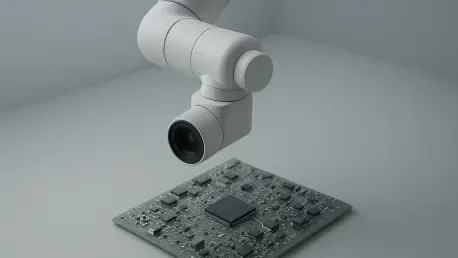
Innovation in specialized manufacturing is also being driven by vision-led automation, particularly in sectors where traditional data-dependent methods fail. The TMscene system for semiconductor inspection serves as a prime example of this trend, utilizing integrated cameras to create real-time 3D models of complex equipment. Unlike older inspection methods that rely heavily on original CAD files, which may be unavailable, outdated, or proprietary, TMscene generates its own spatial data on the fly. This capability allows for the rapid deployment of inspection routines in electronics manufacturing, where product cycles are short and design changes are frequent. By bypassing the need for perfect digital blueprints, manufacturers can maintain high quality-control standards even when dealing with legacy components or third-party hardware. This level of visual intelligence ensures that defects are identified with high precision, reducing waste and improving the reliability of the finished semiconductor products that are so essential to modern technological infrastructure.
Specialized Automation: Portability in Adaptive Welding
Further advancing the field of specialized labor is the TM3S vision-adaptive welding robot, a system designed for maximum portability and ease of use. Light enough to be transported by a single operator, this robot utilizes scan-and-weld technology to instantly generate welding trajectories based on the physical workpiece in front of it. This innovation makes robotic precision accessible for high-mix, low-volume production environments where traditional automation was previously too expensive or too difficult to set up. By automating the alignment of coordinates and eliminating the need for tedious manual calibrations, the system provides the physical backbone for a more responsive manufacturing sector. This democratization of high-end welding technology allows smaller workshops to compete with larger factories, as they can now achieve the same level of consistency and quality without a massive capital investment. As these adaptive systems become more common, the barriers to entry for advanced manufacturing continue to fall, fostering a more diverse and innovative industrial landscape.
Future Considerations: Actionable Steps for Industry
The advancements showcased during this period offered a clear perspective on the future of industrial automation, where the integration of dual AI engines redefined the capabilities of the workforce. Manufacturers who adopted these integrated systems realized significant gains in operational flexibility, as the bridge between digital simulations and physical execution finally closed. The shift toward using real-time vision systems and high-payload cobots allowed companies to address the specific challenges of the AI infrastructure boom without overhauling their existing facilities. Engineers discovered that the Real–Sim–Real workflow drastically reduced the time required for deployment, making it possible to pivot production lines in response to sudden market changes. These strategic decisions ensured that the manufacturing sector remained resilient and capable of handling increasingly complex tasks. Moving forward, the industry learned that the true power of automation lay not in replacing human skill, but in providing intelligent, adaptable tools that amplified human productivity and safety across all levels of production.