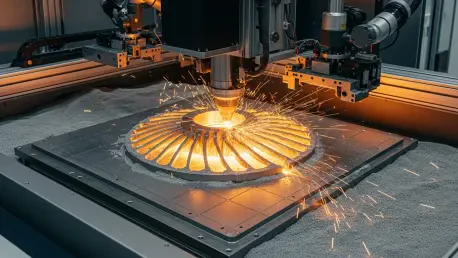

The transition from layer-by-layer experimentation to factory-floor reliability has finally turned the tide for a technology once relegated to the shadows of rapid prototyping labs. Industrial additive manufacturing (AM) has emerged from its niche status, evolving into a sophisticated pillar of modern production that utilizes digital blueprints to fuse materials with surgical precision. This transition reflects a broader maturation where the focus has moved beyond the novelty of complex shapes toward the harsh realities of throughput, repeatability, and industrial-scale uptime. By integrating specialized hardware with advanced computational design, the technology now serves as a bridge between the digital world and physical manufacturing, allowing for decentralized production that was previously inconceivable.
Transition to Serial Production
Moving from the creation of singular components to high-volume manufacturing represents a fundamental change in how the industrial ecosystem operates. While early systems prioritized flexibility over speed, modern platforms are engineered for continuous operation, significantly reducing the idle time between builds. This shift is significant because it addresses the traditional economic barrier of high per-unit costs, making AM a viable competitor to injection molding or casting for complex geometries. As production volumes increase, the amortization of equipment costs becomes more favorable, allowing companies to justify the initial investment through superior part performance and reduced assembly requirements.
Technical Maturity and System Integration
The current landscape is defined by the deep integration of hardware and software within the smart factory ecosystem. Advanced sensors and real-time monitoring allow systems to self-correct during the build process, which is essential for maintaining the structural integrity of critical components. This synergy ensures that every layer adheres to strict tolerances, providing a level of performance that satisfies the rigorous demands of heavy industry. Moreover, the connectivity of these systems allows for remote diagnostic checks and predictive maintenance, ensuring that the manufacturing line remains functional even in high-demand scenarios.
Recent Market Developments and Industry Trends
Following a period of intense consolidation through late 2025, the sector has entered a phase of stabilization and cautious recovery. While some volatility remains, the number of firms reporting positive business growth has surged, signaling a return of investor confidence. However, global trade dynamics and shifting tariffs, particularly in the United States, have forced manufacturers to rethink their export strategies and focus on regional resilience. This shift toward localized supply chains is a response to the increasing influence of international competition, particularly from players who are rapidly scaling their technical capabilities to challenge established leaders.
Real-World Applications and Sector Deployment
The deployment of AM in high-stakes sectors like aerospace and medical technology demonstrates its ability to produce lightweight, biocompatible structures that traditional methods cannot replicate. In the automotive world, the rise of additively manufactured parts in supply chains has mitigated the risk of logistical bottlenecks by allowing for on-demand spare part production. These real-world use cases prove that the technology is no longer a luxury but a strategic asset for domestic and international stability. By localizing production near the point of use, industries are effectively reducing their carbon footprint and logistical complexity.
Technical Hurdles and Market Obstacles
Despite these strides, high production costs and the absence of universal standardization remain formidable obstacles. Automation is the missing link required to eliminate labor-intensive post-processing, which currently inflates the final price of printed parts. Furthermore, regulatory bodies must keep pace with technological advancements to provide the quality assurance protocols needed for widespread adoption across more conservative industries. Addressing these limitations requires a concerted effort from both equipment manufacturers and end-users to create a unified framework for material certification and process validation.
Future Outlook and Strategic Trajectory
Looking ahead, the focus will likely shift toward achieving total economic viability and process stability through 2028. Long-term growth expectations remain high, with many firms anticipating domestic expansion as they refine their value chains and invest in workforce training. Breakthroughs in material science and faster energy-delivery systems will be the primary drivers of this expansion, potentially altering the global manufacturing hierarchy. The strategic trajectory suggests a move toward even more specialized materials, such as high-temperature alloys and advanced polymers, tailored for specific industrial applications.
Conclusion and Assessment
The review of current industrial trends indicated that the sector successfully navigated a complex period of maturation. Stakeholders moved beyond isolated experimentation and began prioritizing value chain collaboration to solve persistent technical bottlenecks. This evolution confirmed that the industry transitioned into a more stable, albeit cautious, phase of strategic growth. Future success was seen as dependent on the ability to standardize processes and integrate automated workflows to finally unlock the full economic potential of additive systems. Ultimately, the path toward industrial maturity required a balance between aggressive innovation and the disciplined implementation of quality controls.