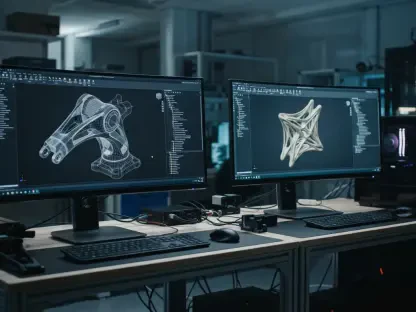

The pursuit of printing meter-scale titanium components for high-stress aerospace applications has historically encountered a formidable barrier where geometric complexity outpaces the computational limits of current engineering software. As the additive manufacturing (AM) sector transitions toward massive, 1,000 mm-class production environments, the traditional trial-and-error methodology has become prohibitively expensive. This shift demands a radical rethink of simulation technology, as the financial risk of a failed large-scale print can reach six figures. PanX by PanOptimization has emerged as a disruptive force, specifically designed to bypass the bottlenecks that have long paralyzed standard finite element analysis tools. This review examines how high-fidelity thermal modeling and advanced computational algorithms are enabling a new era of predictable, industrial-scale metal printing.
The Evolution of Simulation in Large-Format Metal Additive Manufacturing
The trajectory of metal AM is moving rapidly away from small, experimental coupons toward the realization of fully integrated, meter-scale assemblies. This expansion introduces a paradox often termed the “too large, too complex” dilemma. Engineers are frequently forced to choose between a coarse mesh that ignores critical thin-wall details or a high-resolution model that crashes standard workstations. While legacy software was built for the simpler geometries of the past decade, the modern requirement involves tracking thermal gradients across a volume that is several orders of magnitude larger than a typical laboratory build.
The introduction of PanX represents a pivot point in this evolution. By allowing for the simulation of hundreds of millions of elements on standard engineering workstations, it bridges the gap between theoretical design and physical reality. This capability is not merely a convenience; it is a necessity for reducing the immense financial risks inherent in large-format production. Without the ability to simulate at scale, the industry remains tethered to physical prototypes, a process that is both slow and wasteful in the context of high-value materials like Inconel or titanium.
Core Computational Innovations in PanX Technology
Periodic Adaptivity and Multi-Grid Modeling: The Performance Leap
The primary technical hurdle in large-scale simulation is the sheer volume of data required to represent sub-millimeter features within a meter-class envelope. Traditional solvers typically hit a ceiling at around five million elements, which forces a drastic oversimplification of the part’s geometry. In contrast, PanX utilizes periodic adaptivity and multi-grid modeling to handle meshes that are 100 to 1,000 times larger. This approach allows the software to maintain 0.2 mm feature resolution throughout a massive build volume, ensuring that thin walls and internal cooling channels are modeled with the precision required for structural integrity.
By leveraging these multi-grid algorithms, the software achieves a performance leap that moves beyond incremental updates. Instead of linear scaling, which would make billion-element simulations impossible, these techniques allow for the processing of massive datasets without exhausting system memory. This enables engineers to visualize residual stress and potential warping at a granular level that was previously inaccessible, providing a level of confidence that is essential for safety-critical components in defense and aerospace.
Comprehensive Thermal Environment Simulation: Accuracy Beyond the Part
Thermal modeling in AM is notoriously difficult because the part does not exist in a vacuum; it is surrounded by a complex environment of loose powder and a heat-sinking build plate. Many traditional tools simplify this by applying static boundary conditions, which often leads to significant errors. PanX distinguishes itself by explicitly modeling the entire build environment, including the insulating effects of the surrounding powder bed. Research suggests that failing to account for this insulation can cause interlayer temperature predictions to deviate by as much as 300°C, leading to inaccurate distortion forecasts.
Modeling the interaction between the solidifying metal and the powder substrate allows for a high-fidelity representation of the thermal history. This detail is vital because the cumulative thermal load in a multi-day build dictates the final mechanical properties and the likelihood of delamination. By providing a more authentic digital twin of the build chamber, the software ensures that the predicted residual stresses match the physical reality of the post-printed part.
Emerging Trends in High-Fidelity Additive Modeling
A prominent trend in the current manufacturing landscape is the adoption of multi-laser systems designed to accelerate build speeds. However, these systems introduce chaotic thermal overlaps that are nearly impossible to manage without advanced simulation. Modern workflows are moving toward a “simulation-first” philosophy, where every laser path and cooling delay is optimized in a virtual environment before a single gram of powder is melted. This shift minimizes the need for physical iterations, drastically shortening the time-to-market for complex components.
Moreover, there is a clear movement toward the democratization of high-performance computing. Historically, complex FEA required access to massive server clusters or supercomputers. The current generation of solvers is being optimized to run on 60-core workstations and even high-end portable machines with 64 GB of RAM. This accessibility allows smaller engineering firms to compete in the large-scale AM space, fostering innovation across the supply chain rather than restricting it to a few Tier-1 aerospace giants.
Real-World Applications and Industrial Implementation
The practical utility of this high-resolution approach is best demonstrated in the production of complex aerospike components. These parts, characterized by intricate internal cooling passages and large external dimensions, represent the pinnacle of AM difficulty. Using PanX, engineers have successfully processed models containing 26 million elements and 57 million nodes in under four hours. This speed allows for multiple design iterations in a single day, a workflow that would have taken weeks or months using traditional computational methods.
In the broader aerospace sector, this technology is being utilized to optimize the weight-to-strength ratios of structural airframe parts. By simulating the build process, manufacturers can identify areas prone to excessive heat accumulation and adjust the support structures or scan strategies accordingly. This level of industrial validation ensures that the final part meets the rigorous quality standards required for flight-critical hardware, all while reducing the overall material footprint.
Technical Challenges and Computational Hurdles
Despite these advancements, significant hurdles remain, particularly regarding the trade-off between resolution and solve time. While 100x speed improvements are impressive, the industry continues to push for even finer resolutions, which places an ever-increasing burden on memory bandwidth and processor efficiency. Engineers must still navigate the delicate balance of including enough detail to capture localized thermal spikes without making the simulation computationally unfeasible for routine use.
Additionally, regulatory bodies in safety-critical sectors like energy and aerospace demand a high degree of transparency and validation for simulation data. Transitioning from physical testing to digital qualification requires a robust framework for verifying that the software accurately predicts material microstructure and long-term fatigue life. Ongoing efforts are focused on refining these solvers to meet the stringent documentation and accuracy requirements of international quality assurance standards.
The Future Outlook of Metal AM Simulation
The long-term trajectory of the industry points toward a complete integration of digital twins and real-time build monitoring. Future breakthroughs in solver efficiency are expected to allow simulation data to feed directly into machine control systems, enabling real-time adjustments to laser parameters to counteract detected thermal anomalies. This closed-loop system would virtually eliminate the possibility of build failures, moving the industry closer to a “right-first-time” manufacturing paradigm.
Furthermore, the environmental impact of high-fidelity simulation cannot be overlooked. By reducing the number of failed prints and optimizing material usage, the technology plays a crucial role in lowering the energy consumption of global manufacturing operations. As metal AM continues to scale, the reliance on advanced computational tools will only deepen, eventually making physical trial-and-error a relic of the past.
Final Assessment of Large-Scale Simulation Technology
The evaluation of current simulation capabilities revealed that the shift toward multi-grid modeling and periodic adaptivity provided the only viable path for the future of large-scale manufacturing. These innovations successfully dismantled the computational barriers that previously limited engineers to simplified, and often inaccurate, models of complex parts. By prioritizing thermal fidelity and environmental interactions, the technology established a new benchmark for predictive accuracy in the additive sector.
Ultimately, the adoption of high-resolution simulation offered a decisive advantage in the pursuit of meter-class metal production. It empowered manufacturers to validate intricate designs with a speed and precision that were once thought impossible on standard hardware. This transition toward a digitally driven workflow not only mitigated financial risk but also paved the way for more sustainable and efficient industrial practices through the widespread reduction of physical waste and trial-based failures.