
The Yuanye model codifies decades of experience from master steelworkers into a systematic knowledge base that functions as a swarm of 25 core AI agents. This massive technological leap represents the current state of heavy industry in 2026, where the traditional, grit-and-grind nature of metallurgical production has been fundamentally reshaped by deep learning and massive data processing. At Nanjing Iron & Steel (NISCO) in Jiangsu province, the shift from a manual, experience-based operation to a fully digitized, AI-augmented ecosystem has become a global benchmark for industrial modernization. This transition is not merely a superficial update but a comprehensive overhaul that integrates “swarm intelligence” and “digital twins” into the very fabric of the manufacturing process. By partnering with Huawei, NISCO has managed to merge the physical intensity of heavy steelmaking with the ultra-fast, predictive capabilities of high-performance computing, ensuring that the facility remains efficient in a market that demands extreme precision and lean operations.
Precision Engineering in the Rolling Mill
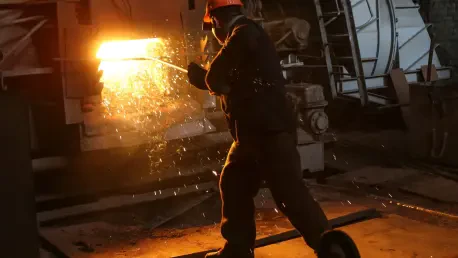
The rolling mill serves as the primary stage where massive, incandescent steel slabs are transformed into specific plates, a process that represents the most technically grueling aspect of production. Historically, maintaining the exact thickness and surface quality of these plates required elaborate physics-based models which, despite their sophistication, often struggled to account for the minute, real-time fluctuations in temperature and metal composition. To solve this, NISCO’s heavy plate production line, which is capable of producing steel up to 4.85 meters wide, now employs an AI-enhanced prediction system for rolling force. This system works in tandem with traditional physics models, using Huawei-powered algorithms to analyze thousands of data points per second. Consequently, the rolling-force prediction accuracy has surged from 88% to a remarkable 98%, allowing the mill to maintain a thickness tolerance of ±0.2 mm across vast quantities of specialized steel.
The financial and physical implications of this increased accuracy are massive when viewed through the lens of industrial output. A 0.5% improvement in overall production yield may sound incremental to an outside observer, but in the context of a high-volume steelworks, it represents thousands of tons of material that were previously lost to scrap or rework. This precision is particularly critical for the high-end sectors NISCO serves, including the construction of large-scale maritime vessels, liquefied natural gas storage tanks, and offshore energy platforms. These applications require steel that can withstand extreme pressures and corrosive environments, where even the slightest deviation in plate thickness could compromise the structural integrity of a multi-billion-dollar infrastructure project. By eliminating human error and model lag in the rolling process, the facility has secured its position as a reliable supplier for the world’s most demanding engineering feats.
The Yuanye Model: Swarm Intelligence in Heavy Industry
Central to this digital revolution is the Yuanye model, a large-scale artificial intelligence framework designed specifically for the unique rigors of the steel industry. This infrastructure is built on a foundation of Huawei’s Ascend AI processors, the Kunpeng computing platform, and the Pangu AI model, providing the raw computational power necessary to manage a complex manufacturing environment. Unlike the monolithic AI systems used in consumer technology, the Yuanye model utilizes “swarm intelligence,” a distributed network consisting of over 300 distinct AI models and 25 core AI agents. Each agent is tasked with a specific operational duty, such as production scheduling, thermal management, or quality inspection. This modular approach allows the system to remain flexible and resilient, as individual agents can be updated or fine-tuned without disrupting the entire production flow of the plant.
Reliability in an industrial setting is a non-negotiable requirement, as any system failure could lead to catastrophic equipment damage or severe safety hazards for the workforce. While a 70% accuracy rate might be acceptable for a social media recommendation algorithm, industrial AI must operate at near-perfection. The rolling force prediction models at NISCO operate with millisecond response times to keep pace with high-speed machinery that never stops. To ensure the technology remains grounded in reality, the company has empowered its field employees to develop over 1,000 lightweight, in-house AI applications. This bottom-up approach ensures that the “digital brain” of the factory is constantly being fed practical insights from the shop floor, bridging the gap between high-level data science and the lived experience of the technicians who manage the furnaces and mills.
Optimizing Blast Furnaces and Raw Material Logistics
The blast furnace has long been considered the “heart” of any steelworks, and its management was traditionally viewed as more of an art than a science, relying heavily on the gut instincts of veteran operators. NISCO has demystified this complex metallurgical process by implementing real-time data analysis and predictive health modeling within its smart operations center. The system now calculates a real-time health score for the furnace based on 57 different indicators, spanning fuel conditions, smelting status, and internal pressure. This comprehensive scoring system allows operators to pinpoint deviations the moment they occur, enabling them to rectify issues before they escalate into critical failures. This level of oversight has replaced the era of manual spreadsheets and reactive troubleshooting, providing a transparent view into the volatile environment of molten iron production.
Predictive foresight has become the new standard for furnace stability, with the AI now capable of forecasting the thermal state and silicon content of the iron two hours in advance. With a prediction accuracy exceeding 90%, this advance warning system has led to a 10% increase in the production of high-quality hot metal. This proactive management style ensures that the furnace remains in its optimal “sweet spot,” reducing fuel consumption and minimizing the environmental footprint of the smelting process. By moving from a reactive mode to a predictive one, the facility has stabilized its most energy-intensive asset, creating a ripple effect of efficiency that extends throughout the entire production chain. The ability to see two hours into the future of a blast furnace represents a fundamental shift in how heavy industry manages its core assets in a data-driven economy.
Streamlining Quality Control and Operational Logistics
The application of AI at NISCO begins even before the raw materials enter the furnace, starting with the logistics at the Yangtze River wharf. When iron ore arrives, AI agents analyze over 20 different variables, including current market costs, furnace stability requirements, and material purity, to determine the optimal blend of raw materials for the current production cycle. Within the massive warehouses, AI calculates the most efficient travel routes for overhead cranes and identifies the ideal stacking positions for materials to minimize unnecessary movement. These logistical optimizations have reduced the overall management workload by approximately 60% and have effectively shortened the total time from production to delivery by about 10%. This streamlined supply chain ensures that the plant can respond rapidly to changing customer demands without incurring the high costs associated with inventory bottlenecks.
Quality control has also undergone a robotic revolution, particularly in the field of metallographic inspection, which involves studying the microscopic structure of metals. Previously, this was a labor-intensive task that required highly trained inspectors to spend hours staring into microscopes to identify structural flaws. By training AI models on over 200,000 detailed inspection images, NISCO has automated this process using specialized robots that perform these checks with over 95% accuracy. The time required to analyze a single sample has been slashed from 10 minutes to just three minutes, allowing the production line to move faster without sacrificing safety. This automation does not replace the human element; instead, it allows skilled metallurgical experts to move away from repetitive scanning and focus their attention on analyzing the rare, complex anomalies that the AI flags for human judgment.
Digital Twin Technology and Future Strategic Growth
A 26-meter-wide digital screen in the smart operations center provides a macroscopic view of the entire steelworks, powered by sophisticated Digital Twin technology. This screen displays a real-time digital replica of every square inch of the plant, from the iron ore docks to the final shipping bays. Because every major piece of equipment is fully digitized, managers can virtually “peer inside” high-temperature environments like blast furnaces and reheating furnaces that are physically impossible to observe directly. This level of transparency is further enhanced by a “digital ID card” system assigned to every steel plate. Each ID tracks the plate’s grade, specific dimensions, and customer data, allowing clients to monitor the progress of their orders in real-time. This system also tracks every spare part in the facility, automatically notifying the maintenance staff when a component is nearing the end of its service life.
The collaboration between Nanjing Iron & Steel and Huawei successfully established a new standard for the “Intelligent Transformation” of heavy industry. By merging deep metallurgical expertise with cutting-edge AI and Digital Twin technology, the project reduced annual expenses by more than 100 million yuan and cut research and development times for new products by half. The transition illustrated that the future of manufacturing lies in the ability to turn vast amounts of industrial data into a tangible competitive advantage. Looking forward, industrial leaders should consider the NISCO model as a blueprint for scaling expertise, where AI acts as a multiplier for human talent rather than a replacement. The integration of swarm intelligence into traditional sectors proved that even the most established industries can find significant growth by embracing a data-centric philosophy and investing in robust, reliable computing infrastructure.