
Kwame Zaire is a seasoned expert in the industrial manufacturing sector, with a deep-seated passion for how electronics and advanced equipment are reshaping the factory floor. His work frequently centers on the delicate balance of production management, where the drive for efficiency must always be tempered by rigorous quality and safety standards. As a thought leader in predictive maintenance, Zaire has spent years analyzing how machines “speak” to us, and now he is turning his attention to how they interact with us. With the rise of physical AI and humanoid robotics, his insights provide a crucial bridge between the raw power of compute and the practical realities of industrial labor.
In this conversation, we explore the significant leap NVIDIA is making by bringing its autonomous vehicle safety frameworks into the world of humanoid robotics through the new Halos system. We discuss the technical layers—from high-performance chips to third-party certification labs—that allow these machines to operate safely in crowded logistics hubs. Furthermore, we examine the real-world applications currently being piloted by Agility Robotics and address the lingering concerns about AI decision-making in environments where there is no room for error.
How does the transition of safety frameworks from autonomous vehicles to humanoid robotics change the way we approach worker protection in a high-traffic factory setting?
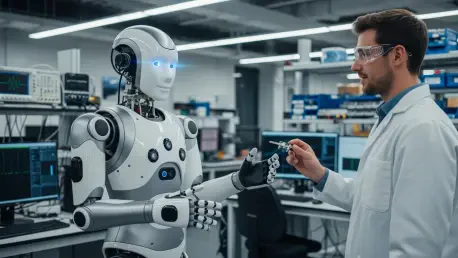
Moving a safety system like NVIDIA Halos from the open road into a warehouse is about shifting our focus from a predictable lane-based map to a dense, 360-degree environment. In a facility where humanoid robots like Digit are moving alongside human workers, the system has to process sensor data with incredible speed to prevent any accidental contact. This full-stack approach means every chip, software tool, and service is optimized so the robot sees a worker not as a moving obstacle, but as a protected partner in a shared space. It is about creating a sense of total security where the hum of the machinery and the movement of the staff feel perfectly synchronized and safe.
Can you break down the importance of the three-layer architecture within this new system and how it serves as a foundation for scaling these autonomous units?
The architecture is essentially a three-pronged shield that begins with the hardware layer, utilizing NVIDIA IGX Thor and the Holoscan Sensor Bridge to handle massive amounts of data from the robot’s cameras and sensors. Above that sits the Halos OS software stack, which functions like a digital nervous system for safety-related operating functions, ensuring the machine can override a command if it detects a potential hazard. Finally, the Inspection Lab provides that critical third-party certification we need to prove these systems meet industrial-grade standards before they are deployed. When you consider that 542,000 industrial robots were installed in 2024 alone—which is more than double the amount from a decade ago—you can see why having this rigorous, unified structure is the only way to scale up responsibly.
With major players like Toyota and Amazon already integrating these humanoid robots, what does this collaboration mean for the future of what industry leaders call responsible automation?
The partnership between NVIDIA and Agility is a game-changer because they are putting the Digit robot into some of the most demanding production environments in the world, from logistics hubs to automotive plants. By using Microsoft’s Arc multi-cloud platform to manage these units, they are creating a workflow where safety is a validated digital protocol rather than just a physical bumper or a warning light. When you hear executives talk about responsible automation, they are emphasizing that for humanoids to deliver real value, safety must be woven into the system’s DNA from the very first line of code. Seeing these machines move pallets at GXO or Schaeffler gives us a real glimpse into a future where the mechanical precision of a robot and the creative problem-solving of a human worker can coexist without any lingering fear of a collision.
Given that AI models for robotics are often non-closed-form solutions, how do we mitigate the risk of a robot making a mistake if its internal brain provides an incorrect command?
This is a vital point because AI “brains” can occasionally make mistakes or choose an inefficient path that seems logical in a digital simulation but fails in the physical world. Since these models are typically not closed-form solutions, there is always a slim chance the robot might misinterpret a command or a sensor reading in a split second. We mitigate this risk by ensuring the safety layer, powered by the IGX Thor hardware, has the ultimate authority to halt or correct an action before it leads to a physical hazard. It is very much like having a veteran supervisor watching over a new trainee; the AI provides the movement and the speed, but the safety architecture provides the “stop” command the moment the situation feels off-script.
What is your forecast for the integration of humanoid robotics in manufacturing over the next five years?
I expect to see the annual installation numbers climb significantly beyond the 542,000 units we recorded in 2024, especially as the cost of hardware drops and safety protocols become even more robust. By 2026 and 2027, the primary conversation in the industry will shift from whether these robots are capable to how many we can safely manage within a single facility alongside our human teams. We are moving toward a reality where “physical AI” is just another standard tool in the manufacturing toolkit, as common as a forklift but with the intelligence to handle much more complex tasks. The ultimate success of this era will depend on these unified safety architectures that allow humans and machines to share the same floor, the same air, and the same goals with total trust.