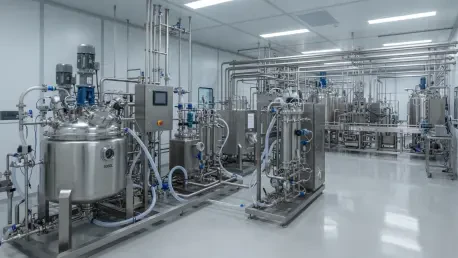

As we navigate the complexities of 2026, the biopharmaceutical industry finds itself at a critical crossroads where the demand for life-saving therapeutics is higher than ever, yet the pool of specialized talent remains dangerously thin. Today, we are joined by an expert in biomanufacturing and workforce development who is currently at the forefront of a transformative shift in how we train the next generation of technicians. With a background deeply rooted in production management and a keen eye for the integration of advanced electronics and equipment, our guest is helping to lead initiatives that bridge the gap between theoretical knowledge and the high-stakes environment of the cleanroom. We are exploring the pioneering work being done through the Vanguard Level UP-XR program, a collaboration involving major contract development and manufacturing organizations (CDMOs) and specialized technology partners, all backed by significant funding to evaluate the true efficacy of extended reality in a Good Manufacturing Practice (GMP) setting.
The following discussion examines the strategic pivot toward immersive learning technologies like virtual, augmented, and mixed reality to solve the ongoing talent crisis. We delve into how CDMOs are utilizing digital twins and airflow visualizations to accelerate the onboarding process, the specific technical nuances of aseptic processing that are being revolutionized by these tools, and the rigorous, data-driven methods being used to measure success. Our conversation also touches upon the necessary balance between digital simulation and physical haptic skills, providing a comprehensive look at the future of workforce readiness in the biopharmaceutical sector.
Biomanufacturing is currently facing a significant talent gap where the demand for skilled workers is outpacing the supply. How is the industry leveraging extended reality (XR) to address this imbalance and accelerate the onboarding process for new technicians?
The tension in our labor market is palpable right now, as established companies are rapidly expanding their campuses and new players are constantly entering the space, creating a fierce competition for a very limited pool of qualified talent. We’ve reached a point where the traditional “see one, do one, teach one” model is no longer sufficient to keep up with the pace of production, which is why the $300,000 in non-dilutive funding provided to each partnership in the Level UP-XR program is so transformative. By partnering CDMOs like KBI Biopharma, Kindeva, and Jubilant HollisterStier with technology leaders like Prism Immersive and Altoura, we are able to create a 12-month immersive “on-ramp” for technicians before they ever step into a high-risk manufacturing environment. This technology allows us to provide the high-repetition practice that is usually impossible during active production cycles, ensuring that when a technician finally enters the cleanroom, they aren’t just theoretically aware of the procedures—they have already developed the spatial awareness and muscle memory necessary for the job. It effectively shortens the time to proficiency by allowing trainees to build confidence in a safe, virtual environment, which is essential when the “supply” of workers is so far behind the industry’s “demand.”
One of the most critical aspects of sterile manufacturing involves work within biosafety cabinets, where technique is everything. How are immersive platforms specifically helping technicians visualize and master the complex physics of contamination control?
Working inside a biosafety cabinet is a bit like performing a silent, high-stakes dance where every single hand movement can alter the invisible currents of sterile air, and that is incredibly difficult to teach through a textbook or a standard video. At KBI Biopharma’s North Carolina facility, we are using Prism’s mixed-reality platform to essentially make the “invisible visible,” overlaying 3D animations of airflow directly into the technician’s field of vision through a headset. Trainees can see in real-time how reaching too quickly or placing a tool in the wrong spot creates turbulence that threatens the “first air” reaching the product, which is a sensory experience that grounds their understanding in physical reality. This is vital for contamination control because these cabinets are semi-open systems, making them one of the most vulnerable points in the entire manufacturing process. By allowing for endless digital repetition, we ensure that the spatial awareness required for these sterile environments becomes second nature, reducing the risk of a multi-million dollar batch being lost to a simple lapse in technique.
Jubilant HollisterStier is utilizing “digital twins” of their new equipment in Spokane to modernize their training. Could you elaborate on how these virtual replicas of advanced isolator lines change the way workers prepare for the complexities of aseptic manufacturing?
The expansion at our Spokane site involves some of the most advanced isolator manufacturing technology in the world, specifically our new Line 4, and because these systems are so sophisticated, we can’t afford to have a steep learning curve for our workforce. By collaborating with Altoura to build a comprehensive digital twin of Line 4, we allow our employees to inhabit a virtual version of the actual cleanroom they will be working in, complete with every gowning requirement and isolator interaction they will encounter. This VR-based environment is a game-changer because it allows a technician to fail safely; they can see the immediate, simulated consequences of an improper gowning move or a breach in aseptic behavior without any real-world risk to product safety or equipment. This experiential learning deepens their understanding in a way that traditional classroom instruction simply cannot match, as it forces the brain to solve problems in a 3D space rather than just memorizing a list of steps. When they finally transition to the physical Line 4, they aren’t just “new hires”—they are experienced operators who have already run the line a hundred times in the digital realm.
With several pilots scheduled to run through June 2027, there is a strong emphasis on “data-driven” evaluation. What specific metrics are being used to prove that XR training is more effective than traditional methods, and how important is employee feedback in this process?
We are treating these pilots with the same scientific rigor we apply to our manufacturing processes, which is why we’ve partnered with outside evaluators like SPEAR to conduct a structured comparison between groups receiving traditional training and those using XR-supplemented curricula. We are looking at hard data points such as the “time to qualification,” knowledge retention scores, and actual skill proficiency during live assessments, but we are also placing a high value on the psychological state of the worker. We measure confidence levels both before and after the mixed-reality sessions because we know that a technician who feels prepared and self-assured is significantly more consistent and less prone to errors under pressure. If the data shows that team members are becoming proficient more quickly and performing with greater consistency, it provides a clear, measurable justification for the technology’s value. Ultimately, the most meaningful indicator of success comes from the people on the floor—if they tell us they feel better equipped to handle the complexities of the job, then we know we’ve succeeded in modernizing our workforce development.
Despite the impressive capabilities of virtual and augmented reality, there are still physical tasks that are difficult to replicate. What are the current limits of XR in biomanufacturing training, and how do you ensure that these digital tools don’t completely replace the necessary hands-on experience?
It’s important to be realistic about what technology can and cannot do; we are not trying to replace hands-on training, but rather to augment it so that the physical time spent in the cleanroom is more productive. There are certain tactile, haptic experiences—like the specific tension required when putting on sterile gloves and sleeves or the delicate thumb-pressure needed for precise pipetting—that current XR technology doesn’t perfectly translate to a virtual space. These tasks require a level of finger-tip sensitivity and physical resistance that you only get from interacting with real-world materials, which is why manual dexterity training remains a cornerstone of our curriculum. We use XR to build the “mental map” of the process and the environment, so that when the trainee finally picks up that pipette, they aren’t distracted by where to stand or what the airflow is doing. They can focus 100% of their attention on the physical nuance of the task, knowing they’ve already mastered the surrounding workflow in the digital world.
What is your forecast for the role of immersive technologies in the biopharmaceutical industry over the next few years?
By the end of 2027, I expect that the success of these pilots will turn XR from a high-tech novelty into a standard GMP requirement for any facility handling complex aseptic processes. We are moving toward a future where every piece of major equipment will come with its own digital twin as a standard feature, allowing for “just-in-time” training and remote troubleshooting where an expert in another country can see exactly what a technician sees through an AR headset. This will not only solve the immediate talent gap but will also create a more resilient and flexible workforce that can pivot between different manufacturing platforms—whether it’s Kindeva’s pulmonary and nasal products or JHS’s sterile injectables—with minimal downtime. We are effectively democratizing expertise, making high-level skills accessible to a broader range of people, and ensuring that our production lines never stop moving because of a lack of trained personnel. This shift will fundamentally redefine the “technician” role as one that is as much about digital fluency as it is about biological science.