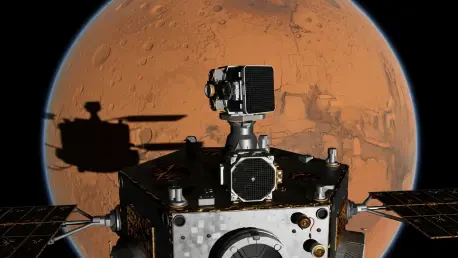

High above the crimson dust of the Martian landscape, a van-sized robotic emissary is currently executing a high-stakes celestial maneuver that relies on the precise physics of orbital mechanics. This complex operation involves a calculated flyby within 2,800 miles of the Red Planet, utilizing its immense gravitational pull to gain the necessary momentum for a deep-space voyage. Traveling at a staggering velocity of 12,333 miles per hour, the spacecraft is essentially performing a “slingshot” move that redirects its trajectory toward the outer reaches of the asteroid belt. Beyond the simple gain in speed, this proximity allows mission controllers to activate and calibrate sophisticated onboard sensors while capturing high-resolution imagery of the Martian surface and atmosphere. By coordinating these observations with the suite of rovers and orbiters stationed at Mars, researchers are conducting a multifaceted comparative analysis of the planet’s data.
Advanced Propulsion and the Quest for Metallic Origins
The journey toward the unique asteroid known as Psyche represents a significant leap in deep-space exploration technology, particularly through the use of solar electric propulsion. This system employs xenon gas thrusters, which provide an efficient acceleration over vast distances by ionizing gas and accelerating it with electric fields. Such technology is crucial for reaching a destination that defies the typical composition of most celestial bodies. Unlike the icy or rocky surfaces of most asteroids, Psyche appears to be composed predominantly of nickel and iron, which suggests that it is not a mere cluster of debris. Scientific hypotheses propose that this potato-shaped object may be the exposed core of an ancient protoplanet that lost its outer layers during violent collisions early in the formation of the solar system. Studying this metal-rich world offers a unique opportunity to peek inside the planetary building blocks that formed terrestrial planets.
Strategic Insights: Preparing for the 2029 Arrival
Successful execution of the Mars gravity assist provided a critical validation of the mission’s trajectory and the functional integrity of its scientific suite. While the primary objective remained the gain in orbital momentum, the data gathered during this phase established a robust baseline for the upcoming years of transit leading to the 2029 arrival. Moving forward, the scientific community focused on refining thermal models and magnetic field expectations based on these preliminary Martian readings. It became clear that the integration of multi-platform data would be essential for optimizing the orbital phase at the asteroid. To maximize the return on this investment, engineers prioritized the maintenance of solar array efficiency and the management of xenon fuel reserves. This methodical approach ensured that once the craft reached its target, it was fully prepared to uncover the structural secrets of a world that mirrors the iron core of our own planet.