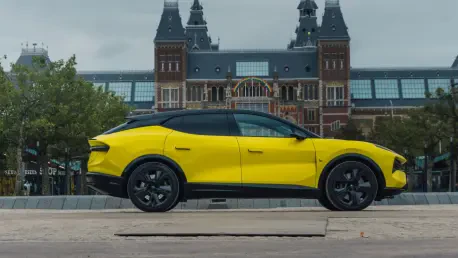

International markets now contribute 25% of XPeng’s first-half revenue, with the average selling price of these exported units exceeding the €40,000 threshold. This financial milestone highlights a fundamental shift for the automotive manufacturer as it transitions from a traditional export-heavy model to a localized production powerhouse in the heart of Europe. Central to this evolution is the G9L, an AI-driven flagship SUV that recently completed its first production trial at the Magna facility in Graz, Austria. By integrating this new model into a production ecosystem that already includes the G6 and P7+, the brand is demonstrating a commitment to “Physical AI”—the marriage of sophisticated Chinese software with European industrial precision. This move is calculated to navigate the complexities of international trade and logistics, ensuring that the final product feels natively tailored to the specific regulatory demands and consumer expectations found across the European continent.
Strategic Partnership: The Road to Paris
Collaboration Dynamics: The XPeng-Magna Alliance
The alliance between XPeng and the specialized manufacturing firm Magna began in earnest during the third quarter of 2025, quickly evolving into a strategic pillar for global expansion. By selecting the Graz facility as a primary hub, the company has gained access to decades of premium assembly experience, which is critical for competing with established luxury European brands. The collaboration ensures that every G9L rolling off the line benefits from the same high-level craftsmanship that Magna has historically provided to world-renowned performance labels. This partnership is not just about physical assembly; it represents a cultural and technical bridge where rapid-fire technological iteration meets the methodical consistency of traditional European engineering. As the facility scales up to meet demand, it serves as a testament to how international cooperation can optimize the production of complex, high-voltage vehicles while maintaining the specific quality standards expected by elite drivers.
The Validation Journey: From Graz to Paris
To validate the endurance and technical sophistication of the G9L, a pre-production unit recently embarked on a 1,324-kilometer journey from the Austrian factory to its official debut at the Paris Motor Show. This trek is far more than a ceremonial road trip; it functions as a rigorous, real-world crucible designed to test the vehicle’s integrated systems under a variety of environmental conditions. Engineers monitored the SUV’s long-range charging efficiency, autonomous driving features, and thermal management systems as it navigated through mountain passes and urban centers. By subjecting the vehicle to such a public and demanding trial, the company aims to demonstrate that its Physical AI technology is robust enough for the diverse infrastructure of the European continent. This journey provides critical data that helps refine the software before the first customer deliveries begin, ensuring that the transition from a controlled factory setting to the open road is seamless and reliable for early adopters.
Global Standards: Engineering Excellence
Global Marketplace: Rigorous Testing Protocols
Development of the G9L has been characterized by an exhaustive three-year validation program that covered more than 6.7 million kilometers of road testing across 26 different countries. This massive undertaking was essential to ensure the SUV could perform reliably in environments ranging from the freezing temperatures of the Arctic Circle to the intense heat of desert climates. The engineering team specifically focused on creating a platform that is compatible with both left- and right-hand-drive markets, a necessity for the company’s planned rollout to 64 countries. To guarantee occupant protection, the vehicle survived 192 individual crash tests and followed over 110 protocols to secure five-star safety ratings from agencies like E-NCAP and A-NCAP. This level of global scrutiny ensures that the vehicle meets the diverse regulatory requirements of multiple continents simultaneously, reflecting a commitment to durability that is foundational to the brand’s international reputation.
Driving Dynamics: Technical Innovation at Scale
The driving dynamics of the G9L are defined by a sophisticated AI-driven chassis system that offers a refined balance between high-end luxury and athletic agility. At the core of this system is a dual-chamber air suspension setup that allows for real-time adjustments to ride height and stiffness based on the road surface and driving mode. This hardware is complemented by intelligent variable damping, which actively minimizes body roll during cornering and enhances passenger comfort by smoothing out road imperfections. Maneuverability in narrow historic streets is further enhanced by an advanced rear-wheel steering system capable of a 15-degree steering angle. These physical capabilities are orchestrated by the proprietary Turing AI chips, which process vast amounts of sensor data to make micro-adjustments in milliseconds. The result is a vehicle that feels intuitively connected to the driver, anticipating road conditions and reacting with a precision that pure mechanical systems cannot match.
Market Trajectory: Economic Footprint
International Growth: Accelerating Market Momentum
The international trajectory of the brand has shown remarkable acceleration throughout 2026, with over 100,000 units now delivered to customers outside of the domestic Chinese market. Europe has emerged as a particularly strong region, accounting for more than 60,000 of those total sales, with the French market showing notable receptivity to the brand’s high-tech offerings. In the second quarter of 2026 alone, overseas deliveries surpassed 20,000 units, marking an 81% year-on-year increase that far outpaces the growth of many established competitors. This surge suggests that the focus on intelligent features and premium build quality is successfully attracting a demographic that values technological innovation over brand heritage. Furthermore, with an average selling price exceeding €40,000, the company is proving its ability to compete in the premium segment rather than relying on low-cost strategies, building a sustainable business model that supports further investment in localized infrastructure.
European Integration: Building a Sustainable Future
The successful rollout of the G9L established a new benchmark for cross-continental industrial cooperation by proving that Chinese innovation could be harmoniously integrated with European manufacturing traditions. Leaders at both XPeng and Magna concluded that local production was the only sustainable path for long-term success, as it allowed the brand to integrate into the local supply chain and contribute directly to the regional economy. This project demonstrated that the future of mobility depended on the ability to merge software expertise with hardware precision in a way that satisfied the world’s most demanding critics. For industry stakeholders, the primary takeaway was the importance of early localization and the aggressive validation of AI systems in real-world environments. Moving forward, the lessons learned from the Graz production trial informed the next generation of global automotive strategy, signaling that true market leadership required a deep commitment to regional industrial roots.