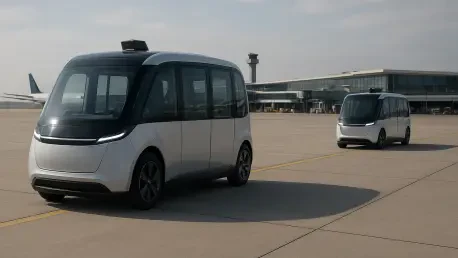

The transition to fully autonomous service scheduled for 2025 follows several years of rigorous testing and data collection under human supervision. This strategic shift at Tallinn Airport has redefined the boundaries of aviation ground operations by successfully integrating driverless technology into its high-security workflow. This milestone marks the first time an international airport has moved beyond experimental prototypes to deploy a fully functional commercial service within airside zones. By partnering with the Estonian innovator Auve Tech, the airport has addressed persistent logistical bottlenecks associated with aircraft maintenance and specialized part delivery. These MiCa shuttles represent a fundamental transition in airport management, moving away from conventional human-operated vehicles toward a more predictable, data-driven framework. This implementation provides a scalable blueprint for other global hubs facing labor shortages and rising costs in the post-2026 aviation landscape, proving that autonomous systems are ready for the most demanding environments.
Mastering Regulatory and Safety Standards
The Challenge: Navigating High-Security Airfields
Managing an active airfield is vastly more complex than navigating a standard city street due to the rigid safety protocols and the high cost of any operational disruption. For years, the integration of autonomous vehicles was hindered by the need for constant human oversight, as safety boards required absolute certainty before allowing driverless systems near multi-million dollar aircraft. The achievement of a permit to operate without an on-board safety operator was described as a significant breakthrough, made possible by the exhaustive analysis of terabytes of operational data. This permit was not granted lightly; it required a collaborative effort between the airport’s safety board and technology developers to review performance metrics on a weekly basis. By demonstrating that the autonomous system could consistently outperform human reaction times in critical scenarios, the project established a new regulatory standard for the industry. This level of institutional trust is now paving the way for other airports to reconsider their safety frameworks, moving toward a future where autonomous logic is a trusted component.
Precision Engineering: The Level 4 Advantage
The technical foundation of the MiCa shuttle rests on Level 4 autonomy, which enables the vehicle to handle all driving tasks within a geofenced environment without human intervention. To navigate the crowded and often unpredictable tarmac, each shuttle is equipped with a sophisticated sensor suite including ten high-definition cameras and seven LiDAR sensors. This configuration provides a comprehensive 360-degree view, allowing the shuttle to map its surroundings in real-time and detect obstacles with pinpoint accuracy. The system is specifically tuned to recognize the unique profiles of aircraft wings and ground equipment. Safety remains the paramount programming priority, often manifesting as an extreme caution that exceeds human capabilities. For instance, the shuttle is programmed to execute an immediate hard brake if it detects even a minor intrusion, such as a bird or debris crossing its path, ensuring that no risk is taken near active runways. This safety-first bias is essential for operating in close proximity to parked jets where space is limited and the margin for error is non-existent.
Unlocking Commercial Profitability
Remote Oversight: Redefining the Human Role
While the vehicles are capable of making independent decisions on the tarmac, the project does not eliminate human involvement but rather relocates it to a more efficient setting. Human oversight has transitioned to a centralized tele-monitoring room, where a single operator can supervise the status of an entire fleet. This remote supervisor acts as a fail-safe, intervening only when a shuttle encounters a glitch or a scenario that falls outside its programmed parameters. This structural change is what ultimately makes the transition from a tech experiment to a viable business model. The economic logic of this arrangement is centered on the break-even ratio of human supervisors to autonomous units. Industry experts have identified that when one remote operator can manage three or more shuttles simultaneously, the cost of the service drops significantly below that of traditional human labor. This shift from one-to-one driving to a one-to-many supervision model is the primary catalyst for rapid scaling. By 2026, the focus has shifted toward refining these remote interfaces to ensure that oversight remains manageable.
Operational Efficiency: Impact on Maintenance Logistics
For large-scale maintenance organizations like Magnetic MRO, ground transport has traditionally been a necessary but expensive cost center. The shuttles are currently utilized to move personnel, specialized tools, and aircraft spare parts across the airfield, covering approximately 50,000 kilometers annually. By automating these repetitive trips between hangars and the tarmac, the company has successfully mitigated the impact of staff turnover and logistical delays caused by human scheduling. This transition allows skilled mechanics to focus on their technical tasks rather than spending time behind the wheel of a transport van. Adopting such out of the box technological solutions has become a survival strategy for smaller aviation players competing with global giants. By removing the unpredictability of human-driven logistics, companies can achieve a level of operational consistency that was previously impossible. This reliability is particularly valuable in aircraft maintenance, where every minute of downtime translates into significant financial losses. The integration of autonomous shuttles has effectively transformed transport into a streamlined, automated asset.
Scaling Autonomous Solutions Globally
Global Expansion: From Logistics to Passenger Care
The successful implementation at Tallinn Airport has attracted significant interest from international aviation hubs in Japan, Abu Dhabi, and the United States. These organizations recognize that the infrastructure built for moving cargo and maintenance teams can be readily adapted to improve the passenger experience. While the current focus remains on high-security logistics, the roadmap for the next few years includes a transition toward VIP passenger transport and automated gate-to-gate transfers. This expansion suggests that the utility of autonomous shuttles will soon extend far beyond the technical zones of the hangar. As the technology matures throughout 2026 and beyond, the focus will likely shift toward creating a seamless mobility as a service ecosystem within the airport boundary. Automated transfers could reduce wait times for travelers and decrease the congestion caused by traditional shuttle buses. By leveraging the data collected during these early logistical phases, developers are refining the passenger-facing aspects of the shuttles, such as interior comfort and user interface.
Future Readiness: Integrating Closed-Environment Autonomy
The lessons learned from the Tallinn deployment showed that closed environments were the ideal testing grounds for Level 4 autonomy. Unlike public roads, airports offered controlled variables and predictable traffic patterns, which allowed regulators to gain confidence in removing on-board human operators. Stakeholders emphasized that success depended on rigorous data collection and a commitment to safety over speed. The process demonstrated that once the initial regulatory hurdles were cleared, the economic benefits of autonomous transport became undeniable, paving the way for a more widespread adoption across various industrial sectors. Future considerations for airport operators focused on upgrading digital infrastructure to support real-time tele-monitoring and fleet management. It was clear that the removal of the safety driver was the final piece of the puzzle, transforming the shuttle from a technological marvel into a sustainable business tool. Ultimately, the project proved that with the right combination of sensor technology and remote oversight, the era of human-driven airport logistics had begun its conclusion.