
The garment industry has long stood as a stubborn outlier in the global landscape of industrial automation, clinging to labor-intensive manual processes while sectors like automotive and electronics transitioned into highly digitized environments. While robots have mastered the art of handling rigid components like steel and silicon, the garment industry has remained stuck in a cycle of offshore production due to the sheer complexity of fabric. Textiles are inherently unpredictable; they stretch, fold, and drape in ways that traditional, pre-programmed industrial robots cannot manage. However, recent breakthroughs in Physical AI and robotics are finally offering a roadmap to bridge this technological gap. By 2026, the focus has shifted toward creating systems that do not just follow a path but actually understand the material they are touching. This evolution represents a critical turning point for a trillion-dollar industry that has historically been defined by its reliance on low-wage manual labor. As these technologies mature, the possibility of a fully autonomous factory floor moves from a theoretical concept to a tangible reality, promising to reshape how the world thinks about clothing production and supply chain management.
Addressing the Complexities: Managing Deformable Textiles
The primary technical hurdle in this evolution is known as deformable-material manipulation, a field that has long perplexed roboticists due to the chaotic nature of soft goods. Unlike a car door or a circuit board, a piece of fabric changes its shape every time it is touched, creating a state of partial observability for robotic sensors where the machine cannot fully predict how the material will behave once moved. To overcome this, the next generation of garment manufacturing relies on Physical AI—a system capable of real-time perception and adaptation that mimics the intuitive touch of a human operator. These machines must possess a high degree of material-state awareness, allowing them to infer how a fabric panel is behaving even when parts of it are hidden or shifting under tension. By integrating advanced computer vision with force-sensitive actuators, these robots can now detect micro-folds and subtle stretches that would have previously caused a mechanical jam. This leap in sensory capability is what finally allows automation to move from the rigid world of metals into the fluid and unpredictable world of textiles.
To effectively manage these materials, Physical AI models are trained on massive datasets of cloth physics, enabling them to predict the nonlinear behavior of different weaves and knits. When a robotic arm picks up a piece of denim versus a piece of silk, the underlying software adjusts the tension and grip speed instantaneously to prevent distortion. This level of granular control is essential because even a slight misalignment in the early stages of assembly can lead to a ruined garment. By utilizing synthetic data and real-world reinforcement learning, manufacturers have developed “digital twins” of fabrics that allow robots to practice maneuvers in a virtual environment before executing them on the factory floor. This proactive approach ensures that the machine can handle common issues like static electricity or edge-fraying without human intervention. As a result, the robotic systems of 2026 are not merely blindly executing commands; they are actively interpreting their environment and making split-second decisions to maintain the structural integrity of the textile during every phase of the manufacturing process.
Revolutionary Assemblies: Replacing Stitching with Bonding
The traditional method of garment assembly—sewing—is perhaps the greatest obstacle to large-scale automation because it was perfected for human hands, which possess unparalleled dexterity. Human operators can make instantaneous micro-adjustments as fabric moves through a needle, a skill that is incredibly difficult to replicate with a robotic arm. Historically, attempts to automate sewing have led to overly complex and fragile systems that required constant maintenance and human supervision. Because textiles are in constant motion during the stitching process, the margin for error is incredibly slim, often resulting in misaligned seams or bunched fabric. To solve this, innovators are looking toward a first-principles redesign of the manufacturing process by replacing traditional sewing with adhesive bonding. Unlike stitching, which requires dynamic material manipulation and high-speed mechanical puncture, adhesives allow fabric panels to be held in a static, fixtured state during the joining process. This shift simplifies the robotic requirements significantly, moving the focus from impossible dexterity to high-precision placement and thermal application.
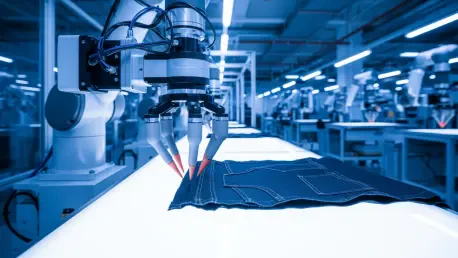
Adhesive bonding draws heavy inspiration from high-volume industries like footwear and consumer electronics, where precision bonding has already become the standard for durability and aesthetics. By stabilizing the material before it is joined, companies can eliminate the unpredictable variables of sewing and make robotic automation far more feasible and scalable. In this model, fabric panels are laser-cut and then picked up by vacuum-based grippers that hold the material perfectly flat. A robotic dispenser applies a specialized adhesive or a thermal bonding film to the edges, and a second arm places the corresponding panel on top. A heat press then cures the bond, creating a seam that is often stronger and more flexible than a traditional thread-based stitch. This method not only reduces the mechanical complexity of the robotic cell but also allows for the creation of seamless garments that offer superior comfort and performance. By moving away from the needle and thread, the industry is effectively removing the “softness” problem from the assembly line, treating textiles more like the semi-rigid components found in other successful automated sectors.
Technological Foundations: Sensors and Physical Feedback
Building a robotic system capable of manufacturing clothing requires a sophisticated stack of hardware and software that goes far beyond the capabilities of standard industrial arms. At the core of this infrastructure are intelligent grippers designed to handle various fabric weights and textures without causing damage or leaving marks. These grippers provide the essential sensory feedback needed to manage material tension and alignment, acting as the “fingertips” of the Physical AI system. Some of the most advanced designs utilize electro-adhesion or soft-actuator technology to gently grasp delicate fabrics like lace or chiffon while maintaining enough force to move heavy wool. Furthermore, simplifying the assembly design to allow for single-sided access reduces the mechanical complexity of the robotic cell, ensuring that the automation process remains efficient and less prone to mechanical failure. This specialized hardware ensures that the robot can interact with the physical world with a level of nuance that was previously reserved for skilled human artisans.
The success of these hardware components depends on a continuous feedback loop between perception and action, where the Physical AI must close the gap by seeing the fabric’s geometry and immediately adjusting the robot’s motion planning. This level of precision ensures that the machine can handle the nonlinear behavior of textiles, such as stretching or wrinkling, in the same way a skilled human operator would. When a sensor detects that a panel is beginning to sag, the software recalibrates the gripper’s path in milliseconds to compensate for the change in gravity. By integrating materials science with real-time computational awareness, the factory floor becomes an intelligent environment capable of high-speed, high-quality production. This integration of high-resolution cameras, tactile sensors, and rapid-response processors creates a cohesive system that can learn from its mistakes. Over time, these machines become more efficient as they encounter a wider variety of textile types, building a library of “physical knowledge” that can be shared across a global network of automated micro-factories.
Economic Resilience: Reshoring and Supply Chain Stability
The shift toward automated apparel manufacturing offers a solution to the chronic supply-demand mismatch that defines the current fashion industry. Most brands today produce goods in distant, low-cost labor markets, leading to lead times that span several months and massive financial losses when trends shift before the product arrives. Automated manufacturing allows for near-shoring, or bringing production back to high-cost economies like the United States and Europe, where production can happen within days of an order being placed. By producing closer to the point of demand, brands can reduce their reliance on long-distance shipping and become far more responsive to market changes. This proximity also mitigates the risks associated with geopolitical instability and fluctuating freight costs, which have plagued the global supply chain in recent years. When the distance between the factory and the consumer is minimized, the entire business model shifts from a push-based system to a pull-based system, where production is driven by actual sales rather than speculative forecasts.
This economic shift is not just about saving on labor; it is about inventory efficiency and the elimination of the “deadstock” problem that costs the industry billions annually. When garments can be produced quickly and locally, the risk of overproduction is significantly minimized because brands no longer need to commit to massive bulk orders months in advance. Automation also addresses the growing scarcity of specialized manual sewing skills in developed nations, providing a way to revitalize domestic manufacturing without the need for a massive, low-wage workforce. This results in a more resilient supply chain that is less vulnerable to global disruptions, ultimately creating a more stable and profitable business model for clothing brands. Furthermore, the ability to manufacture at scale within domestic borders allows for the emergence of “on-demand” fashion, where custom-fitted garments are produced with the same efficiency as mass-market basics. This hyper-localization of the manufacturing process represents the most significant restructuring of the apparel industry since the dawn of the industrial revolution.
Strategic Transitions: Sustainability and Cross-Industry Growth
Beyond the economic advantages, the move toward robotic bonding supports a more sustainable and circular fashion economy that was previously impossible to achieve. Traditional stitched seams are difficult and expensive to separate, making the recycling of old garments a major challenge that often leads to millions of tons of textile waste in landfills. However, the use of thermoreversible adhesives allows for garment-to-garment recycling, where bonding agents can be undone to separate materials at the end of a product’s life. This design-for-disassembly approach, combined with a made-to-demand production model that reduces landfill waste, offers a clear path toward a cleaner industry. By 2026, brands have begun to realize that sustainability is not just a marketing term but a structural necessity that can be solved through engineering. The implementation of closed-loop systems ensures that fabrics can be reclaimed, cleaned, and re-bonded into new items, drastically reducing the industry’s reliance on virgin raw materials and lowering the overall carbon footprint of each garment.
The industry recognized the necessity of these technological advancements as early as the start of 2026, when supply chain volatility reached a critical breaking point. By shifting to robotic bonding and Physical AI, manufacturers successfully mitigated the risks associated with manual labor dependencies and long-distance logistics. This strategic pivot allowed brands to capitalize on real-time data, ensuring that production schedules aligned perfectly with consumer demand. Stakeholders invested heavily in the cross-training of technical staff, who transitioned from manual sewing to managing the complex software-defined factory floors of the new era. Ultimately, the adoption of these technologies paved the way for a more resilient and environmentally conscious apparel sector. The resulting infrastructure enabled a true circular economy, where garments were designed for disassembly and materials were reclaimed with unprecedented efficiency. These steps established a foundation for growth from 2026 to 2030 that prioritized precision, sustainability, and local economic health over the outdated models of the previous century.