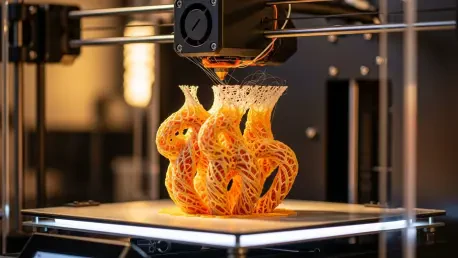

The fabrication of physical objects has long been a slow and methodical dance of depositing material layer by layer, but the arrival of Digital Incoherent Synthesis of Holographic light fields, or DISH, has shattered the long-standing time barriers of the additive manufacturing industry. This sophisticated technology represents a departure from the incremental movements that defined the field for decades, propelling modern manufacturing toward a reality where complex geometry is summoned into existence in less than a single second. By synthesizing recent breakthroughs in high-speed optics, fluid dynamics, and advanced material science, DISH achieves the fabrication of intricate three-dimensional structures with a precision and velocity that were once relegated to the realm of science fiction. The capability to transition from a digital blueprint to a tangible, high-resolution object in just 0.6 seconds effectively removes the mechanical bottlenecks that have historically limited 3D printing to small-scale prototyping rather than full industrial production.
The Historical Shift: From Layered Deposition to Volumetric Synthesis
Traditional additive manufacturing has relied heavily on the stacking of two-dimensional cross-sections, a process that is fundamentally limited by the physical speed at which a printer head or a laser can traverse a build plate. Whether using fused deposition modeling or stereolithography, the necessity of repeating these mechanical motions thousands of times creates an inherent trade-off between the desired resolution and the time required to complete a print. Increasing the velocity of these systems often introduces unwanted vibrations and thermal stresses, which compromise the structural integrity and surface finish of the final component. These physical constraints have kept 3D printing sidelined in many high-volume industries, where the rapid turnaround of injection molding remains the gold standard. Consequently, engineers have spent the years leading up to 2026 searching for a way to decouple the manufacturing process from the slow, mechanical movement of individual hardware components.
The introduction of early volumetric additive manufacturing systems offered a glimpse into a faster future by attempting to solidify an entire volume of resin simultaneously through a rotating container. In these models, a projector cast a sequence of images into a spinning vat of light-sensitive liquid, allowing the material to reach a chemical solidification threshold at specific coordinates. While this was a notable improvement over layering, it introduced a new set of complications, such as centrifugal forces that distorted the forming object and limited the use of low-viscosity resins. To maintain structural stability during the rotation, users were forced to utilize thick, syrupy materials that hindered the printing of fine details and internal channels. These limitations meant that while the process was faster, it remained restricted by the physics of motion, preventing the technology from achieving the extreme precision and material flexibility required for more demanding industrial and scientific applications.
The DISH Methodology: Mastering Light Without Mechanical Motion
The fundamental innovation that sets DISH apart from its predecessors is the elimination of all motion within the resin container itself, ensuring that the liquid remains perfectly still throughout the entire fabrication process. Rather than rotating the vat, the system employs a high-speed rotating periscope that circles the stationary sample, projecting light from every angle with mathematical precision. This hardware configuration is integrated with an advanced array of digital micromirror devices that can modulate and alter the light field thousands of times every second. By moving the light rather than the material, the system avoids the vibrations and centrifugal distortions that plagued earlier volumetric printers. This shift allows for a level of stability that enables the use of low-viscosity resins, which are essential for creating highly detailed parts with smooth finishes. The result is a manufacturing environment where the only limiting factor is the speed of light and the chemical reaction of the specialized resin.
A sophisticated algorithm for holographic optimization serves as the intelligence behind this hardware, ensuring that the light energy is focused exactly where it is needed within the liquid volume. By synthesizing incoherent light fields, the printer can maintain a uniform resolution of approximately 19 micrometers across the entire build area, which is significantly thinner than a human hair. This precision is maintained even as the light passes through varying depths of the resin, allowing for the creation of complex internal geometries that would be impossible to support in traditional printers. The ability to control light at this granular level means that designers can now include functional internal components, such as micro-channels or interlocking parts, without fearing structural collapse during the print. Because the material remains stationary, the chemical bonds form more uniformly, leading to isotropic mechanical properties that ensure the final object is strong in all directions, a common weakness in layered prints.
Industrial Throughput: Transforming Prototyping into Mass Production
Achieving a printing time of under 0.6 seconds is a milestone that bridges the gap between small-scale prototyping and the high-volume requirements of modern factory floors and global supply chains. Historically, additive manufacturing could not compete with the sheer output of traditional injection molding due to the hours required for each build. However, the stationary nature of the DISH system allows it to be integrated into continuous fluid channels where resin flows like a conveyor belt. In this setup, an object is synthesized almost instantly, then carried away by the natural current of the liquid to be collected while the next part begins printing immediately. This continuous production cycle suggests a future where 3D printing can handle thousands of units per hour, making it a viable alternative for the mass manufacturing of consumer goods, automotive components, and electronics. The reduction in cycle time also drastically lowers the energy consumption per part, improving the overall sustainability.
The medical and pharmaceutical sectors are perhaps the most immediate beneficiaries of this rapid synthesis, as the speed of DISH allows for the real-time production of personalized healthcare solutions. In clinical environments, medical professionals can now envision a scenario where custom dental implants or hearing aid shells are printed and fitted during the span of a single patient consultation. Furthermore, the ability to work with fragile hydrogels without the mechanical stress of traditional printing opens new doors for advanced biological research and tissue engineering. Scientists can use this technology to print intricate scaffolds that mimic human vascular systems, providing a foundation for drug testing that is far more accurate than traditional flat petri dish models. By printing thousands of these micro-structures in minutes, pharmaceutical companies can accelerate the testing of new treatments, observing how chemical compounds interact with complex 3D biological geometries without the long delays of old methods.
Material Science Innovation: Unlocking New Chemical Potentials
The extreme speed of the DISH process also provides a unique advantage in material science by essentially freezing a material’s chemical state before it has any chance to settle or separate. Many high-performance resins contain specialized additives, such as conductive particles or reinforcing fibers, that tend to sink to the bottom of the vat if a print takes more than a few minutes. In traditional slow-printing systems, these materials lose their homogeneity, resulting in parts with inconsistent physical properties or failed builds. Because DISH completes the entire solidification process in less than a second, these complex mixtures remain perfectly suspended, ensuring that the final product possesses the exact chemical distribution intended by the engineers. This “freeze-frame” effect allows for the use of a much wider array of elastic, rigid, and biocompatible resins that were previously deemed too unstable for additive manufacturing, expanding the toolkit for designers and materials scientists.
Looking back at the deployment of holographic printing, it was clear that the strategic focus of major market leaders shifted toward high-end industrial and bioprinting applications to capitalize on this speed. Companies like 3D Systems led the way by prioritizing the development of vascularized tissues and organ components, where the delicate handling of biological matter was a non-negotiable requirement. The industry moved toward a decentralized manufacturing model where hardware became more compact and holographic control software became accessible to a broader range of engineers. Professionals in the aerospace and automotive sectors adopted these stationary light-based systems to produce lightweight, high-precision internal components that reduced fuel consumption and improved performance. By removing the time penalty for design errors, organizations fostered a culture of rapid experimentation that essentially closed the gap between conceptualization and physical reality. The transition to light-based synthesis ultimately democratized complex production.