
Future supply security is achieved at the point of industrial use rather than at the initial point of battery collection. As the global transition toward electric transportation matures, the role of recycling has shifted from a peripheral sustainability goal to a central pillar of national security and economic sovereignty. For years, the emphasis remained on collection rates and the sheer tonnage of materials diverted from landfills, yet these figures often masked a fundamental vulnerability in the midstream processing sector. True security requires that recovered materials be indistinguishable from virgin inputs in terms of purity and performance. This necessitates a move away from fragmented recovery efforts toward a unified industrial ecosystem where recyclers and cell manufacturers operate in lockstep. The value of a recycled battery is not found in its metallic weight, but in its ability to re-enter the production line without compromising the energy density or safety of the next generation of power cells. Strategic integration now dictates how nations manage their internal resource loops.
Closing the Gap: From Black Mass to Manufacturing
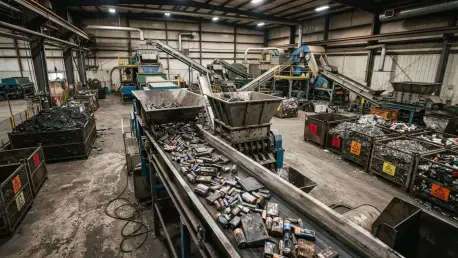
A significant hurdle in the current landscape is the disconnect between recycling facilities and the factories they are meant to serve. Many recyclers produce intermediate products like black mass, which still require substantial chemical refining before they can be used in new cells. Without high-purity processing capabilities, local factories remain reliant on imported raw materials, even when recycling centers are running at full speed, creating a paradox where domestic supply exists but remains unusable. This gap is particularly evident in regions that invested heavily in mechanical shredding but neglected the complex hydrometallurgical refining necessary for high-grade output. To resolve this, facilities must incorporate advanced solvent extraction and crystallization phases that yield battery-ready sulfates. Bridging this technical divide ensures that the material loop is not just closed but is also economically and industrially productive for the domestic manufacturing base.
The evolution of the industry demands a shift toward customer qualification, where recyclers operate as material science partners rather than traditional waste managers. Manufacturers do not buy generic metals; they demand specific chemical formulations and precise particle morphologies tailored to their unique cathode designs. For a recycling system to be truly effective, its output must serve as a direct, high-quality substitute for virgin raw materials at the factory gate, ensuring that the circular loop is actually functional. This requires rigorous testing protocols and a deep understanding of the evolving chemistries, such as the shift from high-cobalt designs to lithium iron phosphate or nickel-rich variants. When recyclers can guarantee that their materials meet these exacting standards, they reduce the risk for cell producers and stabilize the supply chain against price volatility. Strengthening these partnerships allows for a more responsive and resilient manufacturing cycle.
Strategic Policy: Investment in Chemical Infrastructure
Building a secure supply chain requires more than just investment in shredding capacity. Industrial policy must support the complex chemical engineering required to transform battery waste into high-value precursors and active materials. While mining minerals is the first step, the subsequent refining and electrode production stages are currently concentrated in a few global regions, creating a vulnerability that domestic recycling must address through local infrastructure. Governments are increasingly recognizing that material autonomy is impossible without the capability to refine black mass into precursor cathode active materials locally. This shift in policy focus involves providing tax incentives and grants specifically for advanced chemical processing plants rather than simple collection hubs. By incentivizing the development of full-spectrum recovery facilities, nations can insulate themselves from geopolitical disruptions that often affect the global trade of refined battery chemicals.
Innovation is playing a crucial role in this transition, with a massive surge in patents related to automated sorting and advanced material recovery since 2026. These technological leaps are essential for handling the evolving chemistry of batteries and ensuring that recovery processes remain economically viable. Automated systems utilizing artificial intelligence and machine learning can now identify battery types and chemistries with high precision, reducing contamination and improving the quality of the recovered minerals. However, these innovations must be scalable and capable of producing consistent results to win the trust of large-scale manufacturers who demand strict purity standards. New methods, such as direct recycling which bypasses the breakdown into elemental sulfates, offer the potential to retain the value of the engineered cathode structure itself. As these technologies move from pilot phases to industrial scales, they will define the competitive landscape of the circular economy.
Managing Material Availability: The Impact of Longevity
A major challenge for the industry is the timing gap caused by the increasing longevity of electric vehicle batteries. Modern battery management systems and the rise of second-life applications, such as grid storage, mean that batteries are staying in use much longer than initially expected. While this is beneficial for sustainability, it delays the availability of end-of-life feedstock, forcing recyclers to look elsewhere for material in the short term. This longevity extension effectively shifts the primary recycling volume to a later date, complicating the business models of facilities that rely on a steady stream of discarded packs. Furthermore, as vehicle-to-grid technologies become more prevalent, the incentive to keep batteries in active service grows even stronger. This scenario necessitates a strategic approach to feedstock management, where recyclers must secure long-term agreements with fleet operators and storage providers to ensure a predictable flow of materials.
In the interim, the primary source of recycled material will be production scrap from existing cell manufacturing plants rather than old vehicles. This makes the recycling industry deeply dependent on the efficiency and scale of local battery production. As large-scale gigafactories continue to expand, the scrap generated during the early phases of production provides a high-quality, predictable feedstock that lacks the contamination issues often found in post-consumer waste. Additionally, the global movement of used vehicles means that materials sold in one region may eventually be recycled in another, further complicating domestic supply forecasts and security. A car sold in North America might find its second or third life in a developing market, effectively exporting its critical minerals away from the original manufacturer’s reach. This highlights the need for international cooperation and tracking systems to ensure that valuable resources can eventually be reclaimed.
Industrial Logistics: The Importance of Geographic Alignment
To avoid misleading statistics, the industry needs a more transparent way to track progress. Current reporting often confuses simple pretreatment capacity with the sophisticated chemical refining needed for battery-grade output. A segmented reporting structure that tracks material from the point of acceptance through refining and finally to integration is necessary to identify where actual bottlenecks exist in the supply chain. For instance, a country might boast massive shredding capacity while lacking any facility capable of producing battery-grade lithium carbonate. This lack of transparency can lead to misallocated investments and a false sense of security. By adopting standardized metrics that differentiate between input capacity and usable material output, policymakers can better direct resources toward the specific technological gaps that hinder circularity. Clearer data will also allow investors to distinguish between high-value refining projects and simple waste processing operations.
Geography also plays a vital role in the economic success of recycling networks. Large-scale recycling hubs must be strategically located to minimize transportation costs and match the specific battery chemistries found in local markets. A mismatch between plant technology and the available waste stream can lead to logistical inefficiencies that undermine the primary goal of material security. For example, a facility designed for nickel-manganese-cobalt batteries will struggle to operate profitably in a market dominated by lithium iron phosphate cells. Proximity to both the sources of production scrap and the end-users of refined chemicals is essential for maintaining thin margins and reducing the carbon footprint of the recycling process. Regional clusters that co-locate battery manufacturing, usage hubs, and recycling facilities create a symbiotic environment where material flows are optimized, reducing the reliance on volatile international shipping routes and long-distance haulage.
Reimagining Resource Management: A Service-Based Perspective
Securing the supply chain requires a shift toward a service-based view of material security. This approach prioritizes maximizing the utility of minerals throughout their entire life cycle, whether through long-term vehicle use, vehicle-to-grid integration, or efficient recycling. By treating battery circularity as a discipline of material science rather than waste management, stakeholders can ensure that every gram of recovered material contributes to a resilient industrial future. This perspective encourages manufacturers to design batteries for ease of disassembly and material recovery, effectively viewing the battery as a temporary vessel for valuable minerals that will eventually return to the production line. Such a mindset also promotes the development of digital battery passports, which track the chemical composition and history of each unit. This data-driven approach simplifies the recovery process and ensures that recyclers can optimize their chemical processes for the specific material they receive.
The industry moved toward a future where material security was defined by high-purity chemical reintegration. Stakeholders recognized that simply shredding batteries did not constitute a secure supply chain; instead, they focused on developing the advanced hydrometallurgical infrastructure needed to meet the precise requirements of cell producers. This evolution allowed for the domestic recovery of critical minerals, significantly reducing the dependence on foreign mining and refining operations. As these systems matured, they demonstrated that the circular economy was not just a sustainability goal but a practical necessity for industrial stability. The integration of advanced tracking and automated sorting ensured that material quality remained high, while strategic location choices minimized the logistical costs associated with resource recovery. Ultimately, the successful transition to a closed-loop system provided the foundation for a more resilient and self-sufficient global battery market that thrived on precision.