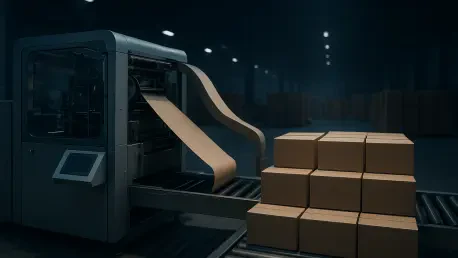

Switching between summer and winter insulation configurations no longer requires complex SKU management or the disposal of obsolete pre-ordered stock. This breakthrough in distribution efficiency stems from a fundamental shift in how high-volume facilities approach secondary packaging needs. Traditionally, logistics managers were forced to play a high-stakes guessing game, placing massive orders for pre-fabricated insulation and padded mailers months in advance based on volatile market forecasts. When those forecasts missed the mark, the result was a warehouse overflowing with unneeded material or a sudden shortage that crippled shipping throughput. Today, the introduction of on-demand production systems has rendered these logistical bottlenecks obsolete by moving manufacture directly to the warehouse floor. By utilizing dense, raw paper rolls, companies are now able to generate exactly what they need at the precise moment an order is processed, ensuring every shipment is protected at the point of origin.
Solving the Challenges of Material Procurement
Strategic Elimination of the Forecast Gap
The inherent unreliability of long-term demand forecasting has long served as a primary source of friction within the supply chain, particularly for third-party logistics providers handling diverse product portfolios. Before the widespread adoption of on-site fabrication, a single change in product dimensions or a seasonal shift in temperature-sensitive shipping requirements could render an entire pallet of pre-ordered packaging useless. This mismatch, often referred to as the forecast gap, forced many operations to dedicate vast swaths of valuable floor space to storing just-in-case inventory. However, the WaveKraft On-Demand Production System addresses this inefficiency by converting raw material into finished goods in real-time. A single truckload of raw paper rolls now provides the same volume of packaging material as ten truckloads of pre-fabricated finished products. This massive increase in material density allows facilities to reclaim nearly eighty percent of their storage space.
Reclaiming Infrastructure Through Material Density
Beyond the immediate benefits of space reclamation, the transition to on-demand manufacturing significantly optimizes the broader logistics network by reducing middle-mile transportation requirements. When a facility manufactures its own padded mailers and insulation panels, it eliminates the need for frequent, fuel-heavy deliveries of bulky, air-filled packaging components. This shift not only lowers overhead costs but also aligns with corporate environmental targets by drastically cutting the carbon footprint associated with shipping empty space. Large-scale shippers, such as WebstaurantStore, have demonstrated that integrating these systems allows for instantaneous adjustments to packaging specs without the friction of new purchase orders or tooling lead times. This level of agility is critical in a market where shipping speed and precision are non-negotiable. Consequently, the warehouse evolves from a mere storage node into a functional production hub for fulfillment.
Efficiency Benchmarks and Performance Standards
Material Innovation and Shipping Protection
The performance of modern paper-based packaging has reached a point where it can successfully compete with traditional plastic-based alternatives. The WaveKraft Padded Mailer serves as a prime example, offering forty-five percent better shock absorption than standard plastic bubble mailers while meeting the rigorous shipping protocols established by major retailers like Amazon. This superior protection is achieved through a multi-layered construction where cushioning properties are built directly into the walls of the mailer. Because the material itself provides the necessary impact resistance, packers no longer need to spend time adding secondary void-fill materials such as air pillows or crumpled kraft paper to every box. This one-grab packing process significantly reduces the physical movements required by warehouse staff, leading to a more ergonomic and rapid fulfillment workflow. By eliminating the need for separate dunnage, the system ensures that every package is compact and safe.
Practical Implementations for Future Distribution
The transition toward on-site manufacturing provided a blueprint for organizations seeking to decouple their operational success from the constraints of traditional supply chains. By prioritizing material density and localized production, forward-thinking logistics managers effectively eliminated the waste associated with over-ordering and the spatial limitations of bulky inventory. The integration of high-performance paper solutions demonstrated that sustainability and operational speed were not mutually exclusive goals, but rather complementary aspects of a modern distribution strategy. Future implementations likely expanded these principles to include more diverse material types and even more granular customization options at the individual parcel level. To capitalize on these advancements, facilities needed to audit their current floor plans and procurement cycles to identify where raw material conversion could replace finished good storage. Ultimately, the move toward a flexible model empowered companies to respond.