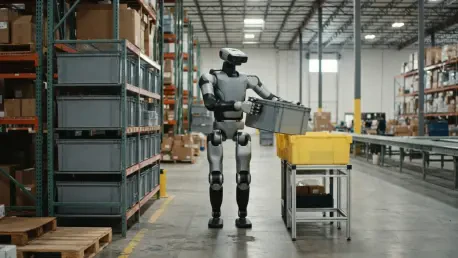

Cloud-based fleet management platforms like Agility Arc now allow enterprises to coordinate hundreds of robots across multiple global facilities from a single interface. This capability marks a definitive shift from the era of isolated laboratory experiments to a period of robust industrial integration. As the global labor market continues to tighten, particularly in physically demanding sectors like logistics and heavy manufacturing, the deployment of humanoid machines is no longer a futuristic curiosity but a strategic necessity. Financial markets are responding with unprecedented enthusiasm, as seen in massive funding rounds and successful public debuts that value these technology providers in the billions. The focus has moved toward creating Physical AI, where sophisticated neural networks are embodied in agile hardware capable of navigating the same environments designed for humans. By streamlining the path from software development to physical execution, companies are effectively closing the gap between digital intelligence and manual productivity.
Global Capital: Scaling Physical AI Through Massive Investment
The scale of investment currently flowing into the humanoid sector is perhaps best exemplified by the recent activities of Munich-based Agile Robots. Securing a $500 million Series F funding round led by the SoftBank Group, the company has attained a valuation exceeding $8.5 billion, a figure that reflects deep institutional confidence in the long-term utility of mobile automation. This capital injection is not merely speculative; it is backed by strategic participation from heavyweights such as Nvidia and Hitachi Ventures. The primary objective for these funds is the rapid expansion of production capabilities to meet a surging global demand for adaptable machines. By focusing on Physical AI, Agile Robots is developing systems that possess the dexterity and sensory awareness required to perform precision assembly in electronics and sensitive handling in healthcare. This approach allows the robots to transition between tasks with minimal downtime, offering a level of versatility that traditional industrial arms cannot match in a modern setting.
To bridge the gap between high-level design and mass deployment, Agile Robots has established a sophisticated manufacturing infrastructure anchored by its new facility in Fürstenfeldbruck. This site is engineered to produce up to 10,000 humanoid and mobile units annually, providing the hardware foundation necessary for large-scale international growth. Such facilities are crucial because they move the industry away from low-volume production toward a standardized automotive-style assembly model. These machines are increasingly integrated into complex workflows where they must interact with unstructured environments, requiring advanced force-torque sensors and vision systems. The integration of these components allows the robots to operate safely in proximity to human workers, performing repetitive lifting and sorting tasks. As the company eyes expansion into the United States, this manufacturing blueprint serves as a scalable template for global automation, ensuring that hardware supply can keep pace with the growing operational requirements of modern industry.
Public Markets: Commercial Readiness and Large-Scale Production
While private funding continues to shatter records, the public markets have also opened their doors to the humanoid revolution through Agility Robotics. By completing a business combination with Churchill Capital Corp XI, the firm became the first pure-play humanoid robotics company to list on the Nasdaq, raising approximately $465 million in gross capital. This public status provides a level of financial transparency and liquidity that is essential for fulfilling a substantial backlog of commercial contracts, which currently exceeds $300 million. Unlike many competitors that remain in the prototyping stage, Agility has already logged over 65,000 hours of operation in live customer environments, providing data on how these machines perform under stress. This transition to the public sphere signals that humanoid technology has matured sufficiently to satisfy the rigorous demands of investors. The influx of capital is earmarked for scaling the production of the Digit robot, a bipedal platform designed to integrate into logistics infrastructures without requiring expensive facility overhauls.
The practical utility of these machines is showcased through the latest version of the Digit robot, which incorporates proprietary cycloidal actuator technology to handle heavy lifting with high frequency. To sustain the rollout of this technology, Agility has operationalized its RoboFab facility in Salem, Oregon, a 70,000-square-foot plant capable of churning out 10,000 units per year. This centralized production hub is supported by specialized software and AI centers in Pittsburgh and hardware engineering sites in California, creating a distributed network of expertise. By focusing on a humanoid form factor, the company ensures that its robots can use the same stairs, ramps, and narrow aisles that human employees navigate daily. This design philosophy eliminates the need for robot-only zones that typically limit the flexibility of warehouse automation. As these units move toward full-scale deployment, they are proving that bipedal machines provide a reliable solution for material handling, effectively augmenting the human workforce during peak demand cycles.
Technical Synergy: Enhancing Performance With Strategic Partnerships
The intelligence behind these physical platforms is largely driven by strategic partnerships with major technology providers, most notably Nvidia. By utilizing the IGX Thor onboard computing system, modern humanoid robots possess the massive processing power required for real-time environmental perception and complex decision-making. This computational backbone allows for the integration of advanced safety protocols, such as those developed in collaboration with FORT Robotics, ensuring that machines can navigate crowded warehouse floors without posing a risk to human counterparts. These synergies are vital because they allow robotics companies to focus on mechanical refinement while leveraging rapid advancements in generative AI and computer vision. Furthermore, the use of high-fidelity simulation environments like Isaac Lab allows engineers to train robotic control policies in a digital twin before deploying them in the physical world. This iterative process reduces the time required to teach a robot new skills, enabling a faster response to changing needs and ensuring each machine remains updated.
Operational efficiency in mobile robotics has historically been hindered by battery limitations, but recent breakthroughs in charging technology are fundamentally changing the economic equation. Through partnerships with firms like Nyobolt, the latest humanoid models can achieve a full charge in less than ten minutes, allowing them to remain active for more than 20 hours within a standard 24-hour cycle. This high level of uptime is critical for achieving a positive return on investment, as it allows a single robot to cover multiple shifts with minimal interruption. When combined with cloud-based management platforms, facility managers can monitor these power levels and task assignments in real time across several different sites. The ability to push over-the-air updates means that a fleet of robots can gain new capabilities or safety improvements simultaneously, regardless of their location. This centralized control model reduces the administrative burden of managing a robotic workforce and ensures that every unit is operating at peak performance to maximize its daily output.
Industrial Adoption: Driving Productivity in the Global Supply Chain
The industrial impact of these advancements is becoming clearly visible as global giants like GXO Logistics and Toyota Motor Manufacturing begin to integrate humanoid fleets into their standard operating procedures. In high-volume logistics facilities, these robots have already successfully moved hundreds of thousands of totes, demonstrating a level of reliability that matches human performance in repetitive tasks. These successful pilot programs are acting as a catalyst for wider adoption, with many firms planning to expand their robotic workforces significantly by the start of 2027. Beyond simple transport, the next wave of deployment involves more nuanced interactions, such as precision assembly in the automotive sector or sorting tasks in agricultural environments. This broadening of scope proves that the humanoid form factor is a viable general-purpose tool rather than a niche solution. As the cost per unit continues to drop due to economies of scale, the barrier to entry for medium-sized enterprises is lowering, promising a future where intelligent automation is highly accessible.
As the industry shifted toward this new era of commercial scale, the focus moved from basic mobility to the integration of precision sensing and real-time metrology. Organizations that embraced these technologies early discovered that success depended on a holistic approach that combined robust hardware with sophisticated fleet management and rapid charging infrastructure. The transition from experimental prototypes to permanent industrial assets required a fundamental rethinking of warehouse design and labor management. Leaders in the sector recognized that the true value of humanoid robots lay in their ability to perform consistently in dynamic environments while maintaining a high safety standard. This period established a clear roadmap for the future, emphasizing that the economic viability of Physical AI was contingent upon reliable, mass-produced hardware. By addressing the critical challenges of battery life and computational power, the industry provided a sustainable solution to the persistent global labor shortage and paved the way for widespread adoption.