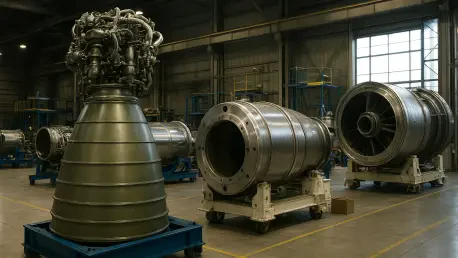

The ability to print complex, lightweight engine parts on demand ensures that the next generation of rockets will be significantly cheaper to launch. For decades, the aerospace industry operated under a paradigm of extreme mechanical complexity, where constructing a single rocket engine required the meticulous coordination of thousands of individual components. These parts, often sourced from dozens of specialized suppliers, were forged, cast, or machined through traditional methods before being laboriously welded or bolted together in a high-stakes assembly process. Every joint and seam represented a potential point of failure, necessitating rigorous and expensive quality control measures. However, the current shift toward additive manufacturing has fundamentally altered this landscape, allowing for the consolidation of multiple parts into single, monolithic structures. This transition not only streamlines the manufacturing floor but also removes the excessive mass associated with heavy bolts and thick flanges, resulting in a lighter vehicle with greater payload capacity.
Accelerating Development: The Digital Production Shift
Economic Efficiency: Lowering Orbital Barriers
One of the most significant advantages of additive manufacturing in 2026 is the radical reduction in both production costs and research timelines. In the past, a single engine failure during testing could delay a program for months due to the long lead times required for traditional part fabrication. Today, the process is digitized; engineers can analyze a failure, refine the CAD model, and print a replacement component in just a few days, fostering a much more aggressive and experimental approach to rocket science. This rapid turnaround is essential for maintaining a competitive edge in an industry where launch schedules are increasingly tight. By eliminating the need for expensive, specialized tooling and molds that were once mandatory for casting and forging, companies can now produce high-performance hardware at a fraction of the previous cost. Furthermore, the ability to store designs as digital files instead of physical inventory has revolutionized the global aerospace supply chain, allowing for localized on-demand production.
Rapid Iteration: Turning Failures Into Data
Beyond the immediate financial savings, the move toward digital production has enabled a level of design flexibility that was previously unimaginable. Traditional manufacturing methods are inherently rigid, making it difficult to iterate on complex designs without incurring massive overhead. In contrast, 3D printing allows for the mass production of components with intricate internal geometries that improve cooling and combustion efficiency. Engineers are no longer restricted by the limitations of a lathe or a drill; instead, they can design for function rather than manufacturability. This shift has led to the creation of highly optimized engine cycles that extract more energy from every kilogram of propellant. As the industry matures throughout the late 2020s, this capability will likely lead to a standardized library of modular engine components that can be printed and integrated into various vehicle architectures, further accelerating the pace of space exploration and satellite deployment.
Material Engineering: Innovation in Extreme Metallurgy
Specialized Alloys: Solving Thermal Extreme Challenges
The transition to 3D printing necessitated a revolution in material science, as standard printing materials cannot withstand the extreme thermal and mechanical stresses of liftoff. This led to the development of specialized alloys, such as NASA’s heat-resistant aluminum and SpaceX’s high-strength nickel-chromium Inconel. These innovative materials allow for the creation of complex internal geometries that are impossible to machine, further reducing the need for heavy joints and vulnerable welds. Reactive Additive Manufacturing, a process that introduces specific particles into alloys to trigger chemical reactions during printing, has yielded components that are both lightweight and remarkably durable. These advancements ensure that the printed hardware can survive the cryogenic temperatures of liquid oxygen and the searing heat of a combustion chamber simultaneously. Without these breakthroughs in metallurgy, 3D printing would have remained a tool for prototyping rather than a viable method for production.
Performance Gains: Integrated Cooling and Geometry
Utilizing these advanced alloys has permitted engineers to incorporate regenerative cooling channels directly into the walls of the combustion chambers. In a traditional engine, these channels would require a complex network of tubing to be manually welded to the outside of the chamber, adding weight and creating potential leak points. By printing the cooling structure as an integral part of the chamber wall, manufacturers can achieve superior thermal management while significantly reducing the total part count. This integration is a prime example of how additive manufacturing provides performance gains that exceed the capabilities of traditional assembly. Furthermore, the structural integrity of these single-piece components is often higher than that of assembled units, as there are no heat-affected zones from welding that might weaken the metal. This level of precision and reliability is now a standard requirement for next-generation orbital delivery systems, ensuring missions proceed safely.
Technical Realities: Navigating Current Constraints
Manufacturing Limits: The Final Fifteen Percent
While the industry has made massive strides, it is important to note that rocket engines are currently mostly rather than entirely 3D printed. Most leading aerospace companies have achieved between 80 percent and 85 percent printed content, focusing on complex parts like combustion chambers and fuel injectors. However, certain components still require traditional manufacturing to ensure unerring dimensional consistency or to withstand chemical interactions and temperatures that exceed the current limits of 3D-printed alloys. For instance, high-precision valves and specific sealing surfaces must often undergo secondary CNC machining to meet the tight tolerances required for high-pressure fluid systems. Additionally, some rotating components in turbopumps are still produced using traditional forging to maintain specific grain structures that provide maximum fatigue resistance. Recognizing these boundaries is essential for maintaining the safety standards required for manned spaceflight missions.
Strategic Integration: Beyond the Jigsaw Era
The integration of 3D printing marked a definitive end to the traditional assembly-line era and established a more agile, digital approach to reaching the stars. By synthesizing advanced material science with rapid prototyping, the aerospace industry proved that additive manufacturing was capable of performing in the most strenuous environments imaginable. This technological evolution ensured that the next generation of rockets was faster to build and significantly cheaper to launch, permanently changing the trajectory of human space exploration. Moving forward, organizations must prioritize the standardization of additive certification processes to ensure that printed parts meet universal safety benchmarks across the industry. Investing in automated post-processing and advanced non-destructive testing will be the next logical step to eliminate the remaining traditional manufacturing hurdles. Ultimately, the successful deployment of these systems demonstrated that the digital factory is a operational reality.