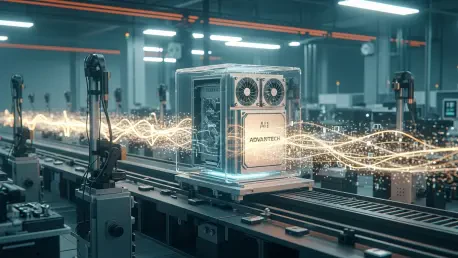

The global industrial sector has reached a critical inflection point where traditional automation strategies are being replaced by high-performance edge computing clusters capable of processing multimodal data in real time. Advantech has strategically aligned with NVIDIA to deploy what is effectively the “brain” of the modern AI factory, leveraging the IGX Orin platform to handle the immense computational loads required for generative AI at the edge. This transition marks a departure from centralized cloud processing, which often suffers from latency issues that are unacceptable in high-stakes environments like surgical theaters or high-speed semiconductor assembly lines. By bringing enterprise-grade AI capabilities directly to the point of data generation, these systems provide the necessary infrastructure for autonomous machines to perceive, reason, and act within milliseconds. The shift toward this decentralized intelligence model suggests that industrial evolution will be defined by the ability to manage complex tasks previously impossible for standard systems.
The Technological Foundation: Hardware and Software Synergy
The partnership centers on the integration of NVIDIA IGX Orin and industrial-grade hardware, creating a specialized ecosystem designed specifically for mission-critical industrial applications. Advantech provides the robust chassis and thermal management systems necessary to sustain peak performance for NVIDIA RTX GPUs and BlueField-3 DPUs in environments where dust, vibration, and extreme temperatures are constant threats. This hardware synergy ensures that AI models can run with functional safety and high-bandwidth connectivity, allowing for the seamless ingestion of data from dozens of sensors simultaneously. Unlike consumer-grade hardware, these systems are built with longevity and reliability in mind, offering the ten-year lifecycles required by global infrastructure and manufacturing giants. By combining these powerful computing modules with specialized carrier boards, Advantech enables a plug-and-play approach for developers who need to deploy sophisticated neural networks without worrying about the underlying physical reliability of their hardware stack.
Beyond the physical components, the implementation of NVIDIA Holoscan and the Metropolis microservices framework provides a standardized software environment for developing real-time AI pipelines. These tools allow engineers to deploy containerized applications that can be updated over-the-air, ensuring that the AI factory remains adaptive as new algorithmic breakthroughs occur. For instance, a facility can switch from simple defect detection to predictive maintenance models without hardware swaps, simply by updating the software containers running on the edge cluster. This flexibility is supported by the massive parallel processing capabilities of the underlying GPU architecture, which handles the complex matrix multiplications required for large language models and vision transformers. Consequently, the edge “brain” acts as a living system that matures alongside the operation it monitors, providing a level of scalability that was once restricted to massive data centers. This localized processing power also addresses data privacy concerns, as sensitive proprietary information never needs to leave the factory floor to be processed by a remote server.
Operational Transformation: Digital Twins and Surgical Precision
A significant advancement in this industrial shift is the deep integration with NVIDIA Omniverse, which allows for the creation of physically accurate digital twins that mirror real-world factory operations in real time. Advantech systems act as the primary conduit for this data, feeding telemetry from sensors directly into the virtual simulation to enable “what-if” scenarios that optimize throughput before a single physical change is made. This bidirectional flow of information means that the AI brain can simulate millions of permutations in the virtual space to find the most efficient path for a robotic arm or an automated guided vehicle. By identifying bottlenecks and predicting mechanical failures before they occur, companies have drastically reduced downtime and energy consumption. This level of synchronization between the physical and digital realms is only possible because of the high-speed networking and low-latency processing inherent in the Advantech-NVIDIA architecture. It fundamentally changes how engineers approach facility management through a proactive, simulation-driven strategy.
The transition toward decentralized, intelligent factories demonstrated that the fusion of high-performance computing and industrial ruggedization was the only viable path for sustainable growth. Companies that successfully implemented the Advantech-NVIDIA framework prioritized the creation of a unified data architecture, ensuring that every sensor and machine could contribute to the broader AI model. They moved away from siloed systems and instead invested in modular hardware that could evolve as software capabilities expanded. This strategy allowed organizations to achieve a measurable return on investment through reduced operational costs and increased production speed. Leaders within the industry focused on training their workforce to interact with these autonomous systems, treating the AI brain as a collaborative partner rather than a replacement for human expertise. By establishing clear protocols for data governance and system maintenance, these early adopters set a new standard for excellence, proving that localized intelligence was the cornerstone of modern manufacturing.