
The integration of high-performance industrial robots on gantry systems has effectively eliminated the manual bottlenecks previously hindering vessel production. For the Fedegari Group, an Italian powerhouse in pharmaceutical autoclave manufacturing, the challenge of meeting skyrocketing global demand while adhering to rigid safety protocols reached a boiling point. The traditional manufacturing of pressure vessels is notoriously slow because the actual welding speed is strictly governed by international engineering standards to ensure structural integrity. This means that increasing output cannot be achieved by simply moving the torch faster; instead, a fundamental rethink of the entire production ecosystem was necessary. By focusing on the non-welding phases—such as preparation, positioning, and programming—the company identified significant opportunities to reclaim lost time. This shift from manual labor toward a highly coordinated robotic environment marks a turning point in how heavy industrial components are fabricated for high-stakes medical environments.
Strategic Automation: Offline Programming and Software
Modernizing the Manufacturing Workflow
The transition from manual methods to a sophisticated automated framework required a complete overhaul of the existing factory floor layout and technical approach. Historically, technicians spent hours manually guiding a robotic arm to specific coordinates using a teach pendant, a process that rendered the machinery unproductive during the programming phase. By shifting these operations into the virtual realm through RobotStudio® offline programming, the facility transformed its workflow entirely.
Now, engineers design and simulate complex welding sequences on a digital twin of the actual cell without interrupting the physical production line. This methodology ensures that when a new vessel design enters the shop, the code is already validated, collision-tested, and optimized for maximum efficiency. This seamless transition from digital concept to physical execution allows the manufacturing facility to maintain a much higher operational tempo than was previously possible with traditional manual teaching methods.
Digital Precision and System Integration
Beyond just the software upgrades, the adoption of a general contractor model for system integration proved vital for the project’s success. Collaborating closely with partners and specialized system integrators allowed the organization to create a unified ecosystem where every component—from the massive positioners to the high-torque robotic joints—communicates in real-time. This holistic approach ensures that the robots are not merely isolated tools but are integrated components of an intelligent machine.
By enabling unmanned shifts during the night, the company has effectively moved toward a “lights-out” manufacturing strategy for its most demanding components. This allows expensive capital equipment to provide a return on investment twenty-four hours a day, significantly increasing the total volume of work processed each week. Such high-level coordination between hardware and software serves as a benchmark for modern industrial facilities looking to scale their operations without sacrificing the precision required for medical grade hardware.
Specialized Technical Configuration: Gantry Systems and Robotics
The Body Production Cell and Logistics
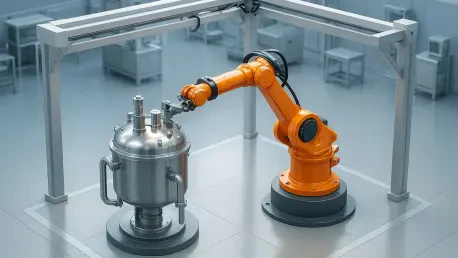
To address the diverse geometries inherent in pharmaceutical autoclaves, the production environment was divided into highly specialized functional zones. The first of these, the Body Production Cell, is anchored by a robust XYZ gantry system that provides an expansive working envelope for a high-performance industrial robot. This setup is paired with three flexible positioners capable of rotating massive vessel bodies with sub-millimeter accuracy, ensuring every weld seam is perfectly positioned for the robotic arm.
Because these vessels often vary in diameter and length, the positioning system must dynamically adjust to ensure the robot always maintains the optimal angle for the welding arc. Integrated sensors play a critical role here, scanning the workpiece to detect and compensate for minor variations in sheet metal thickness or alignment. This real-time adaptability ensures that even as the scale of the product increases, the consistency of the weld remains identical to the engineering specifications, removing the risk of failure.
Optimized Tooling and Multi-Material Logistics
Handling the intricate components of autoclave doors and frames required a second specialized cell with a different mechanical configuration. This area features two high-precision positioners that allow for the manipulation of complex internal geometries that a standard fixed-mount robot could not reach easily. One of the primary technical challenges faced here was the necessity to work with both high-grade stainless steel and carbon steel within the same production cycle, requiring a versatile and adaptable tooling solution.
To solve this, the robotic cells were equipped with multi-process welding tools and an automatic torch-changing system. This innovation allows the robot to independently switch between different welding heads based on the material properties of the current workpiece. By automating this process, the organization removed a significant source of manual downtime and potential human error, as the system automatically selects the correct gas, wire, and voltage parameters for every specific material type encountered.
Tangible Results: Strategic Outcomes and Performance
Significant Efficiency Gains and Performance
The impact of these technological advancements on the company’s bottom line was immediate and profound, characterized by a fifty percent reduction in total production time. This dramatic improvement was not achieved by rushing the physical welding process, which remains governed by strict safety codes, but by ruthlessly eliminating non-value-added “dead time” from the assembly cycle. As a result, the overall manufacturing capacity of the facility expanded by thirty-five percent, meeting global market demands.
This newfound efficiency provided the necessary headroom to take on more complex projects without the need for a proportional increase in physical footprint or labor costs. The ability to produce more units in less time fundamentally changed the economic profile of the business, making it more agile and responsive to shifting market conditions and urgent pharmaceutical client requests. By maximizing the “arc-on” time of the robots, the company turned a traditional manufacturing bottleneck into a core competitive advantage.
Forward-Looking Strategies and Industry Impact
Looking back at the implementation, the success of these robotic cells established a blueprint for future investments across all production lines. The focus shifted from simply automating a task to creating a synchronized system where data flowed seamlessly between the design office and the factory floor. Decision-makers prioritized the extension of this robotic strategy to circular vessel production and other specialized fabrication areas, ensuring that the entire organization benefited from the lessons learned during this initial phase.
It was clear that the synergy between high-performance positioning equipment and sophisticated software was the key to overcoming traditional manufacturing limits. By embracing a digital-first approach to heavy industrial fabrication, the company successfully navigated the pressures of a highly regulated industry. The project proved that intelligent automation maintained the highest levels of quality while providing the speed necessary to dominate a competitive global landscape. It was concluded that long-term scalability depended on the total integration of these advanced robotic systems.