
As the automotive manufacturing landscape accelerates toward a future defined by electrification and extreme precision, the margin for error in structural component validation has effectively vanished. In the bustling heart of modern production facilities, the traditional reliance on human eyesight and manual calipers is no longer sufficient to maintain the rigorous standards demanded by global markets. This shift has necessitated a fundamental reimagining of quality assurance, leading to the development of sophisticated systems capable of inspecting every single part that rolls off the assembly line. By integrating advanced machine vision with robotic agility, manufacturers are now achieving a level of oversight that was once considered technically impossible.
Beyond Human Limits: The Rise of 100% Inline Inspection
The transition from manual spot checks to comprehensive automated validation represents one of the most significant leaps in modern manufacturing history. For decades, quality control relied on statistical sampling, where a human operator might inspect one out of every fifty parts to determine the health of an entire batch. However, this method inherently leaves a window for defective components to reach the final assembly, potentially leading to costly recalls or safety failures. Automated systems eliminate this gamble by performing 100% inline inspection, ensuring that every bracket, tray, and weld meets the exact specifications required by the engineering design before it ever leaves the work cell.
Traditional inspection methods fail to keep pace with the blistering speeds of contemporary production cycles, where components are produced in seconds rather than minutes. Human inspectors, while highly skilled, are susceptible to the physiological limits of fatigue and the cognitive bias of measurement variability. Over the course of a standard eight-hour shift, an operator’s ability to detect minute deviations inevitably fluctuates, leading to inconsistent data. In contrast, automated vision platforms maintain a constant level of scrutiny, providing a reliable and repeatable baseline for quality that remains unswayed by the duration of the shift or the complexity of the task.
The hidden costs of human fatigue in quality assurance extend far beyond the immediate rejection of a faulty part. When a human inspector misses a defect, the subsequent rework, warranty claims, and damage to brand reputation can be astronomical. By implementing a standardized robotic inspection process, companies can mitigate these risks and stabilize their production costs. The shift toward automation allows for the capture of objective digital records for every part produced, creating a comprehensive audit trail that is invaluable for long-term accountability and process refinement in an increasingly litigious and safety-conscious global market.
The Critical Need for Precision in Automotive Underbody Assemblies
Underbody assemblies represent some of the most geometrically complex and safety-critical components of a vehicle, acting as the primary shield for vital internal systems. These trays must be perfectly aligned to ensure aerodynamic efficiency, protect the fuel or battery systems, and maintain the structural integrity of the chassis during a collision. As vehicle designs become more compact and integrated, the tolerances for these components have shrunk to sub-millimeter levels. Relying on offline measurement labs, where parts are transported away from the line for testing, creates a dangerous feedback lag that can result in hours of defective production before a problem is identified.
This challenge is further amplified by the rapid growth of the electric vehicle market, which requires specialized validation for high-voltage battery enclosures and protective shielding. Electric vehicles demand a different set of quality parameters, focusing heavily on hermetic seals and the precise placement of thermal management components. Real-time production feedback is the only viable way to manage this complexity, as it allows the system to adjust for thermal expansion or material inconsistencies as they happen. Integrating the inspection platform directly into the flow of the factory floor ensures that any deviation is flagged the moment it occurs, maintaining the high standards required for next-generation mobility.
Modern automotive plants are moving away from centralized quality labs in favor of distributed, integrated intelligence. This shift allows for the immediate identification of trends, such as a tool wearing down or a robotic welder drifting out of alignment. By capturing data at the source, the platform provides engineers with the insights needed to perform preventive maintenance before a failure happens. This level of precision is not merely about checking boxes; it is about creating a resilient manufacturing ecosystem where the assembly line itself is capable of recognizing and reacting to the subtle nuances of material behavior and mechanical performance.
The Architecture of Intelligence: How Flex-Inspect Operates
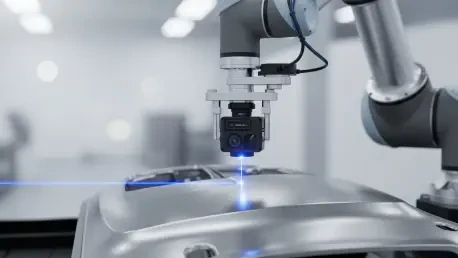
At the core of the Flex-Inspect platform lies a sophisticated hardware arrangement featuring dual 6-axis robotic arms that provide the agility required to navigate complex part geometries. These robots are not confined to fixed paths; they can be programmed to reach deep into the contours of an underbody tray, capturing images from angles that would be impossible for a stationary camera. This multi-axis movement allows the system to inspect fasteners, holes, and flanges on multiple planes within a single cycle. The robots act as the hands of the system, positioning high-performance sensors with a degree of repeatability that ensures every part is viewed from the exact same perspective every time.
The sensory input for this robotic system is driven by 3D snapshot imaging technology, which combines powerful laser projectors with industrial cameras to create a rich data set. Unlike traditional 2D cameras that struggle with shadows and low contrast on metallic surfaces, these 3D sensors generate a topographical map of the part. This allows the system to measure height, volume, and curvature with extreme accuracy. The integration of MVTec HALCON software provides the necessary processing power, leveraging a library of over 2,100 tools to analyze the visual data in milliseconds. This software-driven approach enables the platform to distinguish between a genuine defect and a superficial mark on the material surface.
Achieving sub-millimeter synchronization between the high-speed robots and the sensitive optical sensors requires a rigorous process known as hand-eye calibration. This procedure aligns the coordinate system of the robotic arm with the coordinate system of the camera, ensuring that the software knows exactly where the sensor is in space at all times. Without this precise calibration, the data collected by the camera would be meaningless in the context of the physical part. By mastering this synchronization, the platform can perform highly accurate measurements even while the robots are moving through a series of complex maneuvers, maximizing the throughput of the inspection cell without sacrificing measurement integrity.
Sophisticated Vision Techniques for Complex Geometry
The platform employs surface-based matching to provide robust object localization, even when parts are presented in variable or slightly shifted positions. This technique is essential in a real-world factory environment where components may not always sit perfectly on a conveyor or fixture. Instead of relying on rigid mechanical guides, the vision system uses sophisticated algorithms to find the part in 3D space, virtually “re-aligning” it before any measurements are taken. This flexibility reduces the need for expensive, high-precision tooling and allows the same inspection cell to handle multiple part variants with minimal changeover time.
To capture the fine details of a part’s profile, the system utilizes sheet-of-light imaging, a method that projects a laser line across the surface to reveal its three-dimensional structure. By analyzing the deformation of this laser line, the software can reconstruct high-resolution 3D models of specific features, such as the depth of a countersunk hole or the height of a weld bead. Furthermore, sub-pixel edge extraction is employed to determine the exact boundaries of fasteners and flanges. This technique goes beyond the physical resolution of the camera sensor, using mathematical interpolation to locate edges with a precision that exceeds the size of an individual pixel, which is critical for determining the true position of assembly points.
Real-time data processing is the final piece of the puzzle, ensuring that these complex vision calculations do not become a bottleneck on the production floor. The platform is designed to handle massive amounts of visual data while maintaining the factory’s required cycle times. This is achieved through optimized parallel processing, where the vision software analyzes multiple features simultaneously. By the time a part has moved to the next station, the system has already concluded its assessment, logged the data to a central database, and sent a signal to the sorting mechanism. This seamless flow of information ensures that quality control is an enabler of production speed rather than a hindrance to it.
Implementing True Position Measurements (TPM) on the Shop Floor
The primary objective of the Flex-Inspect platform is the implementation of True Position Measurements (TPM), which define the exact location of a feature relative to a theoretical ideal. By establishing strict tolerance limits for width, depth, distance, and material thickness, the system can determine if a part will fit perfectly into the final vehicle assembly. This goes beyond simple “pass/fail” logic; it provides a quantitative assessment of how far a feature has strayed from its nominal design. Establishing a fail-safe output protocol ensures that any part falling outside these predefined limits is immediately diverted for inspection or scrap, preventing a cascading failure down the line.
The adoption of this technology also facilitates a strategic reallocation of human capital within the manufacturing facility. Rather than spending hours performing repetitive, ergonomically taxing manual checks, employees were transitioned into high-value roles such as system optimization and data analysis. These specialists now focus on interpreting the trends identified by the vision system, allowing them to fine-tune the upstream manufacturing processes. This transition not only improved employee job satisfaction by removing mundane tasks but also empowered the workforce to engage with the advanced digital tools that are defining the future of industrial production.
The platform provided manufacturers with long-term quality data that was essential for predictive process control and trend analysis. By observing how measurements drifted over thousands of cycles, engineers identified the early warning signs of equipment failure or material inconsistencies. This shift toward a data-driven culture allowed the factory to move from a reactive stance to a proactive one. The implementation of the Flex-Inspect platform proved that when advanced vision technology and robotic agility were combined, the result was a manufacturing environment that was more efficient, more reliable, and significantly safer than any manual alternative. This evolution established a new benchmark for excellence in the automotive sector, ensuring that every vehicle produced adhered to the highest possible standards of engineering integrity.