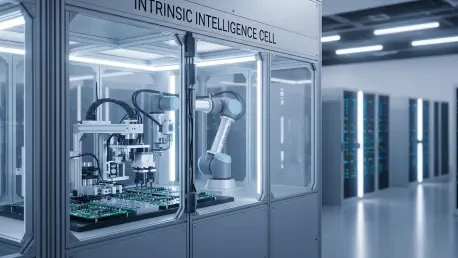

The rhythmic, unyielding thud of traditional manufacturing machinery is giving way to a new era where robots possess the digital intuition to learn on the fly. This shift became undeniable today as Intrinsic and Foxconn introduced the “Intrinsic Intelligence Cell,” an AI-driven platform. Developed under a partnership established last year, this system represents a departure from fixed-function automation.
By merging Google’s neural network capabilities with Foxconn’s industrial scale, the alliance aims to solve persistent challenges in modern production. This technology transforms traditional manufacturing by providing a flexible, software-first template for complex tasks. It signals a move toward general-purpose robotics that are capable of handling diverse electronics assembly with minimal downtime.
Beyond the Assembly Line: Why the Foxconn-Google Alliance Changes Everything
The transition from rigid, product-specific machinery to versatile robotics allows factories to adapt to consumer trends instantly. Instead of replacing entire lines for new product iterations, engineers can now reconfigure software parameters to update robotic behavior. This 2025 joint venture focused on making industrial automation as adaptable as the code that drives it.
The “Intrinsic Intelligence Cell” serves as a software-first template that streamlines complex manufacturing workflows. It allows for the rapid deployment of new assembly processes without the traditional delays associated with mechanical retooling. This innovation creates a more resilient production ecosystem that values digital flexibility over physical permanence.
The Industrial Bottleneck: Why Rigid Machinery Is No Longer Sustainable
High financial risks and sudden production stoppages often plague facilities relying on legacy hardware. When a specific machine fails or becomes obsolete, the entire assembly line typically grinds to a halt, costing companies millions in lost productivity. The inability of rigid systems to handle diverse product batches makes them a liability in a fast-paced market.
The shift toward software-first solutions helps mitigate these technical errors and reduces long-term maintenance costs. By simulating tasks in a virtual environment, manufacturers can identify bottlenecks before they occur on the physical floor. This proactive approach ensures that production remains steady even when facing complex electronic assembly requirements.
Decoding the Intrinsic Intelligence Cell: A Modular Future for Robotics
The foundation of this system is IntrinsicOS, a Linux-based environment designed to secure and manage intelligent industrial applications. Modular workcells act as independent, self-contained units that can be linked for specific tasks like testing or intricate assembly. This setup allows for isolated maintenance, ensuring that one cell can be serviced without stopping the entire operation.
Leveraging Google DeepMind and Gemini AI models, these cells possess enhanced decision-making capabilities for handling component variations. Standardizing the AI layer ensures compatibility with hardware from various providers, such as FANUC, preventing vendor lock-in. This interoperability allows manufacturers to build diverse fleets of robots that communicate through a single, intelligent interface.
From Moonshot to Mainstream: The Strategic Evolution of Google’s Robotics
Intrinsic began in 2016 as a “moonshot” project within Alphabet’s X lab, eventually becoming a central pillar of Google’s AI ecosystem. The journey involved transitioning from pure research to a commercial entity focused on solving real-world industrial problems. This evolution highlights Google’s commitment to integrating advanced machine learning into physical labor markets.
Strategic acquisitions of companies like Vicarious and divisions of Open Robotics helped build this universal software platform. By creating the “Android of Robotics,” Intrinsic established a common framework that simplifies how different machines interact. This standardization is crucial for scaling AI across thousands of factories worldwide.
Strategies for Implementing High-Flexibility Automation in Complex Production
Transitioning to a modular strategy required linking independent units for rapid reconfiguration across the factory floor. Companies focused on identifying the most labor-intensive segments of their lines to introduce AI-driven cells gradually. This phased approach allowed for the modernization of production without the risks associated with total system overhauls.
Best practices emerged around utilizing software-centric platforms to lower entry barriers for advanced robotics. These tools enabled smaller manufacturers to implement high-level automation that was previously reserved for industry giants. Ultimately, the integration of intelligent software proved to be the most effective way to future-proof global manufacturing operations.