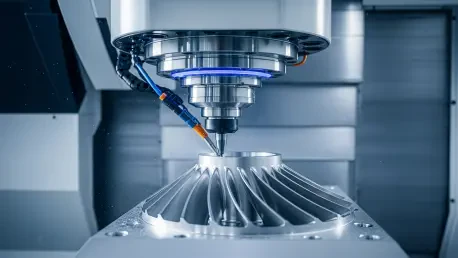

The pressure to produce complex spatial components with sub-micron tolerances has never been more intense, as modern aerospace and automotive industries push the limits of traditional mechanical engineering. In a world where a single degree of thermal expansion or a microscopic vibration can jeopardize a multi-million-dollar turbine blade, the margin for error has effectively vanished. Manufacturers no longer view five-axis machining as an optional upgrade but as an essential survival strategy for handling intricate 3D geometries. This shift necessitates a fundamental rethink of how control systems interact with hardware, moving away from legacy architectures toward digital-native solutions. Siemens SINUMERIK ONE has emerged as the definitive answer to these challenges, serving as a sophisticated bridge that harmonizes virtual planning with physical execution. By integrating high-performance computing directly into the drive control loop, this system allows for a level of spatial awareness and movement coordination that was previously unattainable in high-speed milling operations. This technology allows for the seamless orchestration of synchronized servo motors and the management of vast amounts of data generated during high-speed operations, ensuring that even the most ambitious 3D designs can be realized with absolute fidelity and minimal operational risk.
Mechanical Architecture and Control Logic
Structural Integrity: The Foundation of Precision
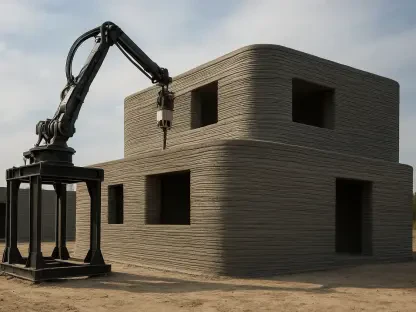
The physical construction of a five-axis machining center dictates the ultimate limits of its precision, requiring a rigid, vibration-resistant frame to withstand high dynamic forces. When dealing with large-scale workpieces, such as those found in maritime propulsion or aerospace structural components, a massive cast-iron or mineral-cast base becomes the primary defense against resonance. This mechanical stability is the essential canvas upon which the SINUMERIK ONE system operates, providing the necessary stiffness to support high-speed movements without compromising the finish quality. Modern gantries often utilize integrated spatial designs that allow for expansive worktables, sometimes exceeding twenty meters in length. These massive structures require perfect synchronization to prevent crabbing or structural twisting during rapid traverses. By pairing robust mechanical engineering with advanced drive systems, manufacturers ensure that the machine remains a stable platform even when the cutting head moves at its maximum acceleration. This stability is crucial for maintaining the geometric integrity of the part throughout the entire milling cycle, preventing the micro-deviations that lead to costly scrap or rework.
Beyond simple mass, the distribution of weight and the placement of linear guides play a critical role in how a machine responds to the rapid directional changes inherent in 5-axis work. SINUMERIK ONE leverages the SINAMICS S120 drive system to manage these dynamics with extreme fluidity, ensuring that every command from the CNC is translated into smooth, jitter-free motion. This synergy is particularly evident in dual-drive configurations where two motors must act as a single unit to move a heavy crossbeam or rotary table. The control logic constantly monitors the feedback loops from high-resolution encoders, making micro-adjustments in real-time to compensate for any physical deviations or load variations. Such a high degree of hardware-software integration allows for the machining of heavy-duty components without the chatter marks that typically plague less sophisticated systems. Consequently, the finished surfaces require minimal post-processing, significantly reducing the overall production time and labor costs associated with manual polishing or secondary finishing operations. This mechanical harmony ensures that complex surfaces are milled with a level of accuracy that meets the most stringent industrial requirements.
Integrated Logic: Orchestrating Complex Movements
Effective five-axis machining requires more than just raw power; it demands an intelligent orchestration of safety protocols and tool path interpolation. The integration of the SIMATIC S7-1500F PLC within the SINUMERIK ONE framework provides a robust layer of functional safety that operates in tandem with the machining process. This controller manages the complex logic required for tool changers, cooling systems, and safety interlocks while maintaining a high-speed link to the CNC core. This internal communication is vital because it allows the system to adjust tool orientation relative to the workpiece surface instantly, ensuring a constant chip load and optimal cutting conditions. By managing the spatial relationship between the spindle and the part with such granularity, the system prevents tool deflection and ensures that even the most aggressive milling paths remain accurate. This level of control logic is what allows for the creation of deep 3D molds and complex aluminum profiles that would be impossible to execute on standard three-axis machinery without multiple, time-consuming setups. The result is a more efficient and safer production environment for high-precision components.
Furthermore, the advanced interpolation algorithms within the control system allow for look-ahead capabilities that anticipate changes in geometry before they occur. This means the machine can automatically decelerate into tight corners and accelerate out of them without losing the true path of the tool. Such sophisticated movement management is critical when working with diverse materials that exhibit different cutting resistances, such as polymer composites or high-strength alloys. The SINUMERIK ONE platform essentially acts as a central nervous system, coordinating every peripheral device and drive unit to achieve a unified manufacturing goal. This holistic approach to control logic minimizes the risk of mechanical collisions and ensures that the machine operates within its ideal performance envelope at all times. By centralizing these functions, manufacturers can achieve a higher degree of repeatability across large production runs, ensuring that the thousandth part is just as precise as the first. This reliability is the hallmark of a system designed to handle the rigors of modern, high-intensity industrial environments where consistency and precision are the primary drivers of commercial success.
The Digital-Native Frontier
Virtual Twins: Simulating Success in a Digital Space
The hallmark of the SINUMERIK ONE platform is its status as a digital-native controller, a designation that stems from its ability to exist simultaneously in physical and virtual forms. This capability is realized through the creation of a high-fidelity Digital Twin, which is a perfect virtual replica of the machine’s kinematics, drive behaviors, and control logic. Using specialized software like Create MyVirtual Machine, engineers can test and validate their entire production sequence before a single piece of raw material is even loaded into the machine. This proactive simulation goes far beyond traditional G-code verification; it accounts for the actual physics of the machine, including inertial forces and mechanical constraints. By identifying potential tool collisions or kinematic errors in a risk-free virtual environment, companies can avoid catastrophic damage to expensive spindles and workpieces. This digital-first approach transforms the workshop from a place of trial and error into a precision-driven environment where success is guaranteed through rigorous virtual verification. By shifting the verification process to the digital realm, manufacturers significantly reduce the time required for machine setup and commissioning.
The benefits of the Digital Twin extend into the realm of workforce training and remote troubleshooting, providing a safe sandbox for operators to master complex procedures. New technicians can practice setting up intricate five-axis jobs on the virtual machine, learning how to navigate the SINUMERIK interface without any risk of damaging the actual hardware. This accelerates the onboarding process and ensures that when the operator finally steps onto the shop floor, they possess a deep understanding of the machine’s behavior. Additionally, if a production issue arises, technicians can use the virtual model to diagnose the root cause remotely, comparing the digital simulation with real-world data to identify discrepancies. This connectivity bridges the gap between the design office and the production floor, fostering a more collaborative and transparent workflow. By leveraging these virtual tools, manufacturers can push the boundaries of experimental design, testing radical new machining strategies in the digital realm before committing to physical production, thus fostering a culture of innovation. This capability ensures that high-stakes projects are executed with confidence and that the machine’s full potential is utilized.
Industrial Connectivity: Enhancing Global Production
Global supply chains in high-tech sectors have become increasingly demanding, often requiring subcontractors to utilize standardized, state-of-the-art control systems to maintain quality. Adopting SINUMERIK ONE aligns a manufacturer with the stringent requirements of Tier 1 suppliers in the aerospace, automotive, and defense industries. These sectors demand more than just physical accuracy; they require high-level cybersecurity features and seamless data exchange protocols to protect intellectual property and ensure traceability. The SINUMERIK platform includes built-in security measures that safeguard sensitive production data, making it a trusted choice for companies handling proprietary designs. By meeting these international standards, manufacturers can compete for high-value contracts that would otherwise be out of reach, positioning themselves as reliable partners in a global network. This alignment also simplifies the integration of the machine into larger Smart Factory ecosystems, where interconnected systems communicate autonomously to manage production flows and inventory levels. This strategic positioning is vital for long-term growth and stability in the rapidly evolving industrial landscape of the modern era.
One of the most significant advantages of a high-performance five-axis system is its ability to process a vast array of materials, from soft modeling foams to dense composites and aluminum. The precision and power provided by the SINUMERIK ONE controller allow a single machine to serve multiple roles within a production facility, enhancing operational flexibility. For instance, the same center used for machining large-scale polyurethane foam models for the automotive industry can be repurposed for trimming high-strength glass-reinforced plastic (GRP) laminates for maritime applications. This versatility is essential for businesses that need to diversify their client base and adapt to shifting market trends without investing in specialized, single-purpose machinery. The control system’s ability to manage different spindle speeds and feed rates with microscopic precision ensures that each material is handled according to its unique physical properties. This prevents issues like material melting in plastics or excessive tool wear in abrasive composites, ensuring a high-quality finish regardless of the substrate being processed. This flexibility makes the machine a cornerstone of diverse production environments.
Strategic Evolution in Machining Systems
The integration of SINUMERIK ONE into the 5-axis machining landscape represented a definitive shift from reactive manufacturing to a proactive, digital-first methodology. By bridging the gap between virtual design and physical execution, this technology provided the tools necessary to overcome the most daunting geometric and material challenges of the modern era. Manufacturers who embraced these digital-native capabilities found themselves equipped with a competitive edge that allowed for faster production cycles and unmatched precision. Looking ahead, the focus had to remain on the continuous refinement of these digital twins and the deeper integration of analytical data to drive further efficiencies. It was essential for businesses to invest in high-end control systems to remain relevant in a global market that prioritized data security and standardized performance. Those who prioritized this technological transition secured their place at the forefront of the industry, proving that the mastery of digital-native workflows was the true key to unlocking the full potential of complex precision engineering. Adopting these advanced systems was the only logical step for maintaining leadership in a high-tech manufacturing world.