
The recent announcement at the Farnborough International Airshow regarding the strategic alliance between Embraer and Hexagon Manufacturing Intelligence marks a transformative milestone in the aviation industry’s quest for absolute precision. Historically, quality control in the aerospace sector functioned primarily as a reactive gatekeeping mechanism where parts were validated only after the manufacturing process reached completion. This antiquated model often resulted in expensive rework and significant delays when deviations were discovered late in the assembly cycle. By contrast, the implementation of predictive quality shifts the paradigm by treating measurement data as a live, dynamic manufacturing asset rather than a static historical record. This collaborative effort focuses on a methodology that combines high-precision metrology, automated workflows, and advanced artificial intelligence to overhaul the entire aircraft lifecycle. By identifying potential defects before they materialize, manufacturers can effectively eliminate the inefficiencies that have long hindered complex aerospace production lines.
Modernizing the Aerospace Production Line
High-Precision Metrology: The Physical and Automated Foundation
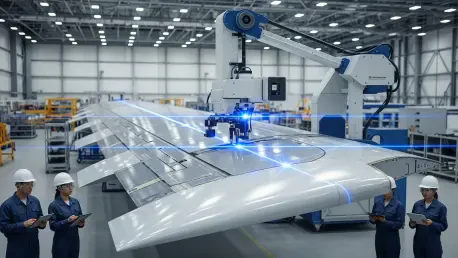
The bedrock of this proactive manufacturing environment is established through the deployment of sophisticated hardware like the Leica Absolute Tracker ATS800. In an industry where massive structural components like wings and fuselages must conform to microscopic tolerances, traditional manual measurement techniques are no longer sufficient to maintain the required pace of production. These hybrid systems allow for large-scale scanning and laser tracking to be performed directly within the automated workflow, providing a level of detail that was previously unattainable on the factory floor. By capturing granular dimensional data throughout the assembly process, Embraer can verify the geometric accuracy of every component in real-time. This capability ensures that parts are perfectly aligned and within specification long before they reach the final inspection stage. The integration of such high-end hardware into the daily production routine allows for a level of confidence that drastically reduces the likelihood of structural misalignments or assembly errors.
The shift toward automated alignment systems represents a departure from the labor-intensive manual jigging processes that have traditionally dominated aircraft assembly. In a modern aerospace facility, laser trackers and scanning systems are no longer peripheral tools but are central to the structural assembly of the airframe itself. These instruments provide the high-speed data acquisition necessary to monitor the position of large components as they are joined, allowing for sub-millimeter adjustments that ensure perfect structural integrity. By integrating these measurements into the robotic control systems, manufacturers can automate the shimming and drilling processes with a level of precision that human operators cannot replicate. This high-volume metrology approach effectively turns the assembly line into a self-correcting machine that accounts for the inherent variability in raw materials. Consequently, the reliance on massive, rigid tooling is reduced, allowing for more flexible factory layouts and the ability to pivot between different aircraft models with minimal downtime or reconfiguration.
Artificial Intelligence: Interpreting Data for Process Stability
While high-end hardware generates the necessary raw data, the true power of predictive quality lies in the application of artificial intelligence to make that information actionable. AI algorithms are uniquely capable of sifting through massive datasets to identify subtle patterns that human inspectors or traditional statistical methods might easily overlook. For instance, these systems can detect minute trends related to tool wear or fluctuations in ambient temperature that cause thermal expansion in metallic components. By recognizing these deviations in their earliest stages, the AI provides real-time recommendations to stabilize the manufacturing process before any parts fall outside of acceptable tolerances. This creates a continuous feedback loop that fosters higher production outcomes and ensures consistent quality across thousands of interconnected aerospace parts. Consequently, the reliance on human intuition is replaced by a data-driven framework that enhances the overall reliability of the manufacturing ecosystem while supporting aggressive delivery schedules.
Beyond just identifying errors, the real-world application of AI-driven predictive quality provides a strategic advantage by significantly optimizing the economic health of the production line. When a system can forecast a potential quality excursion several steps before it occurs, the manufacturing team can intervene during scheduled pauses rather than halting the entire line for emergency repairs. This predictive stability allows for a much tighter synchronization with the global supply chain, as delivery timelines become far more predictable and less susceptible to the volatility of rework cycles. Furthermore, the reduction in material waste and the preservation of high-value components contribute to a more sustainable manufacturing footprint. By stabilizing the process through continuous data analysis, aerospace companies can achieve a higher first-pass yield, which is a critical metric for maintaining profitability in a highly competitive market. Ultimately, the fusion of intelligence and measurement transforms quality from a burdensome cost center into a powerful driver of operational efficiency and long-term financial stability.
Integrating the Digital Factory and Lifecycle Management
The Digital Thread: Connectivity and Shop Floor Decentralization
This technological transition represents a core pillar of the digital thread, a concept that ensures a seamless and continuous flow of data from the initial design phase to the final assembly. By embedding metrology and quality data directly into this digital thread, every department within the organization—from engineering and procurement to production and logistics—operates from a single, verified source of truth. This connectivity is a fundamental requirement for the realization of Industry 4.0, where the factory transforms into a smart environment capable of self-correction and total operational transparency. When designers have immediate access to production data, they can refine future aircraft models based on real-world manufacturing performance. Furthermore, this integrated approach prevents the data silos that traditionally lead to communication breakdowns and production bottlenecks. The result is a more cohesive manufacturing strategy where every stakeholder has the insights necessary to optimize their specific contribution to the aircraft’s construction and eventual deployment.
A significant industry trend involves the decentralization of quality control, moving it out of isolated metrology laboratories and placing it directly into the hands of operators on the factory floor. This shift allows for unprecedented manufacturing flexibility, which is increasingly vital as aircraft designs become more complex and production rates continue to fluctuate. When precision measurement tools are integrated directly into the production line, quality control ceases to be a separate bottleneck and instead becomes a primary driver of overall productivity. This transition empowers the workforce to adapt to production changes or technical anomalies without sacrificing safety or accuracy. Moreover, real-time access to quality data allows technicians to make informed decisions on the fly, reducing the need for administrative oversight and streamlining the decision-making process. By fostering a culture where quality is the responsibility of every participant in the assembly line, aerospace manufacturers can achieve a more agile and resilient production environment that is better equipped for modern demands.
Strategic Operational Excellence: Redefining Maintenance and Future Standards
The advantages of predictive quality extend far beyond the initial assembly phase and offer significant value within the realm of Maintenance, Repair, and Overhaul operations. By utilizing the same high-accuracy measurement technologies during an aircraft’s active service life, operators gain deeper insights into structural health and long-term wear patterns. This facilitates a transition from traditional scheduled maintenance, which often relies on rigid and sometimes inefficient timelines, to a more sophisticated condition-based maintenance model. In this scenario, repairs and inspections are performed based on the actual physical state of the airframe and its components rather than arbitrary intervals. This data-driven approach not only improves the safety and reliability of the aircraft but also optimizes the cost of ownership by preventing unnecessary service downtime. As aircraft continue to stay in service for decades, the ability to track their dimensional integrity over time becomes a critical factor in ensuring continued airworthiness and maximizing the return on investment for global fleets.
The strategic alliance between Embraer and Hexagon demonstrated that the long-term success of the aerospace industry was dependent upon the successful fusion of intelligent software and precision hardware. By prioritizing predictive stability and the digital thread, the industry moved away from reactive problem-solving and toward a model of preventative excellence. Decision-makers were encouraged to invest in scalable metrology solutions that integrated seamlessly with existing enterprise systems to ensure maximum data utility. It became clear that the organizations which embraced these technologies early were the ones that established the highest benchmarks for reliability. Moving forward, the focus shifted toward expanding these predictive capabilities across the entire supply chain to ensure that even the smallest components met the same rigorous standards as the primary structures. This comprehensive adoption of predictive quality protocols fundamentally redefined the aviation ecosystem, providing a clear roadmap for how complex manufacturing should be conducted to meet the demands of a modern, data-centric world.